
TLD;R
This guide is for everyone at a travel agency who has a say in choosing booking engine software the founder, the CEO, the operations head, the finance director, and the technology manager. It covers a six-area checklist you can use before signing with any vendor: integration depth, system performance, security compliance, post-booking workflows, real costs, and contract exit terms. Each section tells you what good looks like,what questions to ask, and what to watch out for.
What Is Booking Engine Software?
Booking engine software is the online reservation system a travel agency uses to search inventory, price it, and confirm bookings in real time. It connects the agency to its suppliers ,airlines through GDS or NDC, hotels through bed bank APIs, transfers, and other services and handles the full transaction from search through to payment and confirmation.
At the front end, it is what your agents or customers use to search and book. At the back end, it is the layer connecting your agency to inventory sources, processing payments, and generating booking confirmations.
It is not a channel manager (that distributes a hotel’s rates to OTAs). It is not a CRM (that manages client relationships). It is the core transaction system your agency runs on.
The global online travel booking market reached $707 billion in 2025 and continues to grow. Every booking routed through a third-party OTA rather than your own booking engine costs your agency 15 to 25 percent in commission per transaction. Getting this decision right has a direct impact on your margins.
Why Most Booking Engine Software Decisions Go Wrong
Most travel agencies make this decision by sitting through a vendor demo, comparing a features list, and signing a contract. The demo looks good. The account manager is helpful. The system seems to do everything needed.
Then, three or six months into live operations, the real picture emerges: search results are slow during busy periods, a supplier connection that was promised is still not live, and the operations team is managing booking issues manually because the system does not handle amendments automatically.
This is not unusual. A survey of travel agency operations conducted by TravelOperations between October and November 2025 found that the most common operational challenges are disconnected systems, manual data entry across platforms, and workflow inefficiencies. And a Travel Market Report feature from late 2025 quoted agency owners describing their technology reality: “80 tabs open, every system working differently.”
Technical due diligence is the process of checking with documentation and real testing, not sales assurances that a system will actually perform under your operating conditions before you commit. The checklist below gives you exactly that.
Key Terms Worth Knowing
GDS (Global Distribution System): Amadeus, Sabre, Travelport the traditional infrastructure connecting agencies to airline and hotel inventory globally.
NDC (New Distribution Capability): IATA’s modern XML standard enabling airlines to distribute richer content and personalised pricing directly to agencies via API often unavailable through GDS.
API (Application Programming Interface): The live connection between your booking engine and a supplier’s system, enabling real-time pricing and booking without manual steps.
Bedbank: A wholesale accommodation supplier (e.g. Hotelbeds, WebBeds) that aggregates hotel inventory and distributes it to travel agencies at net rates.
The 6-Area Booking Engine Software Checklist
Area 1 Integration Depth : Does the Booking Engine Software Connect to What You Actually Need?
A competitive booking engine software setup connects to six to eight inventory sources a GDS or NDC connection for flights, one or more hotel APIs or bed banks, a payment gateway, a mid-office system, and ideally transfer and ancillary APIs. A minimum viable setup needs at least four live integrations to function.
The key word is live. Most vendors will list every integration on their roadmap. What matters is which connections are working in production right now, not which ones are coming.
NDC connectivity is increasingly important to verify. According to ARC data reported by Travel Weekly in January 2026, NDC transactions made up 21.2 percent of all ARC-settled bookings in December 2025, up from 20.3 percent a year earlier. Airlines including American Airlines, Lufthansa, and Emirates have moved significant content special fares, bundles, ancillaries exclusively to NDC channels. Agencies using booking engines without NDC access are missing that content today.
There is also a pressing practical deadline: Amadeus is closing its Self-Service API portal in July 2026. Smaller agencies relying on that access point need to verify their booking engine has an alternative GDS path already in place.
Questions to ask the vendor:
- Which supplier connections are live in production today flights, hotels, transfers?
- Is pricing pulled in real time, or is it cached? Does the fare get re-checked at the point of payment?
- If we need a supplier that is not in your current library, how long does that integration take?
- Can we load our own negotiated rates or direct hotel contracts?
Area 2 System Performance : How Does the Booking Engine Software Hold Up When It Matters?
A well-built booking engine software returns search results in under two seconds under normal load. Checkout is fast and works properly on mobile. The system handles peak traffic periods a long weekend, a promotional campaign without slowing down.
This matters because 52 percent of travelers abandon an online booking specifically because of a poor digital experience, not because of price, according to SiteMinder’s Changing Traveler Report 2025. Performance directly affects how many bookings complete.
Mobile performance is particularly important. Mobile devices now account for over 52 percent of all OTA bookings and are projected to reach 75 percent of all travel bookings by 2030 (Grand View Research, 2025). A booking engine built for desktop and adjusted for mobile is not the same as one built mobile-first.
What to ask for:
- Can you share 12 months of uptime records?
- What does the system do during peak traffic does infrastructure scale automatically?
- What is your contractual uptime SLA?
What a good SLA looks like: 99.9 percent uptime means the system can be down for a maximum of 8 hours and 45 minutes across the entire year. That is a reasonable baseline for a booking engine. Anything below this should prompt questions about redundancy and failover architecture.
Area 3 Security and Compliance : Does the Booking Engine Software Have the Paperwork to Prove It?
A compliant booking engine software vendor holds a current PCI DSS v4.0 certificate and can produce it on request. They can tell you exactly where customer data is stored, under which legal jurisdiction, and how access to that data is controlled.
PCI DSS v4.0 became fully mandatory on 31 March 2025, introducing 51 new requirements compared to the previous version, according to the PCI Security Standards Council. IATA requires all accredited travel agents to be PCI DSS compliant. This means your vendor’s compliance directly affects yours a gap in their system is a gap in your cardholder data environment.
Data breaches are not a theoretical risk in this industry. The global average cost of a data breach reached $4.88 million in 2024, a 10 percent increase from the year before, according to IBM’s Cost of a Data Breach Report 2024. Hospitality and travel were among the sectors where breach costs increased.
If your agency serves customers in the EU, GDPR applies regardless of where your business is based. Non-compliance fines can reach €20 million or four percent of total global annual turnover.
Questions to ask the vendor:
- Can you share your current PCI DSS v4.0 certificate?
- Is Multi-Factor Authentication enforced for all agent and admin logins? This is now required under PCI DSS v4.0.
- Where is customer data stored which country, which data centre?
- Is a SOC 2 Type II report available?
Area 4 Post-Booking Workflows : What Does the Booking Engine Software Do After Confirmation?
After a booking is confirmed, a well-built system handles the subsequent operational steps automatically: delivering booking documents, processing amendments, managing cancellations, and giving agents a clear view of every booking’s status from one screen.
The booking confirmation is not the end of the process. It is the start of a chain of steps that either run in the system or fall to your team to handle manually. A survey of travel agency operations (TravelOperations, 2025) found that manual and repetitive data entry, and disconnected systems, are the top two operational challenges agencies face. This is largely a booking engine workflow problem.
Note: booking engine software handles confirmation, amendments, voucher generation, and cancellation processing. Pre-arrival hotel reconfirmation calling or contacting properties to verify bookings before guest arrival is a separate operational function handled by a mid-office or dedicated reconfirmation process, not by the booking engine itself. These are different systems with different jobs. Make sure you are clear on which function you are evaluating.
Questions to ask the vendor:
- What booking documents does the system generate automatically after confirmation vouchers, e-tickets, itineraries?
- How does the system handle an amendment request can agents process date changes, room changes, and name corrections within the platform, or does each require manual steps outside it?
- What happens when a supplier cancels or modifies a confirmed booking is the agent automatically notified?
- Can agents see the status of all bookings confirmed, pending, amended, cancelled from a single dashboard, without logging into multiple supplier systems?
These questions reveal more about a booking engine’s real-world usefulness than any demo.
Area 5 Total Cost : What Does the Booking Engine Software Actually Cost Over Three Years?
A vendor gives you a full picture of costs upfront subscription or licence fee, any per-booking or per-search fees, GDS segment charges, onboarding costs, and what migration from a previous system involves. The Year 1 figure and the Year 3 figure should not be a surprise to each other.
In practice, the subscription fee is usually the smallest part of the real cost. What is rarely disclosed upfront includes per-search API call fees, GDS segment fees passed to the agency, implementation and training costs, and overage charges when booking volumes grow.
Data migration is another cost that agencies only discover when they need to switch vendors. Data migration projects frequently exceed their planned budgets by 30 percent due to integration complexity, according to IDC research. This cost is not in any initial proposal.
Questions to ask the vendor:
- Is pricing per-booking, per-search, or flat subscription and what triggers an extra charge?
- Are GDS segment fees included in the price, or billed separately?
- What does onboarding and training cost?
- Is there a price increase clause in the contract for Year 2 and Year 3?
- If we ever migrate to another system, what does it cost to export our booking history?
Area 6 Contract and Exit Terms : What Does the Booking Engine Software Contract Actually Say?
The contract clearly states that your agency owns its booking data, that you can export it in a standard format at any time, and that exiting the contract involves a reasonable notice period and no punitive financial penalties.
Most booking engine contracts run for two to three years. Over that time, your agency builds up booking history, integration configurations, pricing rules, and agent account structures inside the vendor’s platform. When the contract ends or when you decide you need a different system , getting that data out is either straightforward or expensive, depending entirely on clauses most people did not read before signing.
Ten vendor integrations create 45 dependency interaction points that need to be unwound when switching, according to SoftwareSeni’s analysis of API integration complexity. This is why agencies stay with systems they are unhappy with not because they want to, but because leaving has become too costly to justify.
Before signing, check:
- Does the contract state that the agency owns all booking data generated through the platform?
- Can you export your complete booking history in a standard format at any time, or only at contract end?
- What is the termination notice period, and are there fees for leaving early?
- Are the integrations built on open APIs, or on proprietary formats that would make moving to another system complicated?
Booking Software Comparison: How to Use This Checklist
Once you have run through each area with your shortlisted vendors, you have a structured basis for comparison one based on what systems actually do, not what they say in a presentation.
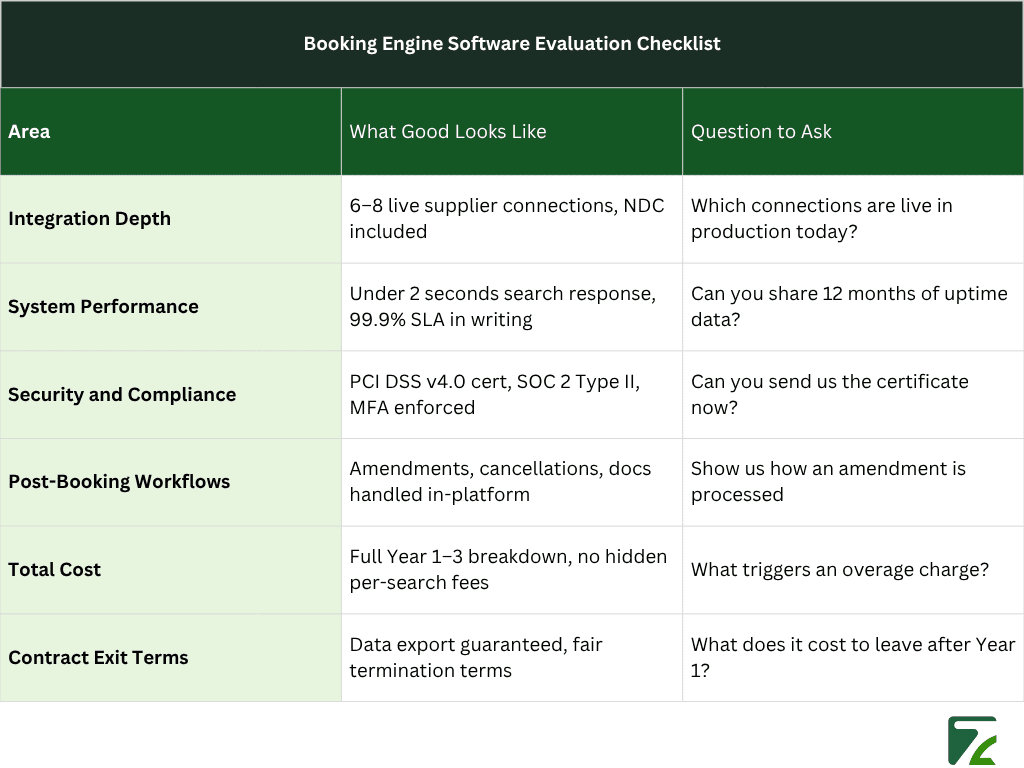
Four practical steps to run a proper booking software comparison:
Step 1 : Get sandbox access. Ask every vendor for a sandbox environment and test it with your actual supplier connections and booking scenarios, not a pre-loaded demo.
Step 2 : Request compliance documents before contract discussions. If a vendor delays sharing a PCI DSS certificate or uptime records, that delay is information.
Step 3 : Talk to reference customers alone. Ask for agencies of similar size. Speak to them without the vendor on the call. Ask what they wish they had checked before signing.
Step 4 : Score all six areas. A system that scores well on features but poorly on compliance documentation, post-booking workflows, or exit terms will cost more over the contract period than a system that costs slightly more upfront but performs consistently.
Conclusion:
Choosing booking engine software is one of the most consequential technology decisions a travel agency makes. It affects every booking, every agent, every customer interaction, and a significant portion of the agency’s margin.
The six areas in this checklist : integration depth, system performance, security compliance, post-booking workflows, total cost, and contract exit terms give every level of your agency leadership a way to evaluate any vendor on what actually matters in live operations.
Founders and CEOs can use it to frame the business risk. Operations heads can use it to find the workflow gaps before they become daily problems. Finance directors can use it to understand what the real cost will be. Technology managers can use it to run a structured, documented comparison.
The vendors worth working with are the ones who can answer these questions clearly and back their answers with documentation. That transparency, or the absence of it, tells you what working with them for the next three years will look like.
Frequently Asked Questions
Booking engine software is what a travel agency uses to search inventory and confirm bookings for customers. A channel manager is what a hotel uses to distribute its room rates to OTAs and sync reservations back to its property management system. They work on opposite sides of the same transaction. A travel agency needs booking engine software. A hotel managing its OTA distribution needs a channel manager.
Ask the vendor to name specific airlines for which NDC connections are live and bookable in their production system today. There are currently seven NDC versions in active use across the industry, and not all booking engines support the most recent ones. If a vendor cannot name specific live airline NDC connections, their NDC capability is not yet operational in a way that helps your agency.
99.9 percent is a reasonable minimum for any booking system your agency depends on for revenue. At 99.9 percent, the platform can be down for a maximum of 8 hours and 45 minutes across the full year. Ask for this in writing in the contract, along with a clear definition of what counts as downtime and how the vendor compensates if they miss the SLA
If your agency handles payment card data in any form taking card details by phone, processing payments through a booking platform, or storing card information then yes. IATA requires all accredited travel agents to be PCI DSS compliant. The current standard is v4.0, mandatory since 31 March 2025. Your booking engine vendor's compliance status directly affects your own.
Five things that often get missed: the uptime SLA definition and what happens when it is breached; any price increase clause for Year 2 and beyond; data ownership and export rights; termination notice period and early exit fees; and who is responsible when a supplier API changes or breaks. These clauses determine what the contract actually costs you over three years, not just in Year 1.