Quick Summary
- A metasearch engine (Google Hotels, Kayak, Trivago) is a price comparison tool it does not take the booking.
- A booking engine is the system that actually confirms and processes the reservation.
- OTAs dominate both, and travel agencies lose margin and guest data every time a booking goes through an OTA.
- This guide explains both tools simply, shows where OTAs win and lose, and tells you what to do about it.
Why Every Travel Agency Needs to Understand Metasearch Engine and Booking Engine Right Now
Travel agencies that do not appear on metasearch engines lose bookings before the traveler ever reaches a booking engine. Understanding both systems is the first step to recovering that revenue.
A traveler searches for a hotel in Dubai. In under three seconds, Google shows prices from Booking.com, Expedia, and Agoda all side by side. They click the best rate and book. Your travel agency never appeared.
This happens millions of times every day. Two systems are working together, and most agencies do not fully understand either of them. The first is the metasearch engine. The second is the booking engine. They are not the same thing. They do completely different jobs. And OTAs have mastered both.
In 2025, the four largest OTAs: Booking Holdings, Expedia, Airbnb, and Trip.com, spent a combined $20 billion on marketing. Booking Holdings alone spent $8.2 billion up from $7.3 billion in 2024. A large portion of that spend flows directly into metasearch platforms like Google Hotel Ads, locking your agency out of the traveler’s decision moment.
By 2026, 65% of all travel bookings will happen online, up from 61% in 2023. Agencies that are not present on both metasearch and direct booking channels are competing with one hand tied behind their back.
The agencies that grow in 2026 are not the ones with the biggest budgets. They are the ones that understand the system well enough to compete inside it.
What Is a Metasearch Engine? How This Search Aggregator Controls the First Click
A metasearch engine is a search aggregator that pulls prices and availability from multiple travel websites and shows them together on one page, allowing travelers to compare options without visiting each site individually.
The critical point: a metasearch engine does not complete the booking. It is purely the comparison layer. When a traveler clicks a rate, they are taken to the site that offered it. That could be an OTA, a hotel website, or your agency page. The metasearch platform then earns revenue on a cost-per-click (CPC) or cost-per-acquisition (CPA) model.
Which Metasearch Engine Platforms Matter Most for Travel Agencies?
- Google Hotel Ads and Google Flights the dominant metasearch engine globally, driving 65–85% of all hotel metasearch traffic
- Kayak owned by Booking Holdings, strong in North America; also functions as a search aggregator for flights and hotels
- Trivago majority-owned by Expedia, hotel-focused price comparison
- Skyscanner strong in Europe and Asia-Pacific, especially as a flight search aggregator
- TripAdvisor combines reviews with metasearch, high trust factor among leisure travelers
- Wego leading metasearch engine across South Asia, Southeast Asia, and the Middle East
The global metasearch engine market was valued at $8.33 billion in 2024 and is projected to grow at a CAGR of 30.2% through 2033.
Why Is the Metasearch Engine the Most Important Battleground for Travel Agencies Today?
Because it is where the traveler’s booking decision is made. A traveler who never sees your rates here will never visit your booking page. In other words, the metasearch engine is the gatekeeper to all downstream revenue. OTAs understand this, which is why they invest billions to dominate it.
If your agency's rates are not on Google Hotel Ads, Trivago, or Skyscanner, you are invisible at the exact moment a traveler decides where to book.
What Is a Booking Engine? The Transaction System That Decides Who Gets Paid
A booking engine is the software system that processes, confirms, and records a travel reservation including checking availability, applying pricing, and handling payment. It is the system where money actually changes hands.
If the metasearch engine brings a traveler to a door, the booking engine is the door itself. For your agency, this might be an in-house reservation system, a white-label platform, or a GDS-connected interface. For Booking.com or Expedia, however, the booking engine is their core product. It is the transaction layer that processes millions of reservations daily.
The reason this distinction matters: whoever operates the booking engine controls the guest data and the relationship. As a result, when a traveler books through an OTA’s booking engine instead of yours, the OTA gains all of that not your agency.
Metasearch Engine vs Booking Engine: What Is the Real Difference?
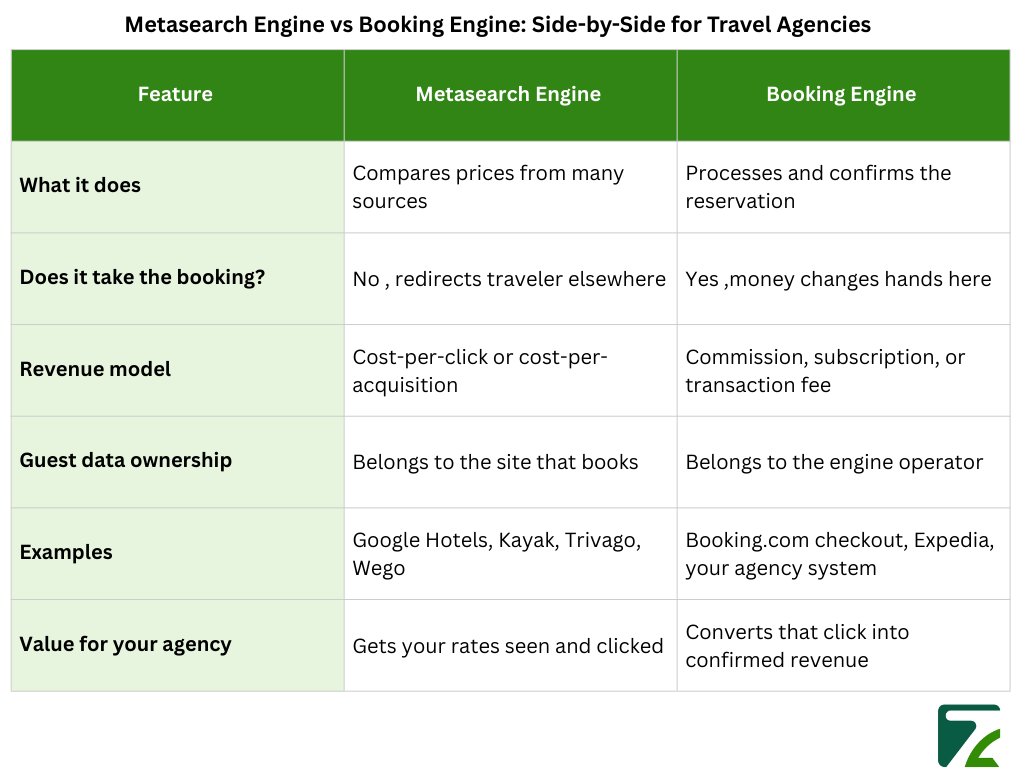
One system gets you found. The other gets you paid. OTAs have invested $20 billion per year to dominate both. Your agency can compete but only once you understand the difference.
OTAs and the Booking Engine: Win, Lose, and What It Means for Travel Agencies
The booking engine is where money changes hands. OTAs have built powerful, trusted booking engines, but that same system creates measurable weaknesses that cost travel agencies revenue, data, and long-term customer relationships.
Where OTAs Win on the Booking Engine
The OTA booking engine wins on traveler trust at the moment of payment. A traveler who has used Booking.com before knows the checkout process, trusts the payment of security, and knows how cancellations work. When they reach the payment page, there is no hesitation and no reason to look elsewhere.
This is a process familiarity advantage, not a price advantage. OTAs have spent two decades making their booking engines feel safe and predictable. As a result, their booking engine converts at a higher rate than most alternatives even when a competing price is lower. For travel agencies appearing on a metasearch engine alongside an OTA, this is often where the booking is lost. Not on price, but on the traveler’s comfort with the transaction platform.
The second win is commission lock-in. Because the OTA booking engine is where travelers prefer to transact, agencies must operate inside it to reach them paying 15–30% commission per booking to do so. Therefore, the booking engine is not just a checkout tool. It is the mechanism through which OTAs extract commercial value from every booking in their system.
The OTA booking engine wins because travelers trust it and every booking that passes through it earns the OTA a commission and a guest relationship that the agency does not receive.
Where OTAs Lose on the Booking Engine
The OTA booking engine model has three structural weaknesses that show up directly in agency revenue and operations.
First: the cancellation problem. OTA booking engines are optimised for confirmed bookings, not completed trips. To maximize confirmation rates, OTAs offer flexible, often free cancellation. As a consequence, OTA bookings cancel at roughly 50%, versus 18% for direct bookings. An agency receiving 300 confirmed OTA bookings should therefore expect only around 150 to actually travel. By contrast, the same volume booked directly delivers around 246 completed trips. That is a difference of 96 paying guests from identical booking numbers.
300 OTA bookings at ~50% cancellation = 150 completed trips. 300 direct bookings at ~18% cancellation = 246 completed trips. Channel choice alone costs agencies 96 trips per 300 bookings. (Cloudbeds, 2026)
Second: the data problem. Every booking completed through an OTA booking engine gives the OTA the traveler’s full profile email, travel history, preferences, and loyalty tier. The agency, however, receives only the details needed to coordinate the trip. Consequently, the traveler’s future business belongs to the OTA. The booking engine owns the relationship, not the agency that served them.
Third: the compounding dependency problem. The commission an agency pays on every OTA booking is partially reinvested into metasearch advertising including bids on the agency’s own brand name. Over time, therefore, every booking routed through an OTA booking engine strengthens the OTA’s metasearch position. Meanwhile, it weakens the agency’s ability to recover direct traffic.
The OTA booking engine's real cost is not the commission line on the invoice; it is the guest relationship, the repeat booking, and the data that leave with the OTA every single time.
OTAs and the Metasearch Engine: Win, Lose, and What It Means for Travel Agencies
The metasearch engine is where travelers compare prices before booking. OTAs dominate this layer through spend and platform ownership but the comparison model itself creates openings for agencies that understand how to use it.
Where OTAs Win on the Metasearch Engine
OTAs win the metasearch engine through investment volume. When a traveler opens Google Hotels, Trivago, or Kayak, the ranked results reflect one thing: who spent the most on CPC bids. OTAs spend more on this than any other category of travel company.
In 2025, the four largest OTAs spent a combined $20 billion on marketing, with a significant portion flowing into metasearch CPC. Google Hotel Ads alone accounts for 65–85% of all hotel metasearch traffic globally. The result: the metasearch engine, designed as a neutral comparison tool, functions in practice as an OTA-controlled gateway because OTAs out-invest everyone else on it.
The second win is platform ownership. Booking Holdings owns Kayak. Expedia owns Trivago. Importantly, these are not independent comparison platforms. Instead, they are metasearch engines built to surface OTA rates and route traffic into OTA booking engines. When a traveler uses Kayak and then books through Booking.com, both steps happen inside the same OTA ecosystem.
The global metasearch engine market was $8.33 billion in 2024, projected to grow at 30.2% CAGR through 2033. Booking Holdings and Expedia own the two largest independent metasearch platforms Kayak and Trivago. (Global Market Statistics, 2025)
OTAs do not just advertise on metasearch engines; two of the biggest ones are owned by OTAs. The comparison layer was never fully independent to begin with.
Where OTAs Lose on the Metasearch Engine
The metasearch engine has two weaknesses that create genuine space for travel agencies.
The first weakness is price equality. The metasearch engine places every rate on the same page at the same visual level. Consequently, a travel agency appearing beside Booking.com on Google Hotels is competing on equal terms at that moment. Price and perceived trust are the only filters. An agency with a competitive rate can therefore win that click without spending anywhere near what OTAs spend globally.
The second weakness is the price transparency trap, and it cuts both ways. The same metasearch engine that commoditizes agency services also commoditizes OTA services. When Booking.com, Expedia, and Agoda all appear on Trivago at similar prices, there is no reason to choose one over another on price alone. By contrast, a specialist agency offering a curated itinerary or niche service is competing ondimensions;, an OTA simply cannot replicate in a price comparison row.
The third weakness is the ownership conflict. Kayak is owned by Booking Holdings. Trivago is owned by Expedia. As a result, both platforms carry a structural conflict between unbiased comparison and OTA commercial interest. This conflict is increasingly recognised by research-driven travelers, and it creates an opening for independent agency platforms seen as more trustworthy.
On the metasearch engine, every provider looks the same size in the results list. That is the OTA's weakness and the travel agency's clearest opportunity to compete on equal visual terms.
How Travel Agencies Can Win on Both the Metasearch Engine and the Booking Engine
Winning on the Metasearch engine means appearing in the comparison results with a competitive rate. Winning the booking engine means converting that click inside your own system keeping the commission, the data, and the guest relationship.
Win on the Metasearch Engine: Be Present Where Your Travelers Are Comparing
The metasearch engine cannot send travelers to a booking page that is not listed on the platform. Agencies that want metasearch visibility need to connect their rates to the platforms where their target travelers search Google Hotel Ads, Trivago, Skyscanner, or Wego, depending on geography and segment.
The goal is not to out-spend OTAs across every destination. Instead, it is to appear on the right metasearch results for the specific routes and travel types the agency serves. A targeted presence on the relevant platforms with competitive rates and live inventory is enough to enter the traveler’s consideration at the exact moment the decision is made.
- Connect to metasearch platforms via a channel manager for the destinations you specialise in
- Keep rates updated in real time a stale or unavailable rate loses the click before the traveler even sees it
- Match or undercut OTA rates where possible price is the first filter on any metasearch engine
- Display your brand name and logo clearly even on a comparison page, recognition influences the click
Win on the Booking Engine: Convert the Click, Own the Relationship
A metasearch engine click that lands on a slow or confusing booking engine is a lost booking. The booking engine is where the traveler decides whether to complete the transaction or return to the OTA. The minimum standard in 2026:
- Mobile-optimised : 52% of all travel bookings now complete on mobile devices
- Transparent pricing: total cost visible before the payment step, no surprise fees at checkout
- Cancellation policy shown before payment, not buried in terms and conditions
- Real-time inventory sync: no unavailable options appearing mid-checkout
- Recognized payment gateway: travelers do not complete payment on platforms they do not trust
Beyond the technical minimum, the booking engine is where the agency captures the guest relationship. Every direct booking gives the agency the traveler’s contact profile, preferences, and communication history. Without this data, the OTA would own it instead. Furthermore, this is the foundation for every future direct booking and every repeat customer who does not require paying another commission.
The OTA market is projected to reach $107 billion by 2026, built on commission revenue from bookings that passed through OTA booking engines. Every direct booking agency captures are revenue that stays in the agency’s ecosystem instead.
Metasearch engine presence gets travelers to your door. A well-built booking engine is the door and everything behind it belongs to your agency, not to an OTA.
Conclusion:
Metasearch engines decide whether travelers see you. Booking engines decide whether they book with you. OTAs have mastered both and in 2025 they spent $20 billion to make sure that stays true.
Travel agencies do not need to match that spend. Instead, they need two things. First, show up on metasearch engines with competitive rates. Second, have a booking engine that converts those clicks into confirmed, direct, repeatable revenue.
Every booking through your direct booking engine keeps the commission with you. It also keeps the guest relationship with you. As a result, the next booking from that traveler is far more likely to return directly without another commission paid to anyone.
Your margins live in the gap between OTA dependence and direct booking capability. Closing that gap one campaign, one booking engine improvement, one converted repeat guest at a time is where sustainable agency revenue is built in 2026.
Frequently Asked Questions
A metasearch engine compares prices across many sites but does not take the booking. A booking engine processes and confirms the actual reservation.
Think of the metasearch engine as a price comparison display platforms like Google Hotels, Kayak, and Trivago pull rates from OTAs and direct sites and show them together. The booking engine is the checkout system where the transaction happens. Booking.com and Expedia operate both: a metasearch presence (through Google Hotel Ads) and their own booking engines. Your agency needs a presence in both to compete.
Yes a search aggregator and metasearch engine are the same thing in travel: a platform that collects and displays prices and availability from multiple sources in one unified interface.
Common examples include Kayak, Skyscanner, and Trivago. They aggregate data from OTAs, airline websites, and hotel direct sites. The term 'search aggregator' emphasises the data collection function; 'metasearch engine' emphasises the comparison and search function. Both terms refer to the same type of platform.
Yes , any agency can connect to Google Hotel Ads, Trivago, or Skyscanner through a channel manager and pay only per click.
The essential requirement is a booking engine on the receiving end that can handle the incoming traffic and convert it. Without a functioning booking engine, there is nowhere to send the traveler after they click your metasearch listing. Start with a small CPC test budget, measure cost-per-booking versus your current OTA commission, and scale from there.
Because nearly half your confirmed OTA bookings will not generate revenue but you will still incur the costs of blocked inventory and pre-arranged services.
Direct bookings through your own booking engine cancel at roughly 18%, making them far more operationally reliable. If you receive 300 OTA bookings per month at a 50% cancellation rate, only 150 actually stay and pay. The same 300 bookings through your direct booking engine at 18% cancellation means 246 paying guests. That 96-booking difference is pure revenue lost to OTA channel dependency.
AI is reshaping how travelers search, but the booking engine remains essential regardless every AI-generated recommendation still needs a transaction system to confirm the reservation.
Booking Holdings and Expedia are both investing heavily in AI-powered personalised search. Travelers increasingly use ChatGPT and other AI tools for trip planning, changing how they discover booking options. However, the booking engine is the one constant: no matter how the discovery channel evolves, the transaction layer must process payment and confirm inventory. The metasearch engine may change form; the booking engine will not disappear.