
TL;DR
Reconciliation in travel is the process of verifying that every booking, payment, supplier invoice, and commission record across all your systems matches accurately and completely. This guide covers what the reconciliation process really involves, why it breaks down, what it costs when it does, and what automated reconciliation software changes in day-to-day operations. Backed entirely by verified industry data.
Picture this: it’s the end of the month. Your finance team pulls booking records from the GDS, payment data from the gateway, and supplier invoices from email threads and portals. The numbers should tell one clean story. Instead, they tell three different ones. Somewhere between what was booked, what was paid, and what was invoiced, money is leaking quietly, consistently, invisibly.
This is not an edge case. According to Phocuswright, travel agencies spend 15–20% of their total operational time on reconciliation yet still operate with accuracy rates below 85%. In an industry where margins average just 8–12% , that gap between effort and accuracy is not a minor inefficiency. It is a direct threat to profitability.
What Is Reconciliation in Travel Agency Operations?
Reconciliation in travel is the systematic process of matching every financial record across booking systems, payment gateways, supplier invoices, and bank statements to confirm they are consistent, accurate, and complete.
At its core, the reconciliation process in a travel agency connects three critical data streams simultaneously:
- Booking data: what service was sold, to whom, at what price, on what date
- Payment data: what money was actually collected, through which channel, and when it settled
- Supplier and commission data: what was paid out and what commission income was earned and received
When these three streams align, you have a clean, auditable financial record. When they don’t and in most agencies, they frequently don’t you have discrepancies that require human investigation to resolve.
Key Insight: Reconciliation is not a finance department problem. It is a whole-agency problem. Every booking an agent creates every payment a client makes, and every invoice a supplier sends is a data point that eventually lands on the finance team’s desk. When agents, operations, and finance are not aligned on how data is entered and tracked, reconciliation breaks before it even begins.
Why Does the Travel Reconciliation Process Get So Structurally Complex?
The difficulty is not a technology problem alone. It is an architecture problem. Phocuswright Research shows most travel agencies operate across 7 to 12 independent software systems never designed to integrate with each other. A booking reference that reads “AA-789456” in your GDS might appear as “789456-AA-2026” in the airline system. Reconciling those two records requires either a custom integration or a human who knows where to look.
On top of this, OTAs which hold a 55% share of the travel booking market typically act as the merchant of record, deducting commissions of 15–30% and remitting balances on settlement schedules that lag weeks behind the original booking date. Every one of those transactions still needs to be verified, matched, and recorded against your own books.
Key Terms Worth Knowing
Commission Leakage: Earned commission income that never gets collected because a reconciliation gaps a missed invoice, an unmatched record, or an unclaimed override lets it slip through. For a $10M agency, this quietly costs $200,000–$400,000 every year.
Exception: Any transaction that does not match cleanly during the reconciliation process. These edge cases represent just 5% of total bookings yet consume 80% or more of your finance team’s reconciliation time.
FX Drift: The currency movement between when a booking is made and when the supplier actually charges. Even a small exchange rate shift creates a discrepancy that someone has to manually investigate multiplied across hundreds of international bookings monthly.
Audit Trail: The documented record of every transaction, match, exception, and resolution in your reconciliation process. Without it, you cannot defend your numbers in a supplier’s dispute, tax audit, or regulatory review.
What Does the Reconciliation Process Look Like, Step by Step?
The reconciliation process in a travel agency follows five operational stages. Each has a specific function, and each introduces its own category of failure risk if not managed carefully.
Stage 1 Data Extraction and Normalization: Pull raw data from every source that touches a transaction GDS, booking engine, payment gateway, bank statements, supplier portals, and accounting software. Before anything can be matched, data must be normalized into a consistent format. This step alone, when handled manually, can consume days of staff time at month-end.
Stage 2 Automated Matching and Validation: Pair booking records with payment confirmations and supplier invoices based on reference numbers, passenger names, travel dates, and amounts. McKinsey found that even with automation, matching success rates in travel reach only 60–70% due to data inconsistencies between systems. The remaining 30–40% require manual review.
Stage 3 Exception Management: Exceptions are records that don’t match cleanly in the reconciliation process. Some are simple a reference number formatted differently. Others are complex a booking partially refunded, charged across two cards, with an FX discrepancy on the supplier side. Every exception needs a defined workflow: who reviews it, what documentation is required, and what the resolution deadline is.
Stage 4 Commission and Budget Reconciliation: Commission reconciliation compares what each supplier contract specifies should be earned against what was actually invoiced, paid, and received. Budget reconciliation runs at a higher-level planned revenue and costs against what actually materialized. These two layers depend on each other. If stages 1–3 are inaccurate, budget reconciliation built on top will produce misleading results.
Stage 5 Reporting, Audit Trail, and Sign-Off: Every matched transaction, every exception, and every resolution must be documented with enough detail to support an audit. Clean audit trails protect agencies in supplier disputes, tax investigations, and regulatory reviews and serve as institutional memory that makes future reconciliation faster.
Watch Out Many agencies treat reconciliation as a month-end task. Discrepancies discovered 30 days after a transaction are significantly harder to resolve supplier records may be closed, staff may have changed, and documentation may be archived. The longer a discrepancy sits unresolved, the more expensive it becomes to fix, and the more likely it is to never be recovered at all.
What Does Poor Financial Reconciliation Actually Cost Travel Agencies?
Unresolved reconciliation gaps directly eat into revenue, inflate operational overhead, damage supplier relationships, and create compliance exposure with losses most agencies never fully measure.
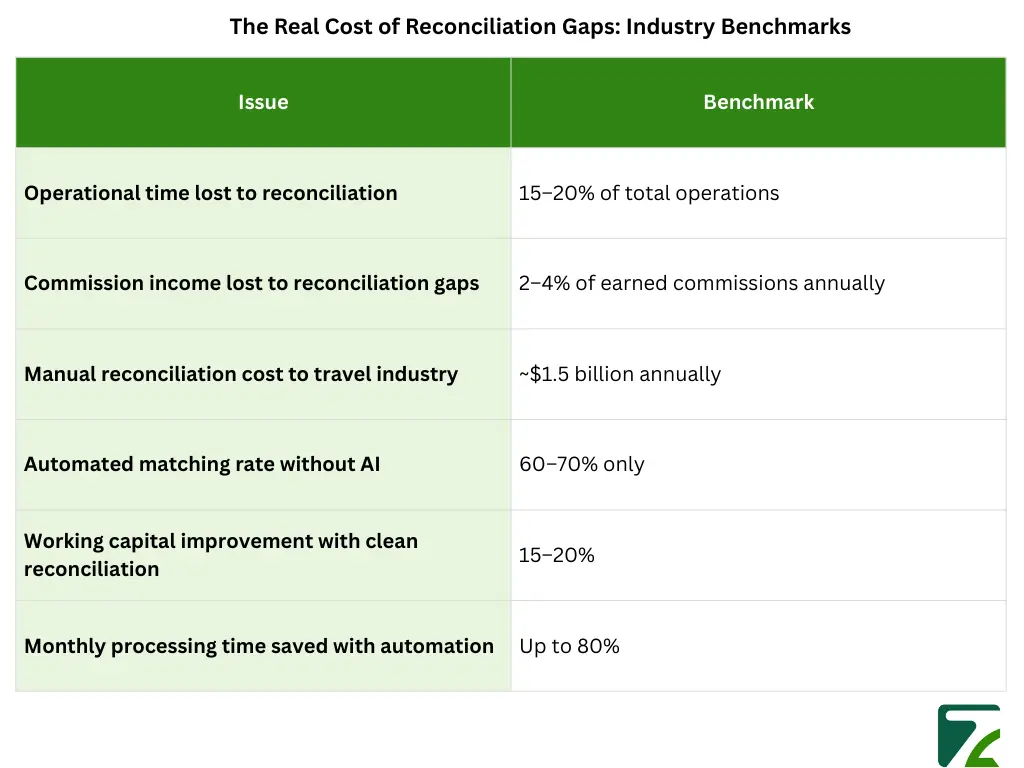
A travel agency generating $2 million annually could be losing between $40,000 and $80,000 every year due to reconciliation gaps alone without ever knowing it. That figure does not include the cost of staff time or the working capital tied up in delayed settlement visibility. For most agencies, fixing reconciliation is the single highest-return financial improvement available without adding a single new booking.
According to Payrails, the roughly 5% of transactions that become exceptions consume 80% or more of total human effort in the reconciliation process. Partial refunds, chargeback reversals processed 30–60 days later; FX drift on international bookings, split payments across multiple cards each requires manual investigation, documentation, and resolution. For agencies processing hundreds of bookings monthly, this means finance teams spend the majority of their reconciliation time on the smallest fraction of their transactions.
ConnexPay research found that agencies processing $5–10 million annually through fragmented payment systems typically incur a hidden “fragmentation tax” of $285,000–$570,000 annually not in vendor fees, but in reconciliation labor, integration maintenance, and working capital trapped in settlement timing gaps.
Key Insights The fragmentation tax is invisible on your P&L because it does not appear as a line item. It hides inside your headcount, your technical debt, and working capital you cannot deploy because it is tied up waiting for settlement cycles to close.
How Does Automated Reconciliation Software Change the Reconciliation Process?
Automated reconciliation software structurally changes the reconciliation process by handling matching continuously, learning from exceptions, and surfacing discrepancies in real time instead of at month-end.
The global market for commission reconciliation technology was valued at $1.26 billion in 2024 and is forecast to reach $3.41 billion by 2033 at a CAGR of 11.4% That growth reflects widespread, urgent operational pain, not a trend.
Manual vs. Automated Reconciliation: What Actually Changes
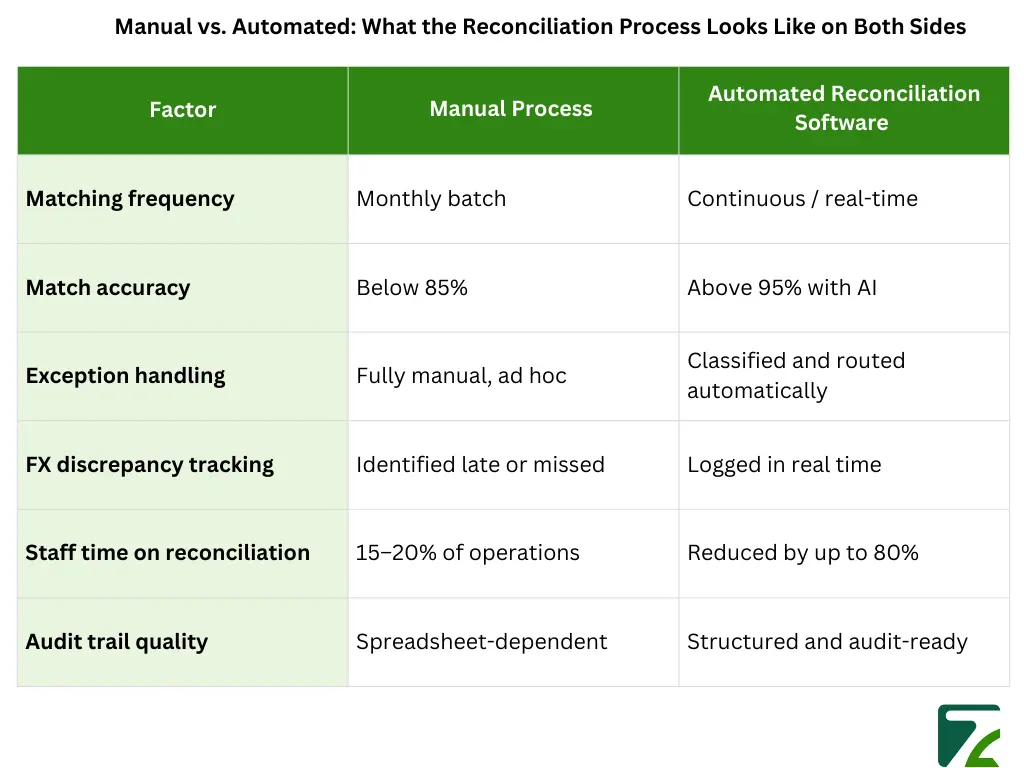
Modern automated reconciliation platforms pull data directly from your GDS (Amadeus, Sabre, Travelport) alongside payment gateways and accounting software, eliminating the manual export-import cycle that is the biggest single source of reconciliation delay. For IATA-accredited agencies, they integrate with BSP and ARC settlement data automatically.
What Are the Long-Term Benefits of Getting Reconciliation Right?
A well-run reconciliation process delivers compounding benefits protecting revenue, improving cash flow visibility, strengthening supplier relationships, and building the operational foundation needed to scale.
Revenue protection. Closing the 2–4% commission leakage gap (ASTA) is one of the highest-return financial improvements available. This is not new revenue; it is revenue already earned that is currently going uncollected.
Cash flow visibility. McKinsey’s working capital benchmarking Shows companies with real-time reconciliation achieve 15–20% better working capital efficiency. For a travel agency, this means better forecasting, more informed decisions on supplier advance payments, and reduced reliance on credit facilities to bridge settlement gaps.
Stronger supplier negotiations. Agencies that can produce clean, audit-ready payment records are in a fundamentally stronger position when disputing commission calculations. Documented evidence protects the negotiated rates and override commission structures built over years of supplier relationships.
Fraud and compliance protection. Automated reconciliation software flags anomalies duplicate charges, unauthorized transactions, altered invoice amounts far faster than manual review. In markets with strict financial regulation, clean reconciliation records protect agencies from tax compliance exposure and audit risk.
Remember ThisThe agencies that treat reconciliation as a strategic financial capability not a back-office administrative task are the ones that retain more of what they earn, make better decisions faster, and scale without proportionally growing their finance headcount. Reconciliation is not overhead. It is infrastructure.
Conclusion:
Every booking a travel agency processes touches multiple financial systems. Every gap between those systems is a potential revenue leak, a supplier relationship at risk, or a compliance liability waiting to surface.
For any travel agency still relying on manual processes or disconnected systems, the question is not whether the reconciliation process is creating hidden costs. The data from ASTA, McKinsey, Phocuswright, and ITILITE makes clear that it is. The question is only how long those costs remain invisible and how much revenue continues to go uncollected in the meantime.
Frequently Asked Questions
Payment reconciliation matches incoming and outgoing transactions against bank statements confirming money moved as expected. Financial reconciliation is broader: it includes payment reconciliation plus supplier invoices, commission statements, and budget versus actual comparisons. Both run as sequential layers of the same process.
Best practice is continuous or daily reconciliation, enabled by automated software. Monthly batch reconciliation creates a compounding problem discrepancies discovered 30 days later are harder and more expensive to resolve, and every business decision made in the interim is based on stale data.
The five most common causes are: data format mismatches between disconnected systems, timing differences between booking and payment settlement, FX fluctuations on cross-border transactions, partial refunds not synced across platforms, and commission records that differ from contracted rate expectations.
Yes. Commission leakage of 2–4% (ASTA) affects all agencies proportionally. An agency generating $2 million annually could be leaving $40,000–$80,000 in earned commissions uncollected. Most platforms are available as SaaS subscriptions priced by transaction volume no enterprise infrastructure required.
NDC connectivity, if you are selling flights and your platform does not currently support it. Airlines are actively moving their best content away from legacy GDS channels, and the gap between what NDC-connected agencies can offer versus GDS-only agencies is growing every quarter. After NDC, the next priority is real-time fare revalidation at checkout it is the single most common source of booking errors and lost customer trust.