Travel CRM (Customer Relationship Management) is industry-specific software that organizes the way travel agencies, tour operators and OTAs manage customer interactions, bookings and relationships from the first inquiry all the way to post-trip follow-up. Unlike regular CRMs, Travel CRMs address industry-specific requirements such as multi-destination itineraries, supplier management commissions received and payable, payment schedules, seasonal trend analysis while they consolidate customer information from several communication channels.
Operating a travel agency without using a CRM will lose those sales to competitors who act faster, personalize better, and function based on greater efficiency. A fact from several industry sources: CRM business applications can boost sales per representative by up to 41 percent. This guide takes a look at 10 such proven benefits, each supported by verified data from IBM, Salesforce, Nucleus Research and Aberdeen Group demonstrating Travel CRM’s direct impact to your bottom line.
According to Grand View Research, the global CRM market size was valued at USD 73.40 billion in 2024, registering a CAGR of 14.6% from 2025 to 2030. Travel CRM for cloud deployment achieved 56.1% market share in travel CRM in 2022 and is projected to expand at an impressive 16.1% CAGR by 2030. This phenomenal growth is indicative of how travel businesses are leveraging technology to cater to the demands of the new-age traveler. Instant replies over WhatsApp and email, personalized suggestions, and seamless booking journeys.
Travel businesses have unique challenges that generic business software doesn’t do a good job of: managing complex itineraries between several suppliers, keeping commission records from multiple sources, dealing with bookings where deposits/final payments come due at different times , navigating high seasonality demands, maintaining relationships with both B2B partners and B2C travelers in real time.
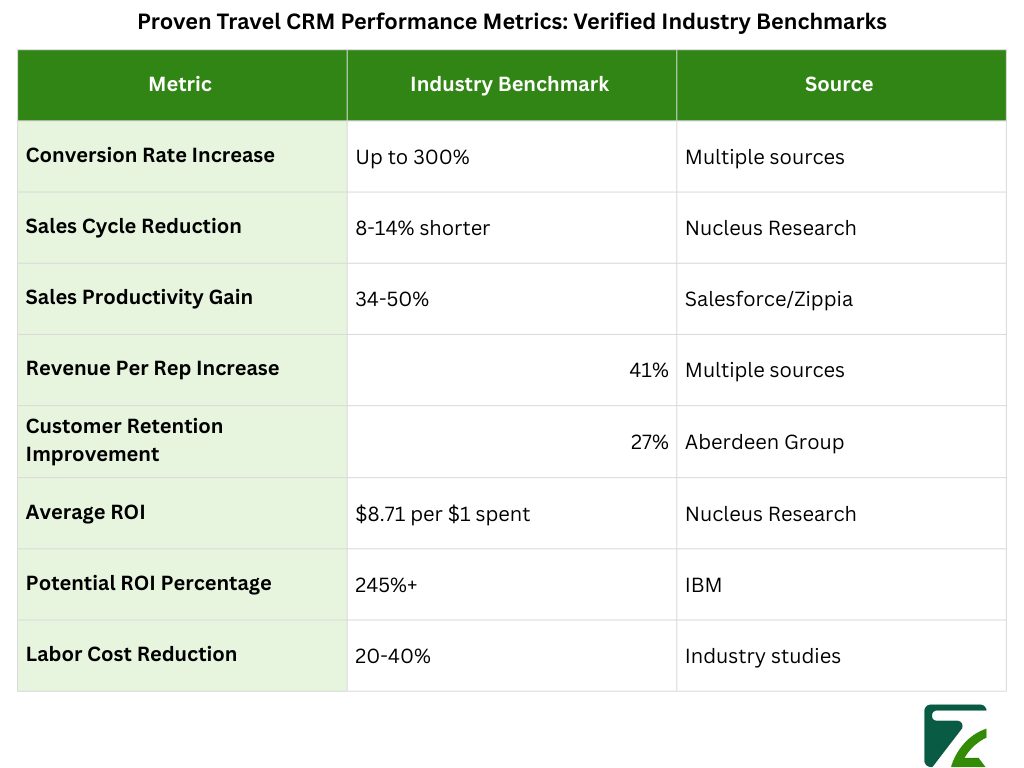
CRM can increase your conversion rate by as much as 300%, according to a number of industry sources. For travel agencies, that means converting a substantially higher percentage of inquiries into bookings by being more precise in lead management and scoring.
Travel CRM collects leads from all source’s website forms, social media messages, calls, trade show contacts and prioritizes them based on engagement signals. High-intent leads that have opened significantly more than one email and/or viewed route pages are immediately handed off to sales, while others go into automated nurture campaigns.
Actionable Step: Focus on leads with a score of over 70 for same day follow-up to get the most out of your conversion opportunities.
Data accessibility for salespeople shortens their sales cycles by 8-14%, according to Nucleus Research. When customers inquire about destinations, they’re typically comparing multiple agencies simultaneously. Speed matters.
Multi-channel inbox unification means when inquiries arrive via WhatsApp, Instagram, or email after hours, your CRM sends instant acknowledgment, assigns to the appropriate agent, and provides complete customer history immediately.
Actionable Step: Set up auto-replies acknowledging inquiries within 60 seconds with reference numbers and realistic response timeframes. During peak seasons (January-March wave season, June-August summer bookings), automation prevents lost opportunities to faster competitors.
According to research from Aberdeen Group, those companies that utilize CRM tools to properly engage with customers see a 27% increase in customer retention rates. According to Capterra polls, 47% of CRM users reported that their CRM affected customer retention significantly.
It is more expensive to acquire new customers compared to retaining existing customers about 5-7x more, so retention translates into higher profits more directly. Travel CRM streamlines post-trip follow-up, keeps track of preferences, and helps you orchestrate timely re-engagement campaigns, so your agency remains their first thought.
Actionable Step: Send automated surveys 48 hours after they get home from a trip, then set up a re-engagement campaigns 4 – 5 months later, suggesting destinations based on their preferred travel style, budget tier, and previous history.
Analysis of business data from Zippia found that using CRM, companies saw an increase in sales productivity of 50%. Companies using CRM platforms achieved 41% higher productivity in sales per employee, Nucleus Research data shows.
This productivity gain comes from automation. Agents spend more time consulting and selling instead of updating spreadsheets, seeking customer information or manually making quotes. Automation is not only incontrovertibly efficient it’s also convenient: You can set it up to work for your schedule and monitor its output with your smartphone from any app-enabled device.
Actionable Step: Audit weekly time allocation to identify automation opportunities. Target shifting 60%+ agent time revenue-generating activities by automating confirmations, payment reminders, and document collection.
CRM apps can increase sales by 29%, sales productivity up by 34%, and, according to our research here at Salesforce, sales forecast accuracy increases 42%. Accurate forecasting helps travel agencies make smarter inventory decisions, pricing strategies, and marketing investments.
Your CRM dashboard can tell you which destinations generate highest margins, what lead times book with fewer cancellations and even the marketing channel that drives more conversion
Actionable Step: Run weekly automated reports to monitor conversion funnel drop-offs (inquiry→quote→booking→payment). Systematically identify bottlenecks and resolve friction points in your sales process.
According to Nucleus Research, when the software is properly implemented to focus on its real objectives, the average return on investment for CRM can be as high as $8.71. Instead, an IBM study indicates that if correctly implemented over the long term, the ROI (Return on Investment) of a CRM software system is more than 245%.
This return on investment arises from rising conversion rates, strategic up-sellings leading to higher average bookings (AUP), lower operational costs deriving from automation, and increased customer retention cutting acquisition spending.
Actionable Step: Use this formula to calculate what your potential return will be: (Expected gain in revenue – One-time Costs to Implementation) / Implementation Costs × 100. After proper implementation, most agencies realize a positive ROI is within 12-18 months.
According to several industry studies, companies can save 20 to 40 per cent in labor costs through automation and increased productivity. Ironically, just travel agencies must stand this benefit because there are some immediate gains in terms of reduced costs which can be translated into increased profits.
Automated re-confirmation of booking, payment reminders, and document collection will save hours per week of manual work. This free time can then be used for revenue-generating activities such as proactive upselling and handling more orders without additional headcounts.
Actionable Step: Calculate current manual process costs (hours × hourly rate) for reconfirmations, payment chasing, and document collection. Compare against CRM automation costs to quantify potential savings.
According to industry surveys, 74% of businesses said that CRM technology has made it cheaper for them to access customer data. When your entire team can see the history, preferences and prior interactions of any customer, they will provide uniform top-flight service that builds loyalty.
Centralized data can clear the way for Customer Relationship Management. Instead of this information being scattered across email inboxes, spreadsheets, or confined to the memory of a particular agent, it is all stored in one place. Each interaction is documented, searchable, and actionable.
Actionable Steps : Creating mandatory post-booking data capture processes to ensure your travel style, budget tier, companion preferences, and special requirements are consistently recorded for future personalization.
Aberdeen Group Research reveals that top sales organizations and teams have a whopping 81% higher likelihood to have a consistent CRM than their unsuccessful counterparts. The key to success is not only having a CRM but also implementing it effectively.
According to LinkedIn research, employees using a CRM experienced higher job satisfaction than workers without a CRM system. Adoption happens organically when agents understand that a CRM minimizes stress by capturing what they forget to do during hectic times.
Actionable Step: Find a CRM champion on your team (a mid-level agent with a good tech background and some credibility among peers). Leverage them to train others and create
According to Research, mobile access to CRM leads to a 14.6% increase in sales productivity. For example, 65% of salespeople using mobile CRM meet their sales quotas compared to 22% who do not, demonstrating the crucial nature of mobile.
Travel professionals are trade-shows attendees, off-site customer meeters, and schedule micromanagers. With Mobile CRM access, they can respond to any inquiries, check customer history, or update booking status anytime and from anywhere.
Actionable Step: Choose a CRM which has a good mobile app and offline capabilities. During the trial period, check mobile usability as well.
Current annual revenue: $500,000
Expected revenue increase (29% from Salesforce data): $145,000
CRM investment (software + implementation): $15,000
Net benefit Year 1: $130,000
ROI: ($130,000 / $15,000) × 100 = 867%
The numbers are persuasive and proven CRM apps lead to as much as a 41% increase in sales revenue per rep in 2017, a 300% increase in conversion rates, 8-14% shorter sales cycles, and a 27% increase in customer retention rate. These are not hypothetical estimates, but actual outcomes that businesses have achieved after implementing CRM systems properly.
The global CRM market, valued at USD 73.40 billion in 2024, is projected to reach USD 163.16 billion by 2030, affirming the disruptive power of CRM, which is being recognized on an unprecedented scale. In particular, travel businesses are leveraging these tools, with cloud-based travel CRM possessing 56.1% of the market and growing at 16.1% CAGR.
However, success requires realistic expectations. Hopefully that the full 12-month ROI period is not overnight, but it means these benefits manifest over time and not instantly. Implementation challenges include data migration, resistance from team to adopt processes, and changes to processes. However, a well-implemented CRM system can provide over 245% ROI, which can make the investment worthwhile for serious agencies.
The travel industry is changing at a fast pace. Mobile-first customers have been trained to expect instant replies over multiple channels, tailored recommendations based on their behavior, and a hassle-free booking process. And this is something manual systems can’t deliver at this level. Agencies that adopt a CRM not only prepare themselves to win market share because they do everything right, but they are doing it while their competitors are stuck tapping out emails to random people that don’t have time for them.
Our recommendation: Try 2–3 CRM systems offering free trials with solutions aimed at your specific pain points: missed follow-ups, response time, retention, or visibility in the business. 92% of companies larger than 10 people are using CRM, so the question to ask might not if you should implement CRM, but rather when you will be joining the crowd enjoying these proven benefits.
The data does not lie: the effect of Travel CRM is tangible directly impacts your bottom line through higher revenues, lower costs, or improved relations with customers. Your competitors are already moving. The time to act is now.
The best Travel CRM is one that manages leads, follow-ups, itineraries, and multi-channel communication (WhatsApp/email) in one place tailored to travel sales workflows.
Travel CRM pricing varies by features and users, but it’s worth it if it helps you convert more enquiries, reduce lead leakage, and increase repeat bookings.
It improves response speed, automates follow-ups, tracks every lead, and helps sales teams focus on high-intent travellers resulting in higher conversions.
Yes. Most modern Travel CRMs integrate with WhatsApp, email, booking engines, and payment gateways via native or API-based integrations.
Yes. Travel CRM helps small and mid-sized agencies organize leads, scale sales without hiring more staff, and compete with larger players.

Travel Automation Expert