The modern travel agency is a chaos machine. If you are an operations director at an emerging OTA, your screen probably looks the same at 9:00 AM as it does at 5:00 PM: a web browser with 25 tabs open. You’ve got GDS (Amadeus or Sabre) on one, three bed banks extranets in another, transfer supplier portal open too, activity marketplace dashboard also claiming that ‘window space’, CRM to manage client details through and surely a huge “Master Tracker” Excel sheet that no one dare touch.
This fragmentation is the agency growths silent killer.
With the online travel market racing projected $1.34 trillion valuation by 2030 per Statista’s Global Travel & Tourism Market Report, agencies that are attempting to capitalize on this demand with disintegrated workflows are hitting a wall. You don’t need another tool to sell travel; you need one to survive the fulfillment of it. And this is where a centralized operations dashboard turns from ”nice-to-have” into the engine of growth for your agency.
Here’s what distinguishes the modern OTAs from traditional travel agencies: you’re not only buying hotels or just ticketing flights. You’re orchestrating an entire travel experience flight + hotel + transfer + city tour + restaurant reservation in which a glitch of any single component can bring the whole thing crashing down.
The complexity isn’t additive; it’s multiplicative.
When you sell a standalone hotel booking, you are only dealing with one supplier relationship and one confirmation process.” When you’re selling a 7-day trip with flights, 3 hotels, 4 transfers and 6 activities instantly you have to keep up with 14+ distinct supplier touchpoints, all of them that come with their unique confirmation notices, payment terms and modification policy.
In Phocuswright’s 2023 study on travel booking behavior, 62% of leisure travelers book trips with multiple components today, but most OTAs continue to handle these in siloed systems. Your flight team operates in the GDS; Your activities and marketplace partners are third party with no view into the full customer itinerary.
This is where a centralized operations dashboard comes into play.
The travel industry has what we’ve termed the “swivel chair operation” where staff are copying and pasting data from a flight confirmation email, swiveling to enter it into a CRM, swiveling back to check details of a hotel voucher, and then checking again that the transfer pick up time matches the arrival of the flight.
The price of this manual friction adds up per type of product:
1% Error Rate on 5 Product Lines: An article by the Data Warehousing Institute states that manual data entry error rate is estimated to be around 1% per item. For an OTA processing 5000 multi-component bookings per month, that’s potentially up to 50 incorrect bookings but with each booking containing 4-6 components you are actually looking at 200-300 distinct touchpoints in jeopardy.
The Cascade Effect: A failure to confirm does not just result in the loss of transfer commission it sets off a cascade of customer service inquiries, potential hotel no-shows, lost revenues from activities not being booked and negative reviews that have repercussions on your conversion rates for months. Be it as it may, 1 negative review can reduce booking conversion by as much as 2-4%, according to a study supported by Cornell’s School of Hotel Administration.
The Time Drain Given that a medium sized OTA with 8,000 multi-product bookings processed on a monthly basis: can use anywhere from 400-600 staff hours just to verify and reconcile across multiple supplier systems. At a fully loaded cost of $35-$50 per hour, that’s between $168,000 and $360,000 spent every year on tasks an operations dashboard can automate.
What we mean in terms of the “unified view” for OTAs is an operational dashboard that can answer these mission-critical questions immediately:
Today, answering those questions means logging into 8-12 different systems. A centralized operations dashboard pulls all this data into a single interface, offering Green / Yellow / Red status indicators against all the components of every booking.
The real power of a centralized operations dashboard isn’t just seeing all your bookings in one place it’s managing the dependencies between them.
Without dashboard: Your client’s flight from London to Bangkok will be delayed by 4 hours. Everything is ok for the hotel, but the driver from the airport transfer waits at the old arrival time. Your activities team has scheduled an afternoon temple trip on the day he now won’t make, and there’s a 6 p.m. hotel check-in that will be missed.
With an operations dashboard: The flight delay triggers a system search for the cause (via GDS API), auto-flags affected transfer booking, new arrival time is calculated, and alerts sent to update pick-up time. It denotes same-day activity as “at risk” and recommends rebook options. It marks a late check-in and asks you to contact the hotel within minutes
Without a dashboard: You find out at 4 p.m. that a hotel has “walked” your client (over booked and moved them). You’re left scrambling for other accommodations, but the pre-booked reservation at a restaurant 45 minutes from the new hotel; pick-up location for city tour next morning is incorrect and client is furious.
With an operations dashboard: The system will indicate that Client A has three linked bookings associated with the original hotel site. As you update the hotel, the dashboard triggers a geographic mismatch with other services and asks you to review them in advance.
According to Skift Research on how OTAs work, OTAs that use dependency aware systems end up seeing 40-55% less customer service escalations because problems are flagged and taken care of before customers encounter them.
A mid-OTA in Dubai focused on Southeast Asia packages, and handling around 4,200 multi-element bookings per month (average of five elements: flight, two to three hotel nights, transfers, activities).
Their team of 18 people in operations spent the equivalent:
After implementing a centralized operations dashboard with API integrations to their GDS, bed banks, and major ground suppliers:
As their director of ops told us: ‘The game-changer was not seeing everything on one screen, it was the system understanding that when Flight A changes, Bookings B, C and D are affected. That intelligence saved us.
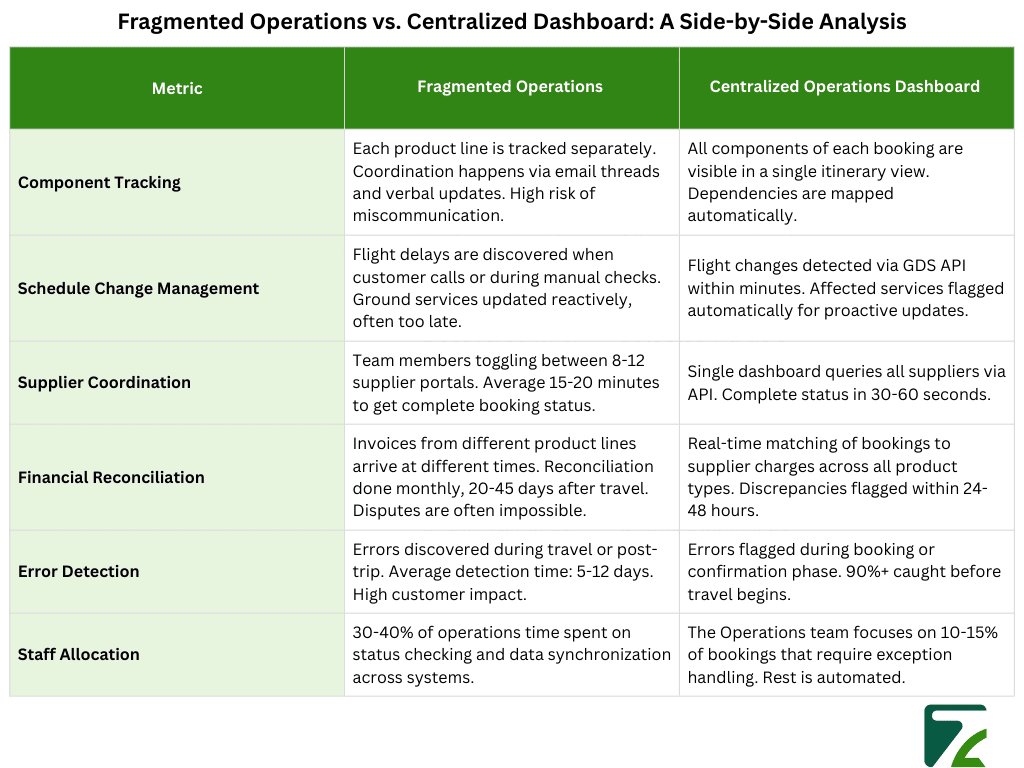
If you’re trying to convince leadership to invest in a unified operations dashboard, frame it not as a technology purchase but as operational insurance.
Take your ops team size, multiply by their average salary, then multiply by the fraction of time wasted checking supplier dashboards by hand, copying data between systems and reconciling discrepancies (typically 30-40% for multi-product OTAs).
For a 15-person operations team where each individual cost (fully loaded) approximately $45,000:
Enterprise grade operations dashboards are yet to cost $24,000-$60,000 annually based on booking volume and integration complexity. Even on the high end of that, you’re getting ROI in the 1st Year while also having the capability to scale without headcount growth.
Take centralized operations out of the equation, and your agency growth appears as follows:
With a centralized operations dashboard:
The difference is compounded massively at scale.
You don’t need to centralize everything on day one. Here’s a phased approach most successful OTAs follow when implementing an operations dashboard:
Integrate your core systems (booking engines, GDS (Global Distribution System), top 2-3 hotel suppliers) to have a single view of the booking. Concentrate on aggregation of data, not automation yet.
Implement automated monitoring for high-risk situations: Changes in a flight schedule, failure to confirm a hotel, getting closer to the payment deadline, and so forth.
Allow the system to recognize relations between booking components to automatically flag cascade risks.
Integrate supplier invoicing data to enable real-time commission and markup verification on every product line
Turn on AI-based capabilities that anticipate problems before they happen by analyzing historical patterns.
Current operations dashboard platforms for multi-product OTA operation include the following:
The primary criteria would be: how many of your existing supplier connections can the platform connect via API? Systems that require a lot of manual data input negate the value add of an operations dashboard.
The OTA space is moving towards hyper-personalized, multi-element travel journeys. And the winning agencies aren’t going to be the ones with the most suppliers (or even the best prices); it’s going to be all about who can deliver complex trips flawlessly, consistently and at scale.
The infrastructure enabling this is a centralized operation dashboard. It turns your operations team from “system checkers” looking at status all day into “experience orchestrators”, in which they can proactively manage customer journeys.
The math is straightforward: fragmented operations do not scale. You can keep layering on headcount linearly to booking volume, or you can invest in an operation dashboard that will allow your team to manage 2-3x the volume while actually increasing quality of service.
Map your current state: How many systems does your ops team log into every day? Estimate hours spent on the verification of cross-systems.
Pinpoint your biggest-pain workflow: Maybe it’s changes to flight schedules? Hotel reconfirmations? Transfer coordination? Start there.
Map your integration landscape: Who are the providers you work with that allow access via API? Which will require workarounds? This controls when your operations dashboard
will be deployed.
Ask for specific demos: Bring that most complex booking scenario, the 8-part itinerary nightmare and ask vendors to show how their operations dashboard would handle it.
It’s not a matter of whether centralized operations are required. The issue is whether your scattered approach can handle your growth plans. If in the next 24 months you’re planning to double, well, then obviously you already know the answer.
An operations dashboard is a centralized platform that aggregates data from multiple systems (GDS, booking engines, suppliers) into one interface, providing real-time visibility of all bookings with color-coded alerts for issues requiring attention.
Enterprise-grade operations dashboards typically cost $24,000-$60,000 annually, with some vendors charging per-booking fees ($0.50-$2.00) or flat monthly subscriptions ($2,000-$5,000/month) depending on your booking volume.
Essential features include real-time booking status tracking across all products, automated alerts for confirmations and deadlines, supplier performance monitoring, financial reconciliation tools, and API integrations with your GDS and major suppliers.
Initial setup takes 4-8 weeks for basic functionality, while full implementation with all suppliers, customization, and advanced features typically requires 4-6 months through a phased approach.
Most OTAs achieve ROI within 8-12 months through 30-40% efficiency gains in staff time, fewer costly errors, and discovery of $50,000-$150,000 in annual billing discrepancies previously absorbed.

Travel Automation Expert