Imagine this: Your travel agency has just reserved 200 hotel rooms for a corporate group that will be attending a conference in Dubai. The sales part is done. So now time is the operational nightmare you never hear anybody talk about manually calling every hotel and reconfirming every single booking.
Your staff spends days on calls. They fight time zones, fumble with language barriers, and sit on hold. Then, the worst happens. After landing in their hotel, a client is told “I am sorry, your reservation doesn’t exist.”
This is the invisible operational cost that eats into travel agencies’ profits around the globe. But a shift is happening. Progressive agencies are increasingly moving the entire process over to Conversational AI.
In this guide, we take a closer look into what conversational AI is, how its automation of hotel booking reconfirmation works, and why it is fast becoming the new protocol for effective travel operations.
Conversational AI is a class of technologies that help computers understand, process, and respond to information provided in natural language. Conversational AI is not only far more advanced than basic chatbots that stick to strict written frameworks, but conversational AI will now respond with greater intelligence and logic while having meaningful discussions.
It includes three fundamental technologies for working:
Natural Language Processing (NLP): The system is able to comprehend the context of words, rather than just the word itself. It knows “Do you have the booking? and “Is the reservation in your system?” means the same thing.
Automatic Speech Recognition (ASR): This transcribes spoken language into text, and text back into human-like speech, thus allowing the AI to generate real-time phone calls.
Machine Learning (ML): The solution evolves with every experience. If it gets an accent or phrase wrong today, it learns from that correction to get it right tomorrow.
Conversational AI was a $13.2 billion market in 2023, according to Grand View Research, projected to increase at a CAGR of 23.6% through 2030 as industries such as travel adopt the tools to cut manual labor out of workflows.
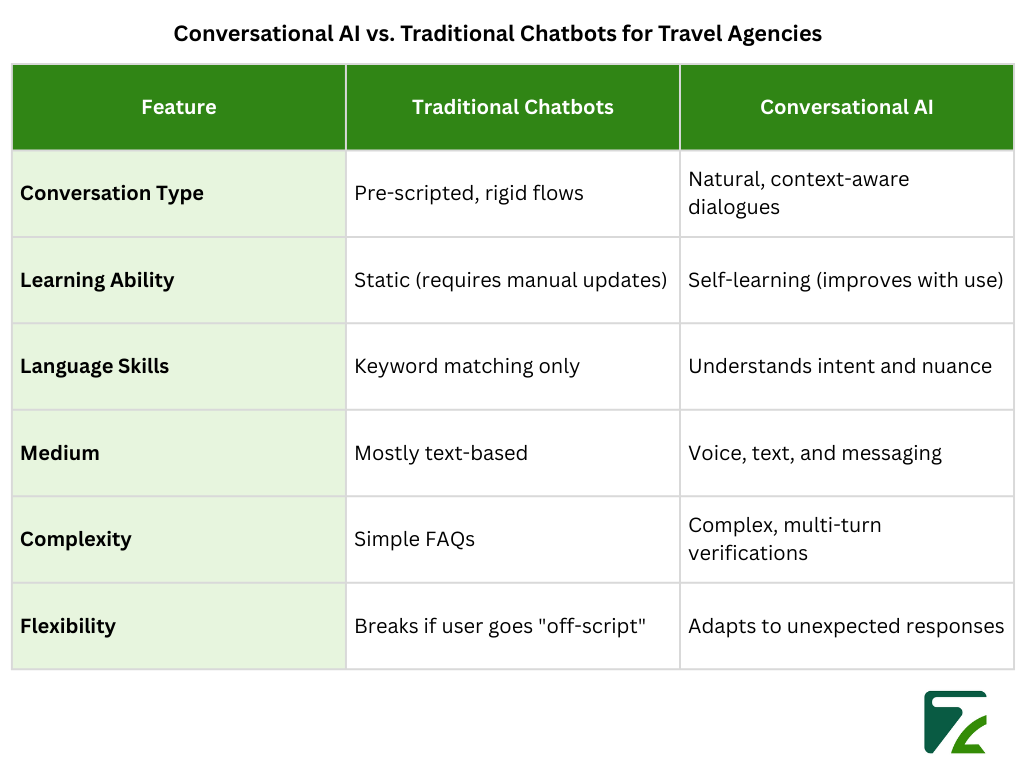
The hotel reconfirmation is where you essentially confirm with a hotel that you do actually have a reservation there in their Property Management System (PMS) after your booking. This important check is made by travel agencies to avoid the scenario of “booking failures” where a guest shows up, but the hotel has no record of them.
There are multiple reasons these failures occur. Systems of reservations (GDS or Channel Manages) won’t always sync completely with the hotel’s PMS. Human error behind the hotel front desk, misspelling a name or overselling a room, can occur. And occasionally, confirmation emails end up in spam.
And for the majority of agencies, reconfirmation is a tedious manual process. Agents download a report of future check-ins, call the hotel often international and confirm guest names, dates and meal options all before updating their internal database.
Based on McKinsey’s work on automation, manual processes are 60-75% slower than automated systems. It takes an average of 8-12mins for a human reconfirmation call to be executed (including dial time, hold time, and data entry).
That is for an agency doing 500 bookings per month, more than 80 hours of staff time two working weeks just validating data that should already be correct.
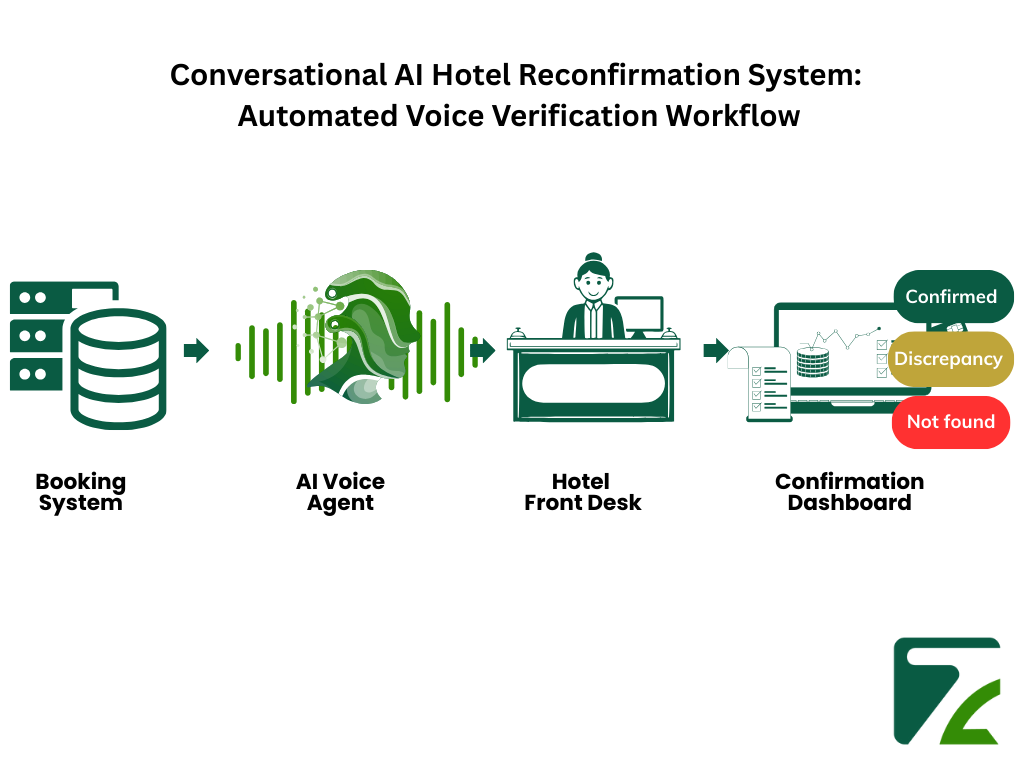
Conversational AI completely changes this workflow. Instead of human agents making calls, an AI Voice Agent handles the entire process.
The technology relies on AI voice agents that sound so human-like. These agents dial out to hotels for your agency. They say who they are, what the call is about, and speak to the hotel front desk in the same way a human co-worker would.
Thanks to enhanced technology for Automatic Speech Recognition (ASR), the AI is able to comprehend those replies from your hotel receptionist even in a crowded lobby. It asks pointed questions: “Can you please confirm Mr. Smith’s check-in date? or “Please, verify which meal plan attaches to this reservation”.
Speed is a major advantage. A human agent may be busy with some other tasks, but the AI usually makes reconfirmation calls within 2 min. And as the AI talks to the hotel, it cross-references your answers with your booking information in real time. If the hotel tells you “Check-in is on the 15th” and your system says it’s on the “14th,” the AI picks up on it immediately.
The system confirms guest names and spelling, check-in and check-out dates, room categories, and any special requests (like additional beds). According to Statista’s hospitality statistics, roughly 40 per cent of hotel bookings are cancelled or modified in advance. AI captures the disconnects that these changes cause before a guest even leaves home.
Humans teams sleep; AI does not. If your agency is based in London and you have a reservation at Tokyo and Los Angeles hotels, your staff would normally need to work during unsociable hours to contact these hotels. Conversational AI handles that autonomously; calling hotels at local business hours without having to force your team into night shifts.
It costs an agency $1.50-$2.50 to confirm a booking manually including staff wages, phone bills, and overhead. Automated AI reconfirmation reduces that cost to around $0.30-$0.50 per booking, which is a 70-85% reduction in cost. This allows agencies to reinvest these funds in marketing or sales.
People get tired. After 50 calls or so, an agent could mistype a confirmation code, overlook a detail. Leading AI performs 85-92% accurately within live operating conditions, with little performance degradation from the first call to the hundredth.
Growth often breaks manual processes. If your booking volume doubles, you probably need to hire additional operations staff. Keeping Your Team Small: When you have a conversational AI, 100 bookings require the same number of staff members as doing 10,000 bookings. According to the World Travel & Tourism Council, travel agency services are a global market valued at more than $1.2 trillion, providing a good runway for efficient operators.
Language has always been a challenging part of global travel. Modern conversational AI platforms can process 30-50+ languages, communicate with hotel staff in their native language and deliver results back in English. This drastically reduces misunderstandings.
Major OTAs: Online Travel Agencies running thousands of bookings per day use AI for automatic checks of the vast volume. And by screening the 90-95% of bookings that are fine, their human teams can leave to focus on just the smaller percentage that cause problems.
Corporate Travel Management Companies (TMCs): For business travelers, dependability is something that goes without being said. TMCs employ AI to offer a “double-check” guarantee that executives never have to experience a lost reservation.
Boutique Travel Agencies: Smaller agencies don’t always cannot afford large operations teams. With AI, a team of three can manage the booking volume that would normally take six to eight people and have an edge on margins.
While conversational AI offers significant benefits, agencies should be aware of realistic challenges:
Accent and Audio Quality: In a high noisy environment or in strong regional accent accuracy of AI falls by 10-15%. Systems get better with time, but early versions may need a human’s assist for tricky cases.
Hotel Resistance: Some boutique hotels, especially in some specific destinations, may prefer answering calls directly by a person and not talking to an AI call recipient. 5-10% of the assets would possibly be processed manually.
Integration Effort: It can take 4-8 weeks to connect AI systems with your booking platforms depending on the technology stack you have. APIs, file uploads, and webhook settings need to be technically aligned.
Change management: People who have done things manually might stick to what they are comfortable with. Clear communication around how AI is empowering them for higher value work (Sales, Customer Service) is essential for them to know.
Data Ingestion: The AI platform integrates with your booking system through API or file upload, and extracts required details: Guest Name, Hotel Phone Number, Dates, Reference ID.
Smart Scheduling: When they are least busy, the system finds out best time to contact based on where hotel is and historic data.
The Call: The AI makes the call through natural language processing (NLP) to engage in the conversation.
Digitization: Spoken responses by hotel staff are automatically recognized based on text from ASR.
Status Update: The answer (Confirmed, Not Found, or Discrepancy) is pushed back to your dashboard immediately with call recordings for quality control.
Audit Your Volume: Determine the number of bookings you handle a month, and how many staff hours are dedicated to verification.
Calculate ROI: Use realistic numbers. If you’re helping clients handle 500 bookings a month at $2 per manual confirmation ($1,000/month) instead of $0.40 per AI confirmation ($200/month), you’re saving them $800 a month or $9,600/year and 80+ staff hours.
Select an AI Hotel Reconfirmation Platform: Don’t pick up a generic AI tool, but something dedicated to hotel reconfirmation. Find skilled developers experienced in travel operations who know the terminology and can help integrate PMS.
Start with a Pilot: Start with 50-100 bookings. Review the call recordings and confirmation status to gain confidence in accuracy before scaling.
Monitor and Refine: Monitor hit rates, look at failure patterns, and drive performance better with your provider over a period of 2–3 months.
Reconfirming hotel bookings has remained as one of those travel agency nuisances that can be costly, time-consuming but is essential for ensuring the guest experience. Conversational AI is turning that liability into becoming an operational asset.
By streamlining this step, agencies are able to cut costs by 70-85%, eliminate human error and guarantee every guest shows up at a hotel that knows they’re coming. It is no longer a question of whether agencies should automate reconfirmation but how quickly they can begin to do so to be competitive.
Phocuswright research indicates that some 30% to 35% of travel firms are in the process of looking into or deploying AI systems designed to increase operational efficiency. Don’t let manual methods prevent your agency from taking off. Assess conversation AI solutions targeting travel operations and introduce a pilot project to test the impact. Empower your team to do what they do best: make travel unforgettable.
Conversational AI automates hotel booking reconfirmation by calling or messaging hotels using human-like conversations, reducing manual work, errors, and operational costs for travel agencies.
It uses NLP, speech recognition, and machine learning to speak with hotel staff, verify booking details in real time, and update systems with an accuracy of 85–92% in real-world conditions.
Most platforms support voice calls, messaging, and email, with multilingual capabilities across 30–50+ languages to handle global hotel networks effectively.
AI reconfirmation typically costs $0.30–$0.50 per booking versus $1.50–$2.50 manually, delivering 70–85% cost savings and freeing up significant staff time.
Integration usually takes 4–8 weeks via APIs or file uploads, with minimal disruption, and agencies can start with a pilot before scaling fully.

Travel Automation Expert