Today, if you are a travel agency, you must have come across this crossroad in your business to build your own booking engine or list your packages on OTA platforms like MakeMyTrip or Booking.com?
Perhaps you see your commission margins eroding. Or maybe you’re having trouble breaking through at all in this noisy market. The reality is that no one size fits all answers. However, the end of this article should provide definite clarity on which it is aligned with your agency’s business model, budget, and growth plans.
A booking engine is a software that allows customers to search for travel services, check availability in real-time, and book instantly without any human interference. It is your digital sales backbone that is working around the clock, taking bookings while you are busy doing other things!
A booking engine is your game changer for operational efficiency in travel agencies. Instead of taking 20 minutes of manually checking hotel availability and going back and forth with quotes over WhatsApp, your client comes to your page, chooses the dates, sees the price, and books about everything in less than 5 minutes.
An online booking engine that is well put together takes care of a number of important functions. It offers bundled packages that include hotels, flights, transfers, & activities all in a single transaction. The solution handles live inventory from multiple suppliers, accepts payments securely through integrated gateways, and provides instant booking confirmations and vouchers. These automations help remove tedious administrative tasks and allow your team to concentrate on customer service and business development.
An OTA is essentially an online travel agency, a large-scale third-party marketplace that helps travelers search, compare, and book their travel services. Major platforms like Booking.com, Expedia, MakeMyTrip, Agoda, and Yatra have become dominant players in travel distribution.
When you put your packages on these platforms, you are putting your inventory in a high traffic digital marketplace. These platforms aggregate from thousands of travel suppliers and connect them with millions of prospective customers looking for travel solutions.
OTAs come in to clear the visibility issue that is a dilemma for most small and medium travel agencies. These platforms provide instant access to wider audiences, millions of travelers who are actively looking, comparing, and booking in real time. This means your packages get in front of qualified prospects actively looking to book you, all without spending a cent on marketing. Trust infrastructure is already in place, with recognizable brand names, reviews systems, and secure payment processing available.
The trade-off is that there are always commission fees involved. As per study, OTAs charge 15% – 25% commission on each booking made through their platform. This means if your Bali package is priced at ₹1,00,000 and you sell through an OTA; you will be paying ₹15,000 to ₹25,000 for that one transaction. For your big volume agency, these commissions are the biggest loss of income.
The primary difference between these two models is ownership and control.
Your booking engine is the distribution channel that you own. You have full control of the customer experience from discovery to the booking stage to the follow-up after the trip. You retain 100% of the transaction value, fully own all customer data, and build direct relationships allowing for repeat purchases.
In other words: a booking engine is like having your own retail shop, while an OTA is like renting shelf space in an enormous department store.
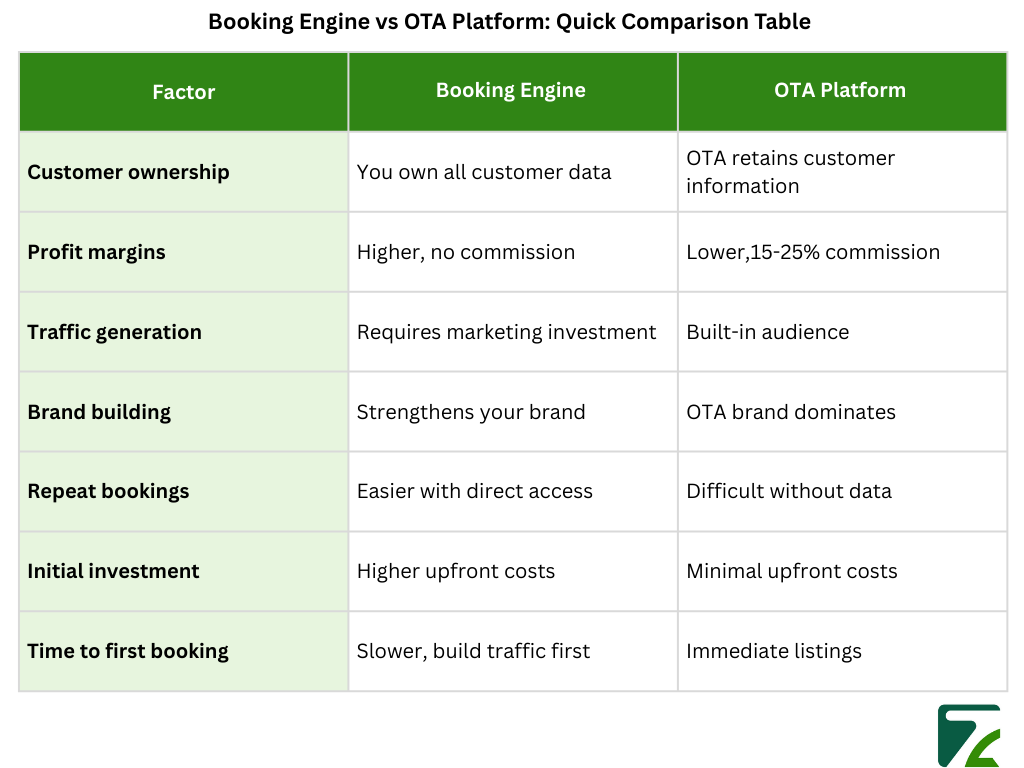
Increase Profit Margins: When you cut 15-25% commission fees, you make a direct impact on your bottom line. Thousands are saved in Commission Per Booking. Saving 20% commission on the ₹50,000 package means ₹10,000 profit per booking. That makes an extra ₹10 lakh, over 100 annual bookings, to be reinvested on marketing, people or expanding the business.
Direct Customer Relationship: Customer data is a game changer for your model. You get emails, phone numbers, travel preferences, and history of bookings. Adobe research shows us that it costs five times more to acquire a new customer than to retain an existing one, thus direct relationships with your consumers are priceless. This helps in sending personalized email campaigns for anniversary trips and also you can target customers with offers based on their previous destinations travelled and use it as a reward for customers and implement a loyalty program for them.
Complete Brand Control: Your booking engine is fully branded to you. You design the user interface, the messaging, how your package is presented, and what the customer experiences overall. Over time these things compound as customers take note and recommend your agency specifically.
Marketing Responsibility: Building traffic requires ongoing investment in search engine optimization, Google Ads, content marketing, and social media management. These capabilities require either hiring specialists or developing in-house expertise.
Technical Implementation: A booking engine setup is not as simple as it sounds. It requires integration with supplier APIs, payment gateway implementation, security protocols, and continuous maintenance. The initial investment can range from lakhs to tens of lakhs depending on customization requirements.
Slower Growth: It often takes 6-12 months to generate significant growth in organic traffic through SEO. It takes longer to see results, which can be difficult for agencies who need cash flow.
Immediate Market Access: Upload your packages today and get booked tomorrow. In Booking.com over 1.5 billion quarterly visits are made to sites within, and your inventory is instantly exposed to this large scale, qualified audience
Reduced Marketing Burden: The entire aspect of acquiring customers is taken care of by OTAs. This means it is a performance-based payment model where you only incur commissions when actual bookings happen, so there is no risk of any marketing spend being wasted.
Established Trust: OTA brands have brand trust with travelers. The review systems act as social proof, and the way payment processing is very secure! But for an agency that doesn’t have the same level of credibility that comes from being relatively well-known, this boosts conversion rates massively.
Commission Impact: Commission payouts can run into lakhs per annum on high volume operations. Unlike purchasing a vehicle, this is a recurring cost that directly impacts the bottom line, and it never goes away.
No Customer Data Ownership: OTAs take customer data. There is no way to build email lists, loyalty programs, or analyze purchase behavior. Every booking is still just a transaction without an opportunity to build a relationship.
Price Competition: Your listings are shown beside dozens of other packages. Where there is no differentiation, price is the only decision factor leading to a race-to-the-bottom.
You want to develop your brand over the long term and intend to be in business for a decade (or more). Direct channels, especially benefit agencies offering niche experiences, luxury honeymoons, adventure tours, wellness retreats, anything that you can’t sell on an OTA, where you can tell a deeper story and offer a personal consultation.
Especially if you have an opportunity for high repeat purchase in your business model, the economics get compelling. According to research, mere 5% improvement in customer retention can increase profits by 25% to 95%. Corporate clients that book on a quarterly basis, or couples who are making their way through multiple life stages together are repeat customers that deliver multiples of transaction value to the business.
You are a new travel agency recently about testing new market viability. OTAs are a low-risk way to enter the market, as they give you the opportunity to test demand without requiring you to invest heavily in technology and marketing infrastructure upfront.
When a team does not have either digital marketing know-how or the money to make large-scale efforts, OTAs alleviate this issue. OTAs also help speed up market feedback on new destination launches before expensive marketing campaigns are decided upon.
The most advanced agencies use OTAs and booking engines strategically for different needs. OTAs are customer acquisition channels, especially for first-time customers. Commission simply becomes a customer acquisition cost with no risk of lost spending.
Booking engines serve as the profit center. Agencies follow it up directly after good service on an OTA booking: “For your next trip, book through our website and save 15%.” The most successful agencies make that transition to direct bookings and do so while even increasing the percentage of revenue generated from OTA bookings before slowly moving that percentage over to direct bookings 12-24 months after their introduction.
If looking at booking engine options, you really need to make sure they are able to seamlessly integrate supplier APIs sealing real-time inventory, have markup controls that suit your business needs, and cover multiple currency for your international clients. Support for integrated payment gateways such as Razorpay or Stripe for PCI DSS compliant transactions.
Mobile friendly responsiveness is a must about 60% of travelers using phones to research and book trips, according to Google. Ensure that your booking engine provides smooth experiences on mobile phones and tablets. Other must-have features include CRM integration, auto-generation of vouchers, and multi-language features, to name a few.
Success requires comprehensive digital marketing. Destination-specific blog posts work wonders attracting travelers in research mode and help create authority through content marketing. Blogging businesses get 55% more website visitors compared to non-blogging businesses, according to the HubSpot.
Your Google Business Profile for local SEO optimization will reach travelers in the area searching specifically for your service. WhatsApp integration solves communication preferences, and the retargeting campaigns on Facebook Ads and Google Ads are aimed to capture those website visitors who did not finish their booking.
This helps in building an audience, and you can create a similar set of audiences using lead magnets and send ongoing campaigns via emails as you have the email list with you. According to a Campaign Monitor report, email marketing has a $42 return for every $1 spent, making it one of the most convenient channels available.
The choice between a booking engine and an OTA should be made in the context of where your agency is at the moment and where it wants to go in the future.
OTAs give you instant customers and fast market validation, which is great if you are starting a new agency or testing new markets. At its inception, the commission structure is more or less zero-risk customer acquisition
And yet, the sustainable travel business needs owned distribution infrastructure. Using a booking engine protects margins, creates customer relationships, and a brand equity which compounds over time.
This can be best tackled by initially using OTAs for quick wins and learning about the market, before methodically establishing the capability to receive direct bookings. Treat OTA commissions like customer acquisition investments, then upsell those customers to repeat direct bookers by providing better service and a compelling economic proposition.
As your business grows, your distribution strategy needs to be kept at a pace. Begin where the market permits but always progress in the direction of greater customer relationship and profit controllability.
A booking engine lets customers book directly on your website, while an OTA is a third-party marketplace (like Booking.com) where travelers book through their platform.
If you want quick bookings, OTAs are better. If you want higher margins + long-term growth, a booking engine is the smarter choice.
Most OTAs charge around 15% to 25% commission per booking, depending on your category, season, and deal terms.
A basic booking engine can cost ₹2–8 lakhs, while advanced systems with API integrations can go ₹10 lakhs+, depending on features.
Yes ,many agencies use OTAs for new customer acquisition and their booking engine for repeat direct bookings and better profits.

Travel Automation Expert