TL;DR
✦ What this covers: A complete classification of travel metasearch engine types, with OTA-specific strategy on bidding models, connectivity, and competitive positioning.
✦ Who it’s for: Online Travel Agencies (OTAs) and travel distribution teams looking to maximise metasearch ROI.
✦ Key takeaway: Each metasearch type serves a different traveller intent, runs on a different commercial model, and requires a different OTA approach.
Reading time: ~8 minutes
Why Should OTAs Pay Attention to Metasearch Engines?
According to the research of Colorado State University dated Q1 2026, currently, metasearch platforms impact more than 60% of all hotel booking decisions.
PhocusWire also outlines that 45% of all global unique visitors in travel are now from metasearch engines. Besides, in the US market, metasearch engines have been outpacing OTAs.
However, most OTAs consider metasearch as a single channel that have a simple bidding strategy. It implies that there are multiple types of metasearch engines, which envisage different audiences, commercial models, and competition levels. Treating Google Hotel Ads, the same way as Trivago or Skyscanner is a costly mistake.
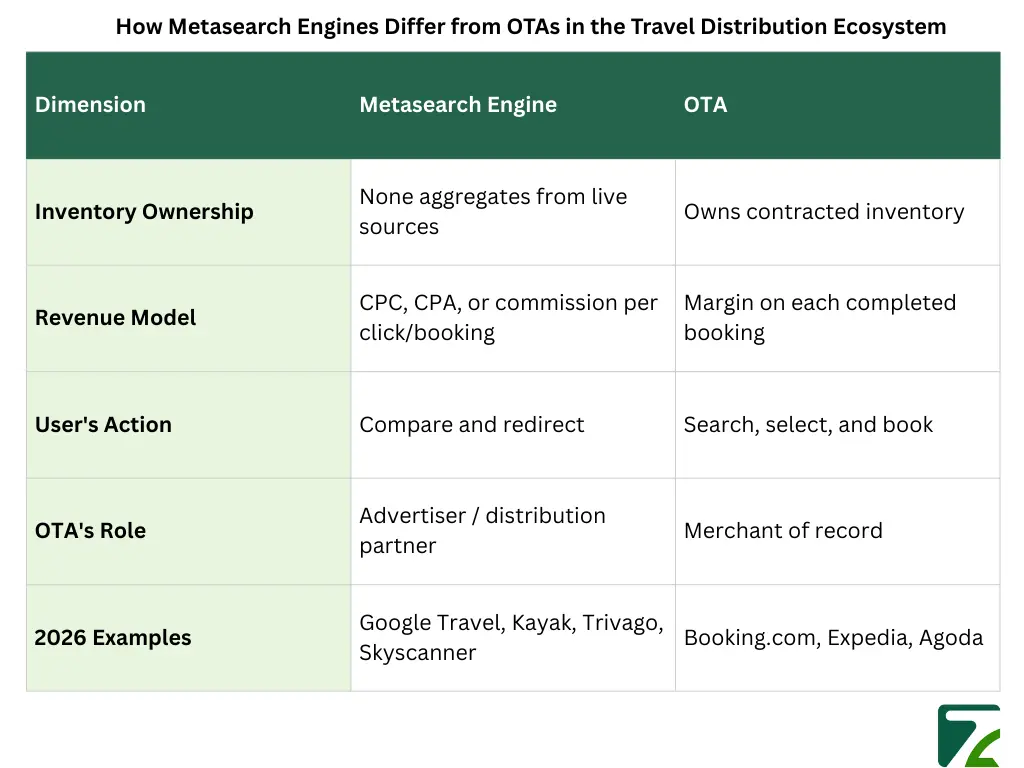
What Is a Metasearch Engine And How Is It Different from an OTA?
Metasearch engines pull from many other booking sources at once and provide multiple results for a certain property type in one place, making them easy to compare. You do not hold the stocks or take bookings. It aggregates.
As an OTA like Expedia owns the booking transaction. Kayak is not a booking site, rather a metasearch engine it sends users to where they can book. The reason users visit Metasearch to begin with is to compare; users go to OTAs to purchase.
Here is a key context for OTAs: OTA commission rates are often between 15–30% per booking today, which means when managed well, metasearch CPC is many times lower in terms of cost-acquisition.
"For OTAs, metasearch is not a competitor it is a distribution channel. The question is which types to prioritise and how to operate on each."
Key Terms Worth Knowing
Metasearch Engine : A travel technology platform that simultaneously queries multiple external booking sources OTAs, hotel direct sites, and airlines and displays consolidated, comparable results in a single interface. It does not own inventory or process bookings. Examples include Google Travel, Kayak, Trivago, Skyscanner, and TripAdvisor.
Price Feed : IATA’s modern XML standard enabling airlines to distribute richer content and personalised pricing directly to agencies via API often unavailable through GDS.
Instant Booking : A metasearch feature that allows users to complete a reservation directly within the metasearch interface without being redirected to an OTA or hotel website. Platforms like TripAdvisor have introduced this model, blurring the line between metasearch engine and OTA
Pay-Per-Stay (PPS) : A metasearch commercial model in which an OTA or hotel pays the platform’s advertising fee only after the guest physically checks in not at the click or booking stage. It is the lowest-risk model for OTAs but offers the least placement control, as visibility is determined algorithmically by the platform.
What Are the Main Types of Metasearch Engines in Travel?
75% of total metasearch market revenue generated from general-purpose engines. According to the data, more than 68% of all global metasearch traffic is shared between the top five players Google, Skyscanner, Kayak, Trivago, and TripAdvisor.
Type 1: General-Purpose Travel Metasearch Engines
These platforms combine results from all travel verticals, flights, hotel, and car rentals into a single interface. They appeal to the widest audience and the largest amount of traffic.
Examples: Google Travel, Kayak, Momondo.
- Audience: Generic leisure & business travelers, Trip planning phase (first steps)
- Commercial model: CPC type with smart bidding automation
- OTA challenge: High Level of competition your displayed rate needs to be competitive at the moment of impression.
Important Update : Google Hotel Ads (Q1 2026)
Google removed commission-based (CPA) bidding on Google Hotel Ads in February 2025. As of Q1 2026, Google Hotel Ads operates on CPC only. OTAs previously running CPA campaigns on Google must now use CPC or Target ROAS bidding.
Type 2: Hotel-Specific Metasearch Engines
The accommodation-only platforms. Features greater property filtering, richer visual content, and interactivity with and a review of listings.
Examples: Trivago, TripAdvisor Hotels, Hotels Combined.
75% of users state that metasearch created specifically for hotels makes hotel selection more efficient, giving these platforms a uniquely high potential for mid-funnel conversion.
Moreover, 3 in 4 travelers always include metasearch before a booking; the channel has confirmed its status as a staple of the hotel research journey.
- Audience: Mid-funnel travelers actively comparing specific properties
- Commercial model: CPC with optional CPA (Trivago offers both)
- OTA advantage: More comprehensive property content, comprehensive amenity/details, accurate reviews, lead to better CTR at same bid price
Type 3: Flight and Transportation Metasearch Engines
These engines aggregate air fares, ground transport, and multi-modal options across multiple carriers. They are optimised for speed and price sensitivity.
Examples: Google Flights, Skyscanner Flights, Rome2rio.
About 60% of users use transportation metasearch to get a quick airline comparison. Mobile-first behavior embedded, with 63% of users aiming at smartphones for flight searches.
- Audience: Price-sensitive travelers, frequent flyers, last-minute bookers
- Commercial model: CPC with GDS-connected pricing feeds
- OTA consideration: Accuracy of fares is key stale fares lead to elevated bounce rates and erode platform trust scores
Type 4: Multi-Product and Holiday Package Metasearch
These sites compare packaged travel, flights + hotels or full package vacations. They cater to travelers seeking value for every component of their overall trip.
Examples: Skyscanner Explore, Kayak Trips, Google Vacation Rentals.
- Audience: Families, package holiday seekers, value-conscious leisure bookers
- Commercial model: CPA or revenue-share, attributed to complex package
- OTA advantage: Only those OTAs that are capable of dynamic packaging can compete structurally, as hotels themselves are never able to offer just a flight bundled package.
Type 5: Niche and Specialised Metasearch Engines
Such segments have their own platforms luxury, corporate, long-stay with focus on curated inventory and relevant filtering.
Examples: Agoda (Asia-Pacific), Jetsetter (luxury), TripActions (corporate), HotelTonight (last-minute).
With wider customer appetite for personalization, specialized engines account for about 10% of the overall travel metasearch market share.
- Travelers with high intent that are specific to the segment with lower price elasticity
- Commercial model: Commission-based or hybrid partnership models
- OTA opportunity: Less competition, higher conversion per impression, and lower CPCs than general platforms
"The biggest strategic mistake an OTA can make on metasearch is allocating budget uniformly across all five types. Each type serves a different user intent at a different funnel stage."
How Do OTAs Connect and Plug Into Each Metasearch Type?
Self-Managed vs. Managed Meta Services
OTAs access metasearch through two routes:
Self-managed: The OTA has direct control of bidding, feed quality, and budget with the platform’s native advertiser tools Google Hotel Center, Trivago Business Studio, etc. Best suited for larger OTAs with dedicated distribution teams.
Managed Service: OTA presence is managed by a connectivity partner or metasearch agency. Typical for mid-size OTAs grow without an ultimate team.
API-Direct vs. Connectivity Partners
Every metasearch engine needs a live, accurate price feed from the OTA’s inventory system. This feed is the foundation of any metasearch presence not the bid.
- API-direct: OTA deploys its pricing engine right to the metasearch API. Quickest and most precision but requires technical effort.
- Connectivity partner: A channel manager or distribution middleware that sits between the OTA’s inventory and the metasearch feed and guarantees full rate accuracy in real time.
Data from the industry indicates that metasearch properties with discrepancies in rates incurred an extra $3,500 for every 10,000 clicks over competitors that maintained rate parity, a real cost of faulty feeds.
"A stale or inaccurate feed produces wrong prices, causes booking failures, and risks listing suspension regardless of how strong your bid strategy is."
What Pricing and Bidding Models Do Metasearch Engines Offer OTAs?
Where most OTAs are missing out on money is at the commercial model stage. The Wrong Model impacts your return on ad spend as each metasearch type supports different pricing structures.
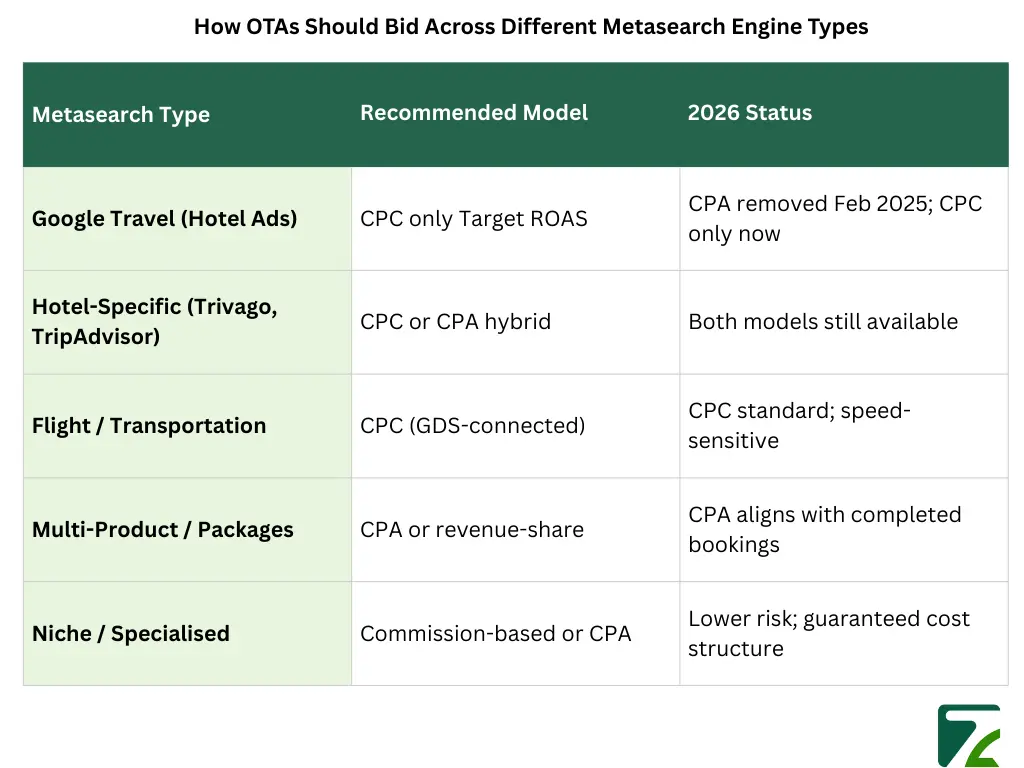
Context: Metasearch advertising CPC has doubled from $0.21 to $0.48 per click due to the growing competition among OTAs on metasearch engines.
"OTAs that segment their bidding strategy by metasearch type consistently achieve better ROAS and lower customer acquisition costs than those applying a flat CPC across all channels."
Hotel Direct vs. OTA on Metasearch Can Both Win?
Globally, the direct booking segment now accounts for 60% of total booking revenue generated through metasearch platforms.
For example, one handy benchmark from PhocusWire: OTAs within Booking Holdings cancel 50% of their bookings; for direct bookings the number is 18.2%.This delta is a real cost OTAs absorb, and a reason hotel increasingly push direct on metasearch.
For example, in a hotel-specific metasearch engine (such as Trivago), a searcher looking for a particular hotel would probably find that hotel’s own site, Booking.com, Expedia, and your OTA all on the same results page. Ads are slotted based on bid price, rate competitiveness, and content quality score.
How OTAs Stay Competitive When Hotels Bid Direct
Instead of matching the hotel direct rate dollar-for-dollar, which is margin destructive the high-performing OTAs are competing on four dimensions:
- Rate parity + added value:Match the direct rate but include free cancellation, provide loyalty points, or include bundled extras.
- Content quality: Management of property photos and completeness of amenity data and information on reviews can improve click-through rate at the same bid.
- Segment targeting: Target metasearch types where hotels are not actively bidding on corporate platforms, last-minute windows or Asia-Pacific niche engines.
- Rate accuracy: Make sure that each rate on metasearch is confirmed and bookable. A rate discrepancy between the listing and the booking page is a leading cause of OTA-to-direct leakage
"On metasearch, OTAs do not need to be cheaper than the hotel. They need to be more trustworthy, more complete, and easier to book."
Conclusion
Metasearch is not just one channel Five different platform types, each fulfilling a unique traveller intent, operating on a different commercial model, and demanding a different OTA strategy. General-purpose engines offer reach. Hotel-specific engines offer conversion depth. Flight aggregators demand feed accuracy. Package platforms reward dynamic bundling. High-intent audiences, low competition that´s Niche engines
Master the types first. Then create your bidding model, feed architecture and content strategy around each one and you will always out-power OTAs that think of metasearch as one line item in their distribution budget.
Frequently Asked Questions
A hotel metasearch engine is a specialised platform that aggregates accommodation pricing and availability from multiple booking sources OTAs, hotel direct sites, wholesalers and presents them side by side. Examples include Trivago and TripAdvisor Hotels. They differ from general-purpose engines by offering deeper property filtering and integrated review scoring.
OTAs pay to appear in metasearch results typically on a CPC or CPA model. Revenue is generated when a user completes a booking on the OTA's site after clicking through from metasearch. The booking margin minus the metasearch advertising cost equals the OTA's net contribution per transaction.
Google Travel operates primarily as a metasearch engine it aggregates hotel and flight prices from OTAs and suppliers and redirects users to book elsewhere. Note: Google removed its commission-based 'Book on Google' model in February 2025. As of Q1 2026, Google Hotel Ads operates on CPC only.
For most OTAs, Google Hotel Ads is the first metasearch investment it commands the largest traffic share and captures users at peak booking intent. Hotel-specific engines like Trivago and TripAdvisor are strong secondary channels. After that, priority depends on the OTA's inventory profile, geography, and target traveler segment.
NDC connectivity, if you are selling flights and your platform does not currently support it. Airlines are actively moving their best content away from legacy GDS channels, and the gap between what NDC-connected agencies can offer versus GDS-only agencies is growing every quarter. After NDC, the next priority is real-time fare revalidation at checkout it is the single most common source of booking errors and lost customer trust.