

TL;DR
In travel, metasearch engines represent the highest-intent booking channel and are also the most contentious in 2026. The OTAs that treat metasearch simply as a passive listing channel are already being displaced by more optimally networked competitors. In this guide we are covering what are metasearch engines and how do they work, which bidding models should OTAs adopt in 2026, how should OTAs strategically co-exist with hotel direct rates, and ultimately what does a high performing OTA metasearch setup infrastructure actually look like. This is a tailored book for OTAs that are done with presence and chasing performance.
Why Metasearch Is Now the Defining Battleground for Every OTA
Metasearch is the place where most (over 60% by 2026) hotel booking decisions happen. OTAs that are not actively optimizing their meta search presence , not just being on it , drive revenue to better organized competitors.
Say you are a mid-size OTA with good hotel inventory in most South and Southeast Asia. Your listings are live in the major marketplaces. Yet at this exact moment a high-intent traveler is on Google Travel comparing your hotel rates to four other OTAs and the one that ultimately gets that click is nowhere near the cheapest.It is the one bidding most intelligently for that specific search, on that device, in that source market.
In 2026, this figure stands at 73% of travelers who compare prices across a minimum of 3 platforms prior to booking. Over 60% of all hotels booking decisions worldwide are influenced by metasearch platforms. At the same time, in 2025 the four biggest OTAs burnt $20 billion on sales and marketing, much of it aimed at metasearch visibility. Every quarter, the difference between OTAs that strategize metasearch and OTAs that scramble to manage it passes passively grows ever wider.
In 2026, metasearch is no longer a distribution checkbox; it is the ultimate battleground for OTA revenue at the moment of highest traveler intent.
What Is a Metasearch Engine and How Does It Operate in 2026?
A metasearch engine is a search aggregator that queries several booking sources for OTAs, hotel booking engines, and direct websites at the same time and presents the rates side by side on a single interface. It does not process bookings. It takes travelers to the booking source of their choice.
Key Terms
Search Aggregator : A search aggregator queries many external booking databases at once and aggregates the results into a single comparison interface. Search aggregators specialised for travel accommodation pricing are metasearch engines. For example, Google Hotel Ads, Trivago, Kayak, TripAdviso
Metasearch Engine : A platform that pulls hotel rates from multiple booking sources OTAs, hotel websites, booking engines and displays them side by side. It does not process bookings; it redirects travelers to their chosen source.
CPC (Cost-Per-Click) : The OTA pays each time a traveler clicks their listing, regardless of whether a booking follows. Market average as of 2026: ~$0.48.
Rate Parity : A contractual requirement to maintain equal room-only rates across all booking channels. Packaging and bundling sit outside parity scope.
Connectivity Partner : An authorized intermediary (e.g., RateGain, DerbySoft) that aggregates an OTA’s multi-source inventory into the standardised feed format each metasearch platform requires.
How Does a Metasearch Engine Actually Work?
Once a traveler inputs their destination and dates, the metasearch platform simultaneously connects with every applicable booking source in real-time and returns results based on a price competitiveness, bid value, and customer review score ranking criteria, allowing the traveler to simply click through to their desired platform to complete the booking.
And the process goes through four steps:
- A traveler enters a destination, check-in check-out dates, and number of guests.
- Platform queries all connected OTAs, Hotel Booking Engines and direct sites at the same time
- Results are ranked by price, bid value, review score, and immediate availability
- A click from a traveler to their desired source the metasearch gets paid for that click
A metasearch does not make their money from commissions per actual booking, but instead, they get their money from advertising (primarily by way of CPC/external source bid competition).
How Does a Metasearch Engine Decide Which OTA Listing Ranks Above Yours?
Metasearch ranking is not a pure auction. You cannot deny that bid amount matters, but the platforms balance bid against a number of other factors such as price competitiveness, historical conversion, and content quality, meaning that the deepest pocket does not always win.
When a traveller treats themselves to hotel search on a Google Hotel Ads, Trivago, or Kayak, you can be sure a live auction is taking place behind the scenes. Your listing creators’ position in that auction is determined through a combination of five factors:
- Bid amount:Floor is set by your CPC bid or Target ROAS target. The better the bid, the more chances a player has to join the auction, but it is not the only thing to reach the top.
- Price competitiveness:This is the most underestimated factor by the OTAs. We found that in a competitive environment, price competitiveness is a direct ad ranking factor in Google. If you do not stay within parity of competing rates, you will not get as much visibility for your ad. No matter what level you bid at, If your listed rate is higher than another OTA showing the same hotel, the algorithm actively demotes your position .
- Historical conversionrate:When it comes to placement, platforms weigh booking conversion rates, meaning an OTA that attracts really high-intent traffic and converts well receives an algorithmic placement advantage over time, even with a relatively moderate bid.
- Ad relevance and landing pagequality:Besides bid amount, ad relevance, and landing page quality are ranking factors. If a traveler clicks through, waits for a slow-loading page, or sees a page that doesn’t match what they were looking for, that signal goes right back into your ranking score.
- Click-through rate (CTR):Ranking algorithms take into consideration recorded CTR signals and user behavior over time. The flip side is an OTA that has brand power on any platform; its advantage tends to compound.
What the Traveller Actually Sees
When a traveller compares OTA listings for the same hotel, they see rate, cancellation policy, and brand name side by side with nothing else. The lowest rate site generally gets the most clicks. At the point of comparison, trust is secondary to price. Essentially, rate integrity is simply a revenue management problem, it is by direct effect your metasearch visibility issue.
The OTA that wins on Metasearch is not the one that bids the most. It is the one that bids efficiently, prices competitively, and converts reliably all three simultaneously.
How Can OTAs Build a Winning Metasearch Strategy in 2026?
The metasearch success of an OTA in 2026 will be driven sequentially by three decisions the correct bidding model, a thoughtfully executed rate strategy vs hotel direct listings, and a multi-source rate feed supporting real-time competitive and accurate pricing.
Which Bidding Model Should OTAs Use in 2026 : CPC or Target ROAS?
In 2026, new Google Hotel Ads campaigns can no longer use commission-based bidding models. The Choice is essentially between Enhanced CPC, where base bid is set by the OTA, but the Google algorithm manages whether to increase or decrease those bids, or Target ROAS, where the automated Google algorithm optimizes those bids towards a revenue target.
Target Return on Ad Spend (ROAS): : A Google Hotel Ads bidding model where the advertiser sets a target return on ad spend and Google’s algorithm automatically adjusts bids in real time to achieve it. Recommended for OTA accounts with at least 30 days of conversion history.
Bidding Model Comparison for OTAs in 2026:
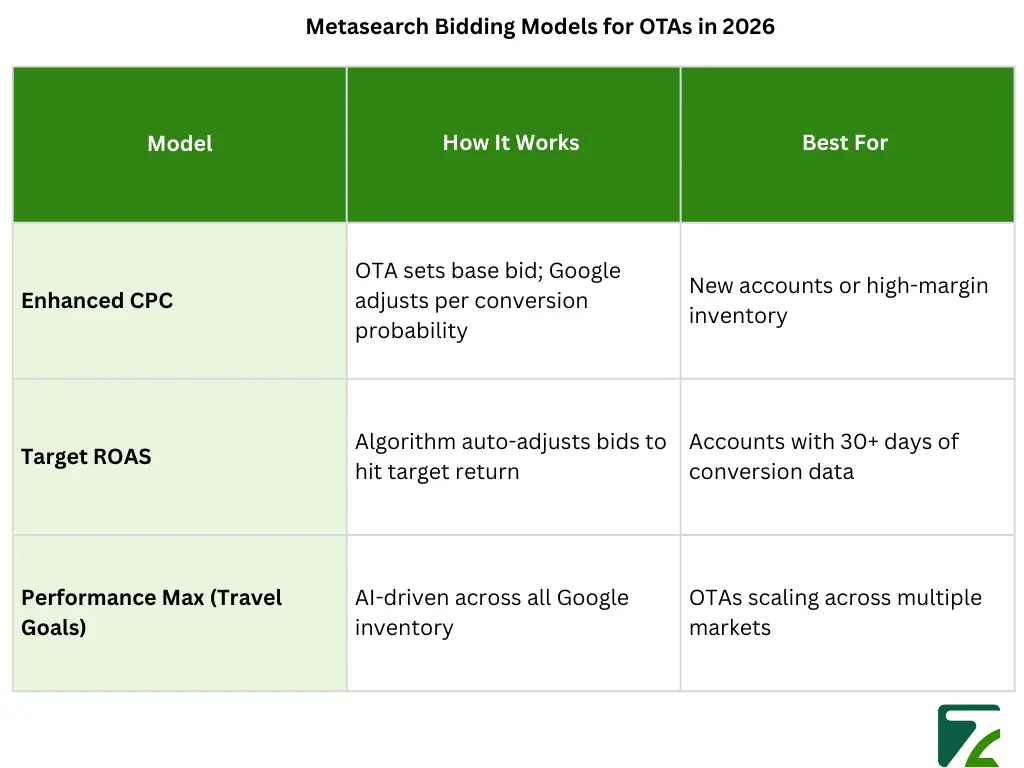
Metasearch CPCs are up to $0.48 per click (up from $0.21 in 2026) and OTAs paying for clicks in a loss of rate-parity are paying $3,500 more per 10,000 clicks than their price integrity maintaining counterparts. Discipline when it comes to bidding is mandatory, not optional.
In 2026, Target ROAS has proven to remain as a powerful strategy, as OTAs running Target ROAS using clean rate feeds and maintaining price parity consistently outperform those using manual CPC bidding only.
How Should OTAs Position Their Rates Against Hotel Direct Listings?
2026’s most successful OTA metasearch strategy won’t be to outbid hotel direct rates. It’s to segment the opportunity where OTA and hotel meet different traveler needs without destructive undercutting.
The Four Deliberate Co-Existence Strategies That Work
Geographic targeting: OTA targets international source markets that hotel cannot easily market against directly; hotel does the same for domestic and loyalty traffic
Packaged rates: OTA markets flight+hotel or hotel+transfer packages that an individual hotel booking engine cannot compete against fairly keeping a rate advantage while not technically violating room-only rate parity
Language segmentation: OTA run’s Arabic, Mandarin or German campaigns (segments hotel does not serve directly)
Agreed rate division: The hotel and the OTA agree on what booking segments the OTA “wins” when it comes to meta last-minute availability and group bookings and credit/EMI in order to avoid bidding on same searches.
By 2026, 18% of travelers who initiate their search on an OTA ultimately book hotels directly. OTAs that manage to synchronize positioning with hotel partners keep a larger share of the rest, not losing clicks to direct listings with no revenue upside.
OTAs which work with hotel partners to coordinate metasearch positioning, limit wasted CPC expenditure, safeguard margin and build longer-term relationships with suppliers.
What Does High-Performance OTA Metasearch Infrastructure Look Like in 2026?
Three infrastructure decisions: a multi-source rate feed with real-time accuracy, a smart platform prioritization strategy, and automated bid management that reacts to demand signals faster than humans can is the secret sauce to winning OTA metasearch in 2026.
Step 1: Build a Multi-Source Rate Feed
Rate Feed: A live or cached data stream that delivers an OTA’s pricing and availability to a metasearch platform in real time. Feed accuracy is the technical foundation of every metasearch campaign any lag or mismatch results in lost trust, abandoned bookings, or listing disapproval.
OTA rate sources often include GDS connectivity (Amadeus, Sabre, Travelport), bed bank contracts (Hotelbeds, Jumbo), Hotel Direct contracts and channel manager integration. RateGain or DerbySoftare examples of such a Layer they package these into a single feed in a standard compliance format as per each metasearch platform. Caching of rates reduces load on the infrastructure but also runs the risk of exposing stale pricing when the demand on a market is high. These are Live rates which are accurate and need a more better API infrastructure. A hybrid approach is what most OTAs operating in 10+ markets are using.
Step 2 : Prioritise Platforms by Source Market
Google Hotel Ads , the starting line without exception makes up 65% of all metasearch-driven hotel bookings by 2026. Review-driven segments are the second priority for TripAdvisor. Based on source market data, the second and third in line are Trivago and Kayak. 80% of Skyscanner sessions in India are mobile, for OTAs targeting Indian outbound travelers, mobile-optimized landing pages are not optional.
Step 3 : Automate Bidding with Property-Level Data
Manual CPC bidding cannot match the performance of automated strategies on Google Hotel Ads, and this disparity becomes consistently greater from 2026 onwards. Automated systems that bid in real time according to varied factors (occupancy, competitor bids, booking-arrival lead time, device type, etc.) outperform static bid management. Instead of just click and conversion data, OTAs should channel property Level margin data into their bidding algorithms, to ensure that their bids are reflective of the actual profitability per booking, rather than just the volume of traffic.
OTAs that automate metasearch bidding with property-level margin inputs capture the performance gains that manual management consistently leaves behind.
What ROI Can OTAs Realistically Expect From Metasearch in 2026?
OTA metasearch campaigns that are optimized for performance consistently deliver stronger results than the majority of other digital acquisition channels out there, yet, at the same time, the gap between optimized and unoptimized has never been greater.
Verified benchmarks as of 2025–2026:
- 82% of travel marketing professionals report high ROI from metasearch
- Compared to OTAs out of parity , OTAs at rate parity have +242% higher revenue per impression (Triptease, 2024)
- Google Hotel Ads delivers ~900% ROI for optimised campaigns 9 units returned per 1 invested
- GHA cancellation rate: ~13% vs OTA-sourced bookings at 20–40% metasearch-driven bookings carry structurally lower cancellation risk
Specifically, for OTAs in the Indian market: India’s travel economy is growing at 15% CAGR, with 2/3rds+ of Indian travelers intending to take more international trips in 2026 , a deep, engrossed and high value segment for respective OTAs with a solid outbound inventory and mobile-first campaigns.
In 2026, the OTA with the best bid intelligence not the biggest budget wins the metasearch click.
Conclusion
OTAs winning on metasearch in 2026 will not be those with the deepest pockets. It is they who are most intelligently bidding based on real-time rate feeds, strategic co-existence with hotel partners, and bidding automation that responds to demand signals quicker than any human ever could.
These travelers comparing prices right now 73% are already within the metasearch ecosystem. The real question, however, is whether or not your OTA is best positioned to win that click or whether a better-optimized competitor is.
Start with Google Hotel Ads. Build rate feed accuracy. Layer in Target ROAS. Segment by market and device. Scale from real data.
Frequently Asked Questions
A search aggregator that queries multiple booking sources OTAs, hotel direct sites, booking engines simultaneously and displays their rates side by side. It does not handle the booking; it redirects travelers to their chosen source. Google Hotel Ads, Trivago, Kayak, and TripAdvisor are the dominant platforms as of 2026.
A standard OTA listing means the OTA owns the booking and earns commission. OTA metasearch means bidding to appear in a neutral rate comparison paying per click (CPC) or targeting a return (ROAS) competing directly against hotel direct rates and other OTAs for the same traveler at the same moment.
Commission-based bidding is fully discontinued as of 2025. In 2026, OTAs use Enhanced CPC for new accounts or inventory control, and Target ROAS for accounts with sufficient conversion history and automated optimisation in place.
Packaging bundling flights, transfers, or services rather than undercutting room-only rates. Parity agreements govern room-only rates. Packaging, geographic segmentation, and value-add bundling remain outside parity scope.
Yes , they serve different funnel stages. Google Search Ads capture travelers in early research. Google Hotel Ads targets travelers already comparing specific hotel rates. They are complementary and should run in parallel for full-funnel coverage.