TL;DR Summary : This guide helps travel agencies, tour operators, and DMCs select the right travel-specific CRM platform in 2026. You’ll learn a systematic evaluation framework and discover the top 5 purpose-built travel CRM solutions ranked by use case. Make data-driven CRM decisions backed by industry research and verified user reviews.
According to Statista’s 2025 report, 72% of travel bookings were completed online in Q1 2025, with 45% via mobile. Travel Weekly research shows agencies using CRM responded 33% faster and achieved 25% more lead conversions vs. manual processes.
The global travel agency market will grow from $521.5M in 2024 to $776.2M by 2030 at 6.9% CAGR, making the right CRM critical.
Generic CRMs (Salesforce, HubSpot, Zoho) require extensive customization. Travel-specific CRMs offer native features generic platforms cannot match:
Built-in Itinerary Builders | Supplier Management | Multi-Currency Support | Travel Document Automation | Commission Tracking
According to Tourwriter research, 91% of travelers say response speed impacts booking decisions, and 83% of luxury travelers cite personalized service as the loyalty driver. Travel-specific CRMs enable both through purpose-built workflows.
Solo Advisors (1-3 agents): Simple itinerary creation, $0-100/month budget → TravelJoy, basic Travefy
Mid-Sized Operators (4-15 agents): Team collaboration, supplier coordination, $500-2,500/month → Sembark, Travefy, Ezus
Enterprise DMCs (15+ agents): Advanced customization, multi-brand management, $3,000-10,000+/month → Ezus Premium,
Conduct two-week audit: How long does quote generation take? What percentage of leads go cold? How many hours spent on manual supplier coordination? Where do booking errors occur? How accurately do you track commissions?
According to Sembark testimonials, agencies reduced quote turnaround from hours to 2-5 minutes post-CRM.
Essential integrations: Accounting (QuickBooks, Xero), Email (Gmail, Outlook), Payment processors, Booking engines/GDS, WhatsApp Business API. Verify capabilities before purchasing to avoid expensive custom development.
Ideal For: Travel advisors, agencies, tour operators, and DMCs of all sizes
Key Strengths:
Pricing: Starting $31/month
Best For: Advisors wanting comprehensive solution without juggling multiple tools; trusted by 30,000+ travel brands
Ideal For: Large travel agency groups, DMCs specializing in FIT and MICE
Key Strengths:
Pricing: From $78/user/month (includes setup fee)
Best For: Agencies with 10+ users requiring sophisticated multi-currency and multi-language capabilities
Ideal For: Growing travel agencies and tour operators seeking comprehensive CRM without enterprise complexity
Key Strengths:
Pricing: Custom pricing based on team size
Best For: Mid-sized agencies (5-20 agents) in growth phase; users report reducing quote turnaround to 2-5 minutes
Ideal For: Solo travel advisors and small boutique agencies
Key Strengths:
Pricing: $29-49/month
Best For: Beginner freelance agents creating simple packaged itineraries; note: limited features for scaling operations (no supplier management, no advanced budgeting, no team collaboration)
Ideal For: Travel agencies, tour operators, and DMCs in India and Asia
Key Strengths:
Pricing: Custom pricing
Best For: Indian/Asian agencies needing complete CRM, operations, marketing, and web solution; clients report 40% more business and 5%+ conversion rates on social leads
Phase 1: Data Preparation (Weeks 1-2) : Clean existing database, organize supplier contacts with rates, prepare sample itineraries
Phase 2: Configuration (Weeks 3-4) : Set up service types, create document templates, configure pricing rules, map integrations
Phase 3: Team Training (Weeks 5-6) : Conduct hands-on workshops, practice building itineraries, test quote generation
Phase 4: Gradual Rollout (Weeks 7-12) : Start with new inquiries, run parallel systems for 2-3 weeks, monitor adoption metrics, optimize workflows
3-6 Months (Fast ROI): Solo advisors and small teams using entry-level platforms focused on time savings
6-12 Months (Standard ROI): Mid-sized agencies with platforms like Travefy, Sembark targeting 15-25% conversion improvement, 30-50% faster quotes
12-18 Months (Enterprise ROI): Large agencies with Ezus Premium, Tourwriter Enterprise achieving 20-40% productivity gains
Based on Travel Operations Q1 2025 research, agencies using CRM achieve:
Mistake #1: Choosing Based on Brand Recognition Over Fit – Large platforms aren’t always better. Match platform to current team size and operational complexity.
Mistake #2: Ignoring Setup and Training Costs – Calculate 36-month total cost including setup fees ($2,000-3,000 for some platforms), training time (40-80 hours), and integration costs.
Mistake #3: Underestimating Learning Curve – Research shows 50% of sales leaders report usability concerns. Test thoroughly during trial periods with actual workflows.
Mistake #4: Selecting Without Testing Real Workflows – Use 14-30 day trials to test actual client itineraries, complex trips, and group bookings with agents who will use the system daily.
Mistake #5: Overlooking Geographic Market Fit – Choose platforms with strong presence in your geographic market and client base.
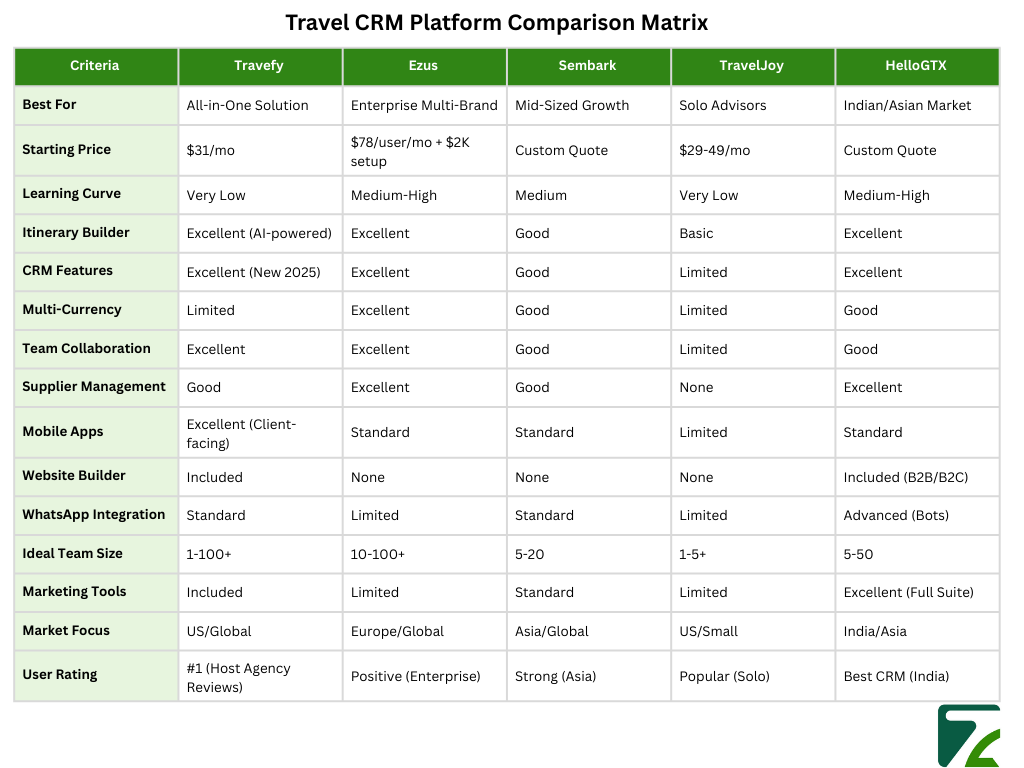
Selecting the right travel CRM in 2026 depends on three factors: your agency size, geographic market, and primary workflow needs. Travefy offers the best all-in-one value for most agencies. Ezus suits large multi-brand operations. Sembark balances features and affordability for mid-sized teams. TravelJoy works for solo advisors starting out. HelloGTX dominates the Indian/Asian market.
According to Phocuswright’s Travel Forward 2026, online bookings continue rising 8% annually to $1.07 trillion. The agencies thriving in 2026 are those choosing travel-specific CRM platforms that match their operational reality, not marketing promises.
Start with the diagnostic framework, test 2-3 platforms during free trials, and prioritize platforms that solve your top 3 pain points. The right CRM transforms chaos into competitive advantage.
Travel CRM focuses on client relationship management and lead tracking. Travel management software encompasses complete operations: itinerary building, supplier management, booking coordination, financial tracking, and CRM combined. Platforms like Travefy, and Ezus are full travel management systems.
According to Tourwriter research, agencies should "start with a travel management platform to power itinerary delivery" rather than generic CRM. Generic CRMs track leads but don't help deliver personalized itineraries the product clients actually buy.
Solo advisors: $300-1,200/year | Small agencies (2-5): $1,500-6,000/year | Mid-sized (6-20): $12,000-48,000/year | Enterprise (20+): $48,000-200,000+/year. Include setup fees ($500-3,000), training time, and integration costs.
Entry-level (TravelJoy): 1-2 weeks | Mid-tier (Travefy, Sembark): 4-6 weeks | Enterprise (Ezus): 8-12 weeks. Plan 3-6 months of optimization after launch.

Travel Automation Expert