A B2B travel booking engine is an online platform for booking travel services that is based on B2B (business to business) technology. It serves travel agencies and OTA channels by giving them the power of managing and booking directly out of inventory put up by multiple suppliers.
Unlike B2C (business-to-consumer) booking software in which individual travelers make direct purchases, B2Bs focus their attentions on business-to-business transactions with wholesale prices, an enterprise-wide agent log-in and ability for multilevel distribution.
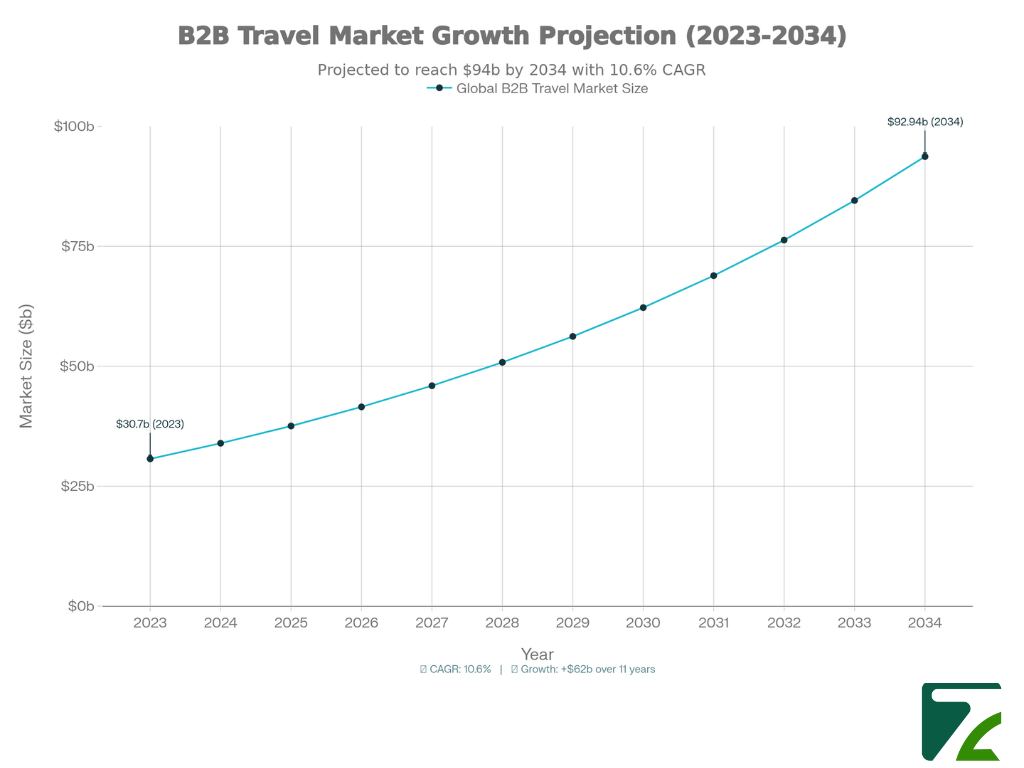
In 2023, the global B2B travel market reached $30.7 billion, and its growth is expected to continue for years to come predicted at 10.6% annually all the way through 2032. This substantial rise in travel has led more travel agencies and OTAs to pour funds into B2B booking engines. They see great scope and increased efficiency in scalability which their operations too can profit from.
In the business-to-business model, travel agents use negotiation rates to make searchable reservations and purchases for airfares, accommodations, car rentals-helped by a web-based system. They can manage sub agents, custom markups, and deal with a number of bookings at the same time under one centralized platform. This greatly improves efficiency while allowing travel companies that want to expand their operations to increase in size without having to negotiate dozens of suppliers separately.
A b2b booking engine integrates with Api access to multiple suppliers for real-time inventory and pricing. This means agents can search flights from global systems (gds), accommodation from all the different wholesalers around the world and ground transport services all on one search interface.
The key technical advantage here is intelligent content aggregation with de-duplication. If the same hotel or flight is offered by several suppliers, then the system will identify duplicates and offer the best available rate to agents. This unified approach to inventory management significantly improves conversion rates and booking efficiency.
Agencies can offer clients a wider range of options by drawing on multiple sources of inventory, and without the need to manage individual supplier contracts or keep track of multiple login credentials.
Different travel products have individual modules included on B2B platforms. The flight booking system connects with GDS systems and airline APIs including low-cost carriers, which are not usually accessible through conventional channels. It also supports multi-currency pricing and multi-city search capabilities to support complex international itineraries.
The hotel booking engine works with bed banks and channel managers, including a substantial component such as property photos, details on the property and service facilities, guest reviews, etc. This type of comprehensive information helps guide agents in providing recommendations to their clients.
When all these modules are integrated into the one platform, there is no need for separate systems. This reduces training time and streamlines workflow throughout all agents. Flights, hotels, transfers and any other service that difficulty surprises the customer are all bookable over a single interface.
With white-label functionality, travel agencies can transform the booking engine into one that appears to be their own. Agencies can personalize their interface to display their logo, utilize a domain name of their choice, and ensure that all customer documents (vouchers, itineraries, confirmations) match the look-and feel of their own brand.
This feature now extends to sub-agents, as well as each can have their unique portal, powered by the same underlying engine. White labeling can inculcate trust and help agencies establish their own brand image in a crowded market. The ability to present a consistent brand experience across all customer touchpoints is a major competitive advantage for growing travel agencies
B2B booking engines include sophisticated financial management features that differentiate them from consumer platforms. Master agencies can set flexible commission structures for sub-agents and effortlessly apply mark-ups to net rates.
Payment flexibility is particularly important for the B2B travel sector. According to research from PayPal, 75% of travelers are likely to use buy now, pay later (BNPL) solutions in the future for vacations on credit. Many B2B engines offer credit limits for trusted agents, wallet systems to keep balances and various ways to defer payment. This helps agencies manage their cash flow much better.
Such features enable agents to confirm bookings instantly without having to wait for the client payment to clear: conversion rates improve and customer satisfaction goes up. Being able to offer flexible payment terms can be a decisive factor in winning business from corporate clients and tour operators.
When agencies grow their partner networks, they need a good agent management system. A well-designed booking engine can support multi-tier agent hierarchies allowing the creation and management of sub-agent accounts with different access rights, pricing mechanisms.
Improved onboarding facilities, such as self-registration and automatic approval workflows, shorten the amount of time taken to activate sub-agents. This function supports franchise or affiliate business models: one travel company can grow by making its inventory available to other agents.
Data indicates that with multi-tier distribution models, agencies can greatly expand their market reach at little extra cost. For small and medium-size travel operators, this represents the most valuable aspect of going multi-tier.
A quick and easy-to-use interface will ultimately help turn more visits into bookings. Compared with slower systems, one that delivers searches fast can lift booking volumes significantly. Research shows that travelers expect instant results increasingly, with 72% of travel bookings in Q1 of 2025 completed online and over 45% made on their mobile phones.
Essential interface features include:
These features enable agents to create customized packages and upsell additional services. At the same time, the average booking value increases while customer satisfaction goes up as well.
Real-time reporting capabilities give agencies visibility into their business performance. Comprehensive dashboards should track:
Data driven insights allow travel agencies to spot trends, tweak pricing strategies, and focus on the top sellers in their portfolios. In the fiercely competitive travel market, a better handle on real-time data is vital for keeping a business profitable.
With an API-first architecture, the future is open. Booking engines today should integrate with more than travel suppliers.
Customer Relationship Management (CRM) systems; Accounting and financial software for businesses; Corporate client booking tools; Marketing automation platforms
Agencies with powerful API integration capabilities can respond more quickly to changes and technologies that are making a breakthrough. This flexibility is extremely important in the fast-paced travel industry where new suppliers emerge frequently and technology changes just as quickly.
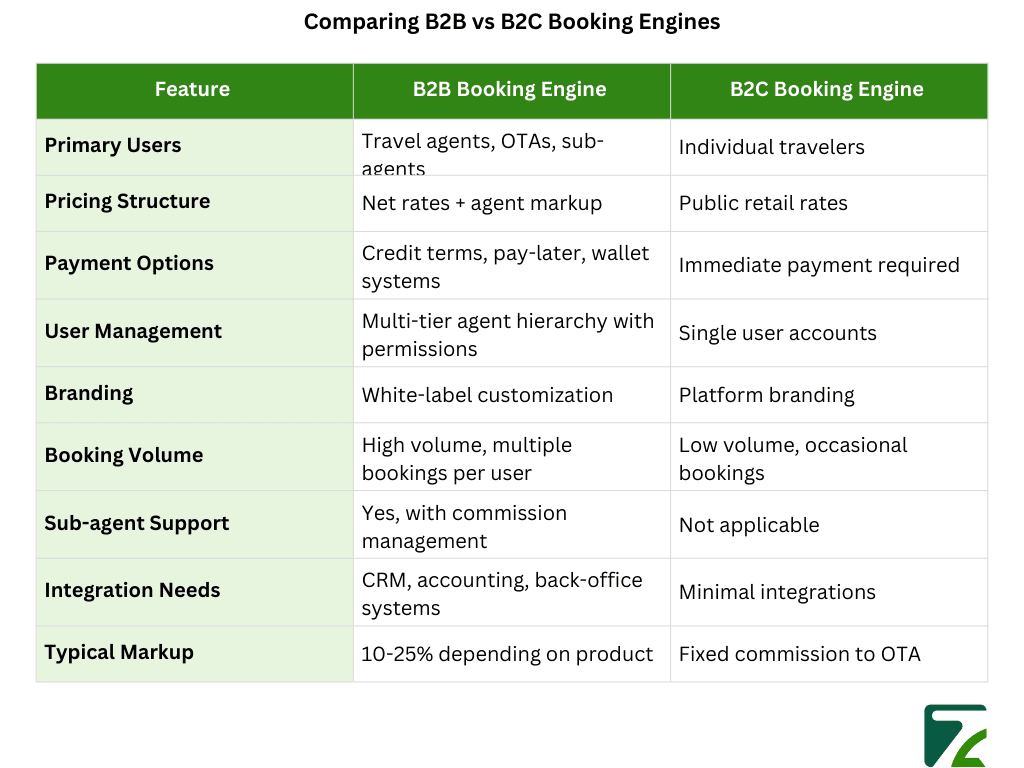
The business model being understood is the value proposition of the agency. Toward a B2B business model, travel suppliers (airlines, hotel wholesalers, car rental companies) provide platform inventory at net or negotiated wholesale rates.
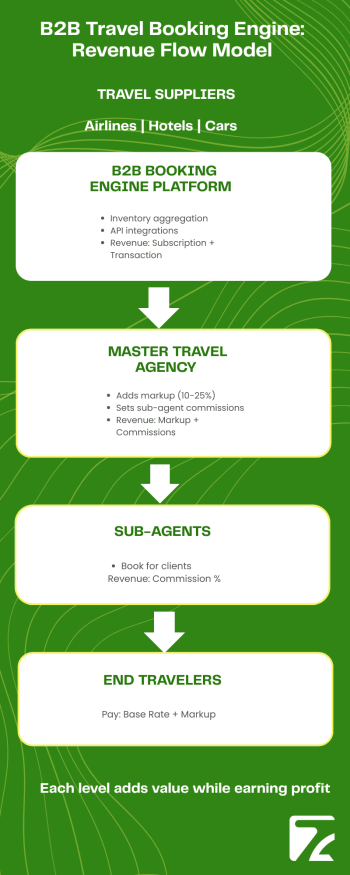
The platform aggregates this inventory, and travel agencies access it through the engine. The engine allows agents to raise the price and sell tickets to end consumers. The system could hardly be more perfect for the suppliers, who are saved end sales costs. Agencies benefit from having many sources of supply, without having to negotiate one-by-one contracts with former sources.
Small travel agencies have many opportunities under this model. If a host agency is a consolidator, the little ones can benefit from the earliest-mover advantage of having GDS access without requiring entry into an expensive IATA accreditation. This makes for much easier entry to newcomers in travel.
To illustrate the scale of B2B opportunities, consider that Expedia Group’s B2B business reached $25 billion in gross bookings and saw revenue growth of 18% in Q3 2024, with the B2B segment now powering travel for over 60,000 partners including Walmart Plus Travel, Chase Travel, United Airlines, and Mastercard. This demonstrates how major OTAs recognize the lucrative potential of the B2B model alongside their consumer-facing operations.
To illustrate the scale of business-to-business opportunities, consider that Expedia Group’s B2B business amounted to $25 billion in gross bookings (and thus revenue), which showed an impressive 18% increase reported at Q3 2024. The Travel serving B2B segment already provides support for more than 60,000 partner organizations including Walmart Plus Travel and Chase Travel. Other names in this space include United Airlines and Mastercard. This shows that these large OTAs find the b2b model, which is coming close at this point to equaling their already well satisfied consumer traffic businesses in terms of profit and revenue, very attractive.
Multi-Currency and Multi-Language Support: International tourists need to be able to view prices in different currencies and operate the UI in their own language. This is not just handy; it’s vital for serving international markets well enough to compete with established OTAs.
Mobile Accessibility: Todays modern travel agents work anywhere. According to industry statistics, in 2024 mobile bookings accounted for over 60% of all hotel reservations. A responsive and mobile-optimized interface makes it possible for the agent to check on availability, make bookings, and reserve a seat at restaurants from his smartphone or tablet browser.
Safety and Compliance: Security on this level must not be compromised. The system must comply with PCI-DSS standards for payment, GDPR for data protection regulations, and other industry rules. This is the best form of protection against data breaches as well as legal complications for both enterprise and customers.
Customer Support Integration: The built-in tools for customer contact management, quote generation and amendment or cancellation streamline post-booking operations. In terms of the quality of service provided overall, they are another big plus.
It was pointed out by the Global Business Travel Association that in recent years, 60% of companies turned to online booking systems. The travel industry is recovering and evolving with great rapidity. Those with b2b technology will do better to:
The platform links features that had to be manually combined in the past, like multiple systems and logins and manual tasks into one smooth flow. Since 80% of business travelers today book through OTAs agencies must also offer an equally good service online if they are to keep their customers who have become used to being able to buy without hesitation whether airline tickets or hotel accommodations.
With real-time inventory access, flexible payment options and comprehensive agent management, a modern B2B travel booking engine is changing the way travel agencies operate. These platforms don’t just automate bookings; they create new business models, widen market reach, and offer the necessary insights needed to compete in today’s market.
As the global B2B market of travel continues its trajectory toward an estimated $ 92.94 billion by 2034, the growth has become self-evident agencies that come up with strong booking engine technologies to stand to grab a disproportionate share. In any case there are a combination of operational efficiency, an expanded inventory, and scalable distribution networks. The competitive advantage gained in this way can be hard to duplicate through manual processes.
For travel agencies and OTAs that are thinking about the technology foundation, the question here is not that of whether or not to implement a B2B booking engine but rather which is most congruous with their overall development plan and nature of business. This investment in the right technology platform is perquisites: higher bookings, increased operational efficiency (which means lower fixed costs) as well as making sure that scaling up without becoming more complex operationally is possible.
A B2B travel booking engine allows travel agents and OTAs to book flights, hotels, and other travel services at wholesale rates and resell them to customers with their own pricing.
It generates revenue through subscription fees, per-booking transaction fees, or commissions earned on supplier inventory accessed by travel agencies.
No. Many B2B platforms provide access to flights and hotels through consolidators, allowing non-IATA agencies to sell travel products.
Yes. Most B2B engines allow agencies to create sub-agent accounts, set commissions, manage markups, and track performance from one dashboard.
Yes. B2B booking engines are built to handle high booking volumes, multiple agents, and expanding supplier networks without increasing operational complexity.

Travel Automation Expert