
TLD;R
Travellers in 2026 arrive at agencies with AI-built itineraries and expect everything flights, hotel, transfers, activities to work as one connected experience. Most agencies cannot deliver this because their systems are fragmented. A travel booking engine fixes this by bringing all supplier inventory into one workflow, enabling custom trip packaging, and automating post-booking operations. The agencies building this infrastructure are gaining market share. Every agency still routing bookings through OTAs is paying 15–30% commission, carrying ~50% cancellation exposure, and handing the client relationship to a platform that will remarket to their customer without them.
A client messages your agency on WhatsApp. They have attached a screenshot a complete itinerary built in ChatGPT. Flights from Dubai to Tokyo, four nights at a Shinjuku hotel, a bullet train to Kyoto, a ryokan stay, and a day trip to Nara. Priced roughly. Sequenced correctly. And they want you to confirm it, book it, and manage it as one thing.
That is the 2026 version of the connected trip problem. Not a lost PDF. Not a transfer arranged over email. The problem is that a traveller just used a free AI tool to show themselves what a fully connected itinerary looks like, and now they are sitting in front of your agency expecting you to make it real. Bookable. Confirmed by a team who will pick up the phone if something goes wrong at 11pm in Kyoto.
Most agencies cannot do this in one system. The flights go into the GDS. The hotels go into three different supplier portals. The ryokan is an email chain. The bullet train booking is handled separately. By the time the itinerary is confirmed, it lives in six different places, and no one’s system holds the whole thing.
That is a connectivity gap. And there are four of them sitting inside most agency operations right now, quietly costing revenue, eroding client confidence, and handing market share to platforms that at least feel more connected, even when they are not.
This article is about those four gaps and about how a travel booking engine closes them. It is written for everyone inside a travel agency who owns a piece of this problem: the CEO deciding where to put the technology budget, the operations director who watches manual reconciliation eat up half the team’s day, the product manager evaluating platforms, and the sales lead trying to justify agency value against a tool that costs the client nothing.
What Is the Connected Trip Experience and Why Does It Demand a Travel Booking Engine?
The connected trip experience is simpler to define than it is to deliver. It is a journey where every component outbounds and returns flights, accommodation, airport transfers, in-destination of transport, and activities is booked, managed, and visible through a single workflow. One itinerary. One confirmation. One team is accountable for all of it.
Travel agencies have been promising this for decades. The honest truth is that most of them deliver the components and hope the connection between them holds. It usually does, right up until it does not until the hotel has no record of the booking, or the transfer is timed to a flight that changed three days ago, or the activity confirmation sits in an email thread that only one agent can find.
Key Terms Worth Knowing
Connected Trip Experience: A journey where every component: flights, hotel, transfers, activities is booked and managed in one workflow, with one itinerary document and one point of contact for any change.
Agentic AI (Travel): AI systems that autonomously search, compare, and complete bookings on a traveller’s behalf. As of spring 2025, a quarter to a third of US and European travellers expressed interest in agent-led booking (Phocuswright, 2025).
API (Application Programming Interface): A protocol enabling two software systems to exchange data in real time. In travel, APIs connect a booking engine to supplier systems for live availability, pricing, and booking confirmation.
Dynamic Packaging: Combining individual components from different suppliers into a single quoted price, with one margin applied at the agency level. The traveller sees a package. The agency controls every element of it.
Why the Connected Trip Experience Is a 2026 Problem, Not a 2019 One
2024 global survey by TTS found that 77% of travelers say the quality of the travel experience now matters more to them than the price of the trip. That is a significant shift. Five years ago, the price was the primary lever. Today, experience is. And experience, in this context, means connectivity the sense that the whole trip was planned and managed as one thing, not assembled from parts.
The Hilton 2024 Trends Global Survey found that 80% of global travelers consider digital booking important, rising to 86% among Millennials and 83% among Gen Z. But here is the part that most agencies are underreacting to: travelers now build itineraries in AI tools before they call an agency. They have already seen what a connected trip looks like when assembled in one place. They arrive with a reference point. And your system either clears that bar or it does not.
The travel booking engine is the infrastructure that determines whether it does.
The traveller is not comparing your agency to another agency anymore. They are comparing you to what their AI assistant built them in twenty minutes for free. That is a different kind of competition, and a spreadsheet quote process cannot win it.
Where Does the Connected Trip Experience Break Down Without a Travel Booking Engine?
Call it what it is: a connectivity gap. Not a process inefficiency, not a technology shortfall a gap between what the traveller expects to experience and what most agency infrastructure is actually capable of delivering. There are four of them. Together, we call this the Four Connectivity Gaps framework.
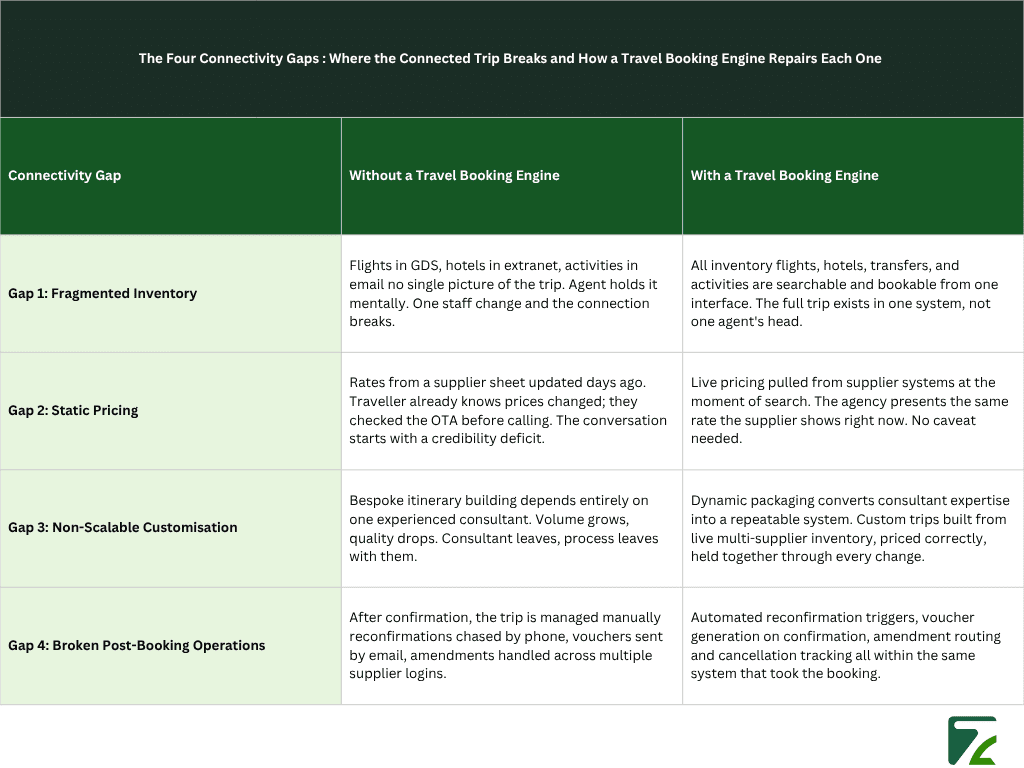
Connectivity Gap 1 : Travel Booking Engine vs. Fragmented Inventory
When flights sit in a GDS terminal, hotels in a separate extranet, activities in an email chain, and transfers in a WhatsApp thread. Nobody, not the agent, not the client, nor the operations team holds a complete picture of the trip in one place. The agent holds it mentally. Which means the trip’s connectivity depends entirely on that agent being available, alert, and at their desk.
One handover, one sick day, one system outage, and the connection breaks. The client does not know this is happening. They find out at the airport.
Connectivity Gap 2 : Travel Booking Engine vs. Static Pricing
Connectivity Gap 3 : Travel Booking Engine vs. Manual Customisation
In 2024, more than 68% of travellers preferred customised travel packages over pre-built bundles (MarketGrowthReports, 2026). Every good agency has consultants who can build a bespoke itinerary. The problem is that the capability lives in those consultants, not in the system. It does not scale when volume grows. It does not survive when the consultant leaves. Custom trips are the agency’s strongest product and its most fragile process at the same time.
Connectivity Gap 4 : Travel Booking Engine vs. Manual Post-Booking Operations
This one is the quietest gap and the most expensive. After the booking is confirmed, someone needs to reconfirm with the hotel, dispatch the vouchers, track the amendment deadlines, manage the cancellation windows. In most agencies, someone is a person working across multiple supplier logins, sending emails, making calls, and logging everything manually.
It is not that this work is beneath the team. It is that it is the wrong use of them. Every hour spent reconciling supplier confirmations is an hour not spent building client relationships or selling the next trip.
The Four Connectivity Gaps are not separate problems. They are four symptoms of the same underlying issue: the agency's booking infrastructure was not designed to connect a trip end-to-end. The travel booking engine is not one fix for one problem. It is the architecture that closes all four gaps at once.
How a Travel Booking Engine Restores the Connected Trip Experience Across Your Agency
A travel booking engine does not add a layer of technology over a fragmented workflow. It replaces the fragmentation with a single integrated system. Here is what that replacement looks like across each of the Four Connectivity Gaps.
Closing Gap 1: How a Travel Booking Engine Connects Multi-Supplier Inventory
A travel booking engine pulls live inventory from GDS networks for flights, direct hotel APIs or aggregators for accommodation, specialist platforms for transfers and car rentals, and activity distribution APIs for experiences all into one searchable interface. The full trip is assembled in one place, not across six.
When a consultant builds a Japan itinerary flights into Tokyo, bullet train to Kyoto, ryokan, day trip, private transfer every component is sourced and confirmed inside the same system. When the client changes the return flight, the transfer timing reflects it automatically. The connection is structural. It does not depend on anyone remembering to update a spreadsheet.
Closing Gap 2: How a Travel Booking Engine Restores Real-Time Pricing Credibility
Because a travel booking engine retrieves live pricing from supplier systems at the moment of each search, the rate on the screen is the rate in the market right now. Not yesterday. Not Tuesday. Now.
For sales teams, this is a significant shift. The conversation stops being defensive ‘I’ll need to check if that price is still available’ and becomes confident. Here is the price. Here is the availability. Would you like to hold it? That is a different client relationship, and it starts from the very first quote.
Closing Gap 3: How Dynamic Packaging Inside a Travel Booking Engine Scales Customisation
Dynamic packaging converts the consultant’s expertise into a repeatable system. Components from different suppliers are combined, priced with one margin applied, and presented as a single package built around the client, not pulled from a catalogue. Travel companies using AI-driven recommendation within their booking workflows report revenue per booking increases of 10–25% (TravelAI.com, 2026). Agencies using AI-assisted personalisation see a 25% increase in overall bookings according to Mize and Skift data.
And when the client arrives with a ChatGPT itinerary? The agency shows them a bookable version of it same components, verified suppliers; professional support included inside the same consultation. That is not slower than the AI tool. That is better than it. Which is the only place an agency’s value proposition actually lives.
Closing Gap 4: How a Travel Booking Engine Manages the Trip After It Is Sold
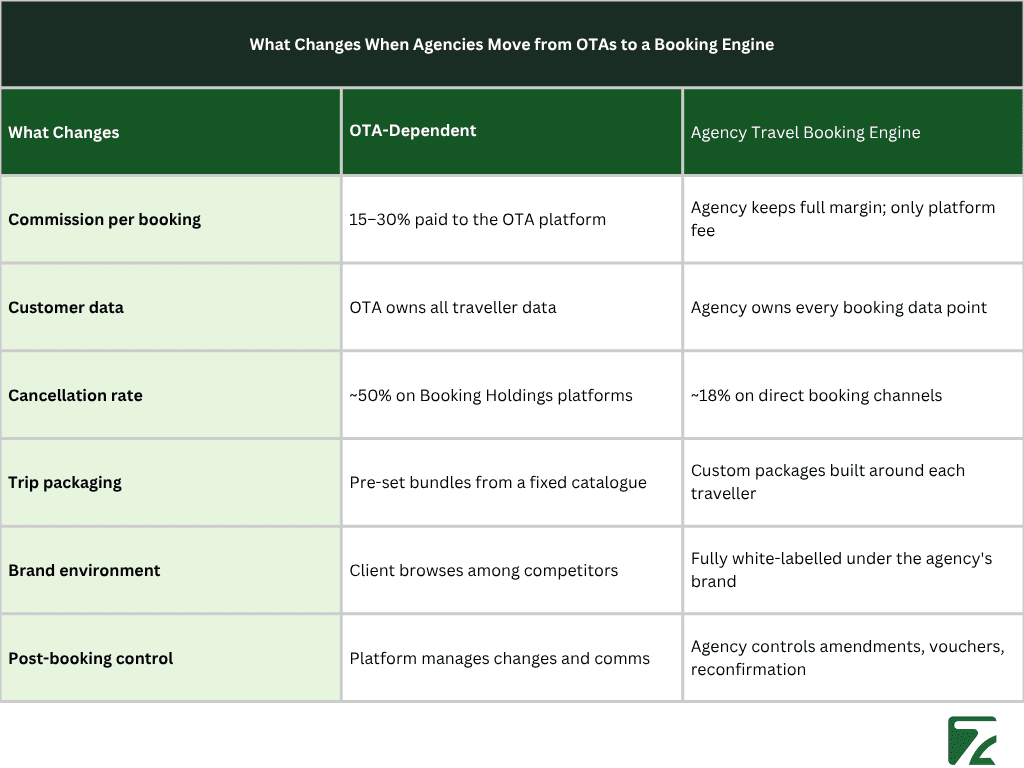
What Changes When a Travel Agency Moves from OTA Dependency to Its Own Travel Booking Engine
What Does the Connected Trip Experience Actually Cost a Travel Agency That Relies on OTAs?
There are three costs that every OTA-dependent agency is carrying right now. Most have calculated one of them. Almost none have added all three together.
How OTA Commission Rates Drain the Connected Trip Economy
OTA commissions currently range between 15% and 30% per booking, according to Cloudbeds’ 2026 OTA commission guide. A decade ago the industry average was around 10%. In 2024, the four largest OTAs Expedia Group, Booking Holdings, Airbnb, and Trip.com Group collectively spent $17.8 billion on sales and marketing. That budget does not come from nowhere. It comes from the commission on every booking that flows through their platforms.
On a $1,000 hotel booking at 20% commission, $200 goes to the OTA. On 500 such bookings a year, that is $100,000 before staff costs, before platform fees, before the revenue lost to cancellations. That is not a distribution cost. That is a structural drain on agency margin that compounds every year as commission rates climb.
Why OTA Cancellation Rates Quietly Destroy the Connected Trip
What Travel Agencies Lose in Customer Data When the Connected Trip Goes Through an OTA
Every booking completed through an OTA is a transaction where the platform gains a customer and the agency gains a commission. The OTA keeps the contact details, the booking history, the travel preference data, and the right to remarket directly to that traveller without the agency’s involvement.
According to Phocuswright’s 2024 US Travel Agency Landscape Report, US travel agency market share is projected to grow from 21% in 2022 to 26% in 2026, while OTA share declines. The agencies driving that shift are the ones who stopped treating the OTA as the primary distribution channel and built direct booking infrastructure instead. They are converting first trips into second trips because they own the relationship. That is the compounding advantage that commission payments can never buy back.
Commission. Cancellations. Data loss. Three separate costs. One root cause. The agency is not the distribution channel the OTA is. And that relationship does not get cheaper over time.
What Should a Travel Agency Evaluate in a Travel Booking Engine to Support the Connected Trip?
The Four Connectivity Gaps tell you what the platform needs to close. Here is how to test whether it actually does.
API Connectivity: Does the Travel Booking Engine Cover the Full Connected Trip?
The connected trip includes flights, hotels, transfers, car rentals, and activities. A booking engine covering only two or three of these forces the agency back into the fragmented multi-platform workflow that created the gaps in the first place. During evaluation, ask which supplier categories are natively supported, whether hotel connections are direct to property systems or through aggregators, whether NDC airline content is available, and whether activity and transfer inventory can be added through open APIs.
Test it live, not in a demo video. Build a three-component itinerary from scratch. If the consultant has to open a second system at any point, the connectivity gap is still there.
Dynamic Packaging: Can the Travel Booking Engine Build a Custom Trip or Just Pull a Catalogue?
This is the distinction that matters most commercially. A genuine travel booking engine for agency operations lets you combine components from different suppliers, apply your own margin, and present the result as a single package price. A white-labelled OTA feed lets you sell what is already bundled. They are not the same product.
Test the margin logic. Build a package that includes components from at least three different supplier types. Change one component and watch whether the package price updates automatically. If it requires a manual recalculation at any step, the dynamic packaging is not complete.
Post-Booking Workflow: Does the Travel Booking Engine Keep the Connected Trip Connected After Confirmation?
This is the feature most agencies underweight during evaluation and most regret neglecting after go-live. Ask the vendor to walk you through what happens operationally when a flight changes and the transfer needs updating. Watch whether it resolves inside one system or requires action across multiple supplier logins. Ask about reconfirmation automation at what intervals, triggered by what, traceable how.
For operations directors: this is the feature set that either recovers or wastes the most team hours per week. It deserves the same scrutiny as the front-end booking experience.
Reporting and Analytics: Can Leadership See the Connected Trip in the Numbers?
A travel booking engine without a reporting layer gives operational capability without commercial visibility. Revenue per booking by product type, conversion rates by source, supplier performance over time these are the numbers that inform product, commercial, and marketing decisions. The AI in tourism market is growing from $2.95 billion in 2024 to a projected $13.38 billion by 2030 at a CAGR of 28.7% (MarketsandMarkets, 2024). Platforms already incorporating AI into their analytics layer surfacing anomalies, recommending upsell opportunities based on booking patterns are providing intelligence that static dashboards cannot match.
Conclusion:
The connected trip experience is not a product tier. It is not something you offer at the premium end of the catalogue while everything else gets managed manually. In 2026, it is the baseline. Travelers expect it. The ones who do not get it move on quietly, without a complaint, to whatever platform gives them the closest version of what they were looking for.
The Four Connectivity Gaps fragmented inventory, static pricing, non-scalable customisation, and broken post-booking operations are not new problems. Most agency CEOs know they exist. Most operations directors feel them every day. What has changed is the urgency. The traveller arriving with a ChatGPT itinerary is not a niche scenario anymore. It is Tuesday morning at most mid-sized agencies. And the gap between what that traveller experienced from a free AI tool and what the agency’s booking system can actually deliver is visible in the client’s eyes before the first quote is sent.
The travel booking engine closes that gap. It is not a complicated sell internally. The commission being paid to OTAs at 15–30% per booking is a number that exists in the accounts. The cancellation rate gap 50% on OTA channels versus 18% direct is a number that can be calculated from any agency’s booking history. The customer data walking out the door with every OTA booking is harder to put a number on, but any agency that has tried to run a repeat-booking campaign off an OTA-dependent client list knows exactly what it feels like.
Here is what does not get said enough: every month without a travel booking engine is a month where that commission is paid, those cancellations land, and that customer data belongs to someone else. It is not a future cost. It is a current one. It showed up on last month’s P&L. It will show up on next month’s too.
The agencies that build this infrastructure now will have owned client relationships, accumulated booking data, and a connected trip product that compounds in value every year. The agencies that wait will be paying higher OTA commissions on a smaller market share to platforms that are getting better at replacing them. That is not a projection. That is the direction the data has been pointing for three years.
Frequently Asked Questions
Yes. Modern SaaS booking engines are accessible to smaller agencies because pricing usually scales with usage or revenue. In fact, smaller teams often benefit more because they feel the impact of manual booking work more sharply.
A travel booking engine updates linked trip components in one system when changes happen. If a flight changes, connected services like transfers can be adjusted without separate manual updates across multiple supplier portals.
An OTA controls the platform, customer relationship, and booking data. A travel booking engine lets the agency sell under its own brand, manage the trip directly, and retain customer data and repeat-booking opportunities.
For SaaS platforms with ready supplier integrations, implementation can take a few weeks. Many agencies start with core components like flights, hotels, and transfers, then add more integrations over time.
Agentic AI will favour booking systems with structured, real-time inventory data. Agencies using open, API-driven booking engines will be better positioned to connect with these new AI-led booking channels.