
TLD;R
Most travel agencies treat multi-language and multi-currency support as a checkbox feature something to tick off during vendor evaluation. This article shows why that mindset costs bookings. For OTAs, DMCs, and B2B travel agencies serving international travelers, localization is not a feature. It is a revenue engine that directly impacts conversion rates, customer trust, and market expansion.
The Checkbox Mindset That Kills Travel Booking Engine Conversions
When travel agencies evaluate booking engines, multi-language and multi-currency support often gets reduced to a simple question: “Does it have it? Yes? Check.”
This checkbox mindset is costing agencies real revenue.
Here is what happens when localization is treated as a feature rather than a strategy: A travel agency quotes a European family in Euros on a localized landing page. The destination descriptions are in German. The family proceeds to checkout and finds prices displayed only in USD.
They abandon the booking.
This scenario plays out thousands of times daily. According to Hotelagio’s 2025 analysis, 81% of online travel bookings are abandoned before payment. One factor stands out for international bookings: 17% of international shoppers abandon carts specifically because they cannot pay in their home currency, according to Elavon research.
For travel agencies operating globally, multi-language and multi-currency support is not a checkbox. It is a revenue engine that directly impacts whether a booking converts or dies at checkout.
This article breaks down why the checkbox approach fails, where localization impacts the booking journey, and how travel agencies can turn these features into a competitive advantage.
Why Does the Global Travel Market Need Better Booking Engines?
The scale of the opportunity demands it.
According to the UN Tourism World Tourism Barometer (January 2026), 1.52 billion international tourists traveled globally in 2025, a 4% increase from 2024. International tourism receipts reached USD $1.9 trillion.
The online segment is growing rapidly. Navan’s 2025 report values the global online travel market at $523 billion in 2024, projected to reach $1.3 trillion by 2030 at a CAGR of 13.1%.
According to Market Reports World, 48% of global travelers used an OTA platform in 2024, with mobile bookings accounting for 67% of all transactions.
The implication: the market is global, booking behavior is digital, and source markets are diverse. A booking engine serving only one language and currency cannot capture this opportunity. Travel agencies need booking engines built for a multilingual, multi-currency world, not retrofitted with localization as an afterthought.
Key Terms Worth Knowing
Display Currency: The currency shown to the customer during search and checkout. This is what the traveler sees on screen.
Settlement Currency: The currency in which the agency receives payment from processors or pays suppliers. Often different from display currency.
FX (Foreign Exchange) The conversion of one currency to another. FX rates fluctuate and impact margins on international bookings.
Localization: Adapting a product or content for a specific market includes language translation, currency display, date formats, and cultural preferences.
How Does Multi-Language Support in a Travel Booking Engine Impact Conversions?
What Do the Statistics Say About Language Preferences?
The data on language preferences in purchasing decisions is unambiguous. The CSA Research “Can’t Read, Won’t Buy” study, based on a survey of 8,709 consumers across 29 countries, found that 76% of online shoppers prefer to buy products with information in their native language. More significantly, 40% will never buy from websites in other languages.
This preference extends beyond browsing. Unbabel’s 2021 Global Multilingual CX Survey found that 68% of consumers would switch to a different brand that offers support in their native language.
For travel agencies, where booking values are substantial and purchase decisions involve multiple considerations, the role of language is even more pronounced.
Where Does Language Matter in the Travel Booking Engine Journey?
One gap in existing content on this topic is the failure to map language touchpoints across the complete booking journey. For travel agencies, language matters at every stage:
Search and discovery: Travelers need to understand destination descriptions, filter options, and fare rules in their language. A localized homepage means little if search results display policy terms only in English.
Quotation: For B2B travel agencies serving agents or partners, generating and sharing quotations in the recipient’s language builds trust and reduces clarification requests.
Booking and payment: Terms and conditions, cancellation policies, and payment instructions must be clear. A single misunderstood clause can result in a support ticket or dispute.
Post-booking communications: Vouchers, confirmation emails, itinerary PDFs, and modification request interfaces should all be in the customer’s language. This is where many agencies fail the booking completes, but the voucher arrives in English, causing confusion for a French-speaking hotel or Spanish-speaking transfer company.
Refunds and modifications: When a booking changes, clear communication in the customer’s language prevents escalations and chargebacks
What Happens When Language Is Neglected?
Consider a real failure mode: A French-speaking travel agent receives a hotel voucher in English. The cancellation deadline states “48 hours prior to check-in, local time.” The agent misinterprets the timing, the guest cancels late, and the hotel charges a no-show fee. The agency absorbs the cost or loses the client.
The takeaway: Agencies that check the “multi-language” box but only localize the homepage are doing it wrong. Travel agencies that localize the entire booking journey search to refund turn language support into a revenue engine.
How Does Multi-Currency Support in a Travel Booking Engine Reduce Cart Abandonment?
What Do Cross-Border Payment Statistics Reveal?
Currency is the final friction point in international bookings. According to the PYMNTS/Worldpay “Payments Optimization” report (2025), 99% of cross-border shoppers expect to pay with their preferred local payment method, and 94% expect to pay in their own currency.
The conversion impact is measurable. Stripe’s 2024 analysis found that businesses offering additional relevant payment methods saw an average 7.4% increase in conversion and a 12% lift in revenue. In specific markets, the impact is even more pronounced offering Alipay to Chinese customers led to conversion increases of up to 91%.
For travel agencies, where average booking values are higher than typical e-commerce transactions, a 7-12% conversion improvement translates directly to significant revenue recovery.
How Should a Travel Booking Engine Handle Display vs Settlement Currency?
One gap in existing content is explaining the technical distinction between display currency and settlement currency. For travel agency decision-makers, this distinction matters and the booking engine must handle both correctly.
Display currency is what the customer sees at checkout. A traveler from Germany sees prices in Euros. A corporate client in the UAE sees prices in AED.
Settlement currency is what the agency receives from the payment processor or pays to the supplier. A European DMC might display prices in GBP, EUR, and USD, but settle all transactions with hotels in USD.
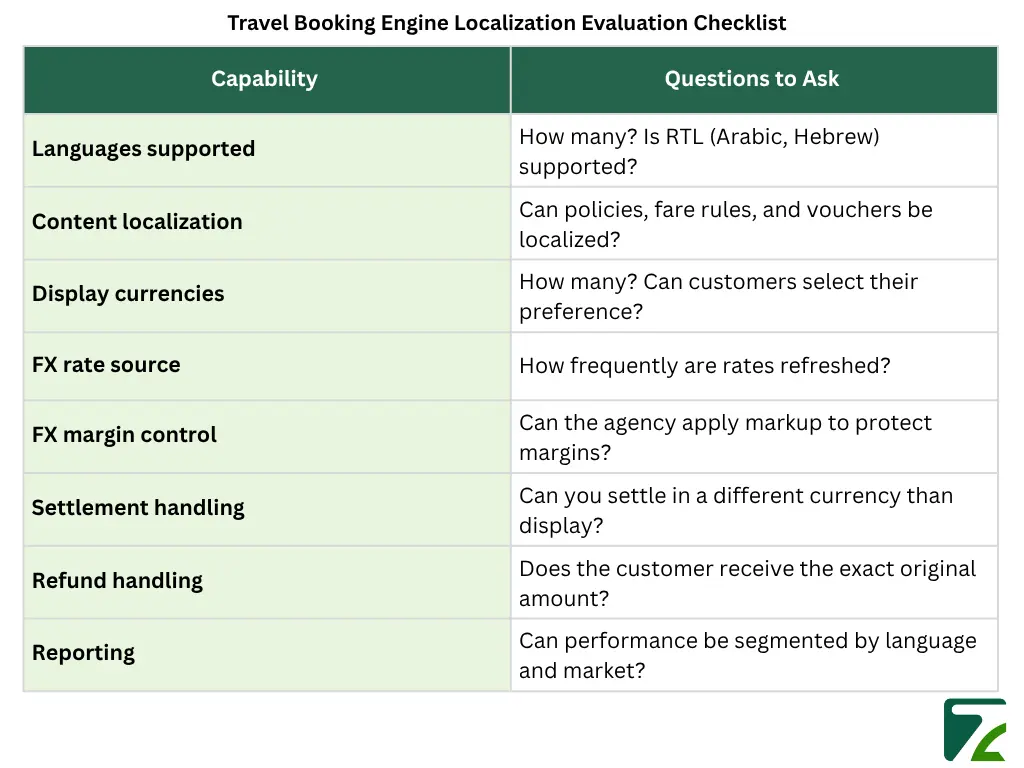
A well-designed travel booking engine should:
- Allow independent configuration of display and settlement currencies
- Convert rates from supplier feeds automatically using reliable FX sources
- Apply configurable FX margins to protect agency margins
- Settle payments in the agency’s operational currency regardless of display currency
- Handle refunds in the customer’s original currency, absorbing any FX variance
The complexity increases with refunds. If a customer books in EUR and the exchange rate shifts before a refund is processed, a good booking engine returns the exact amount in the customer’s original currency.
What Are the Risks of Ignoring Multi-Currency?
A customer in India books through a travel agency. The booking engine displays the price in INR, but the payment processes in USD. The customer’s bank applies its own exchange rate plus a cross-border fee. The final charge is 5% higher than expected. The customer disputes the transaction.
The takeaway: Multi-currency is not a checkbox item. It removes the final friction point that kills conversions at checkout and that makes it a revenue engine.
Why Must Multi-Language and Multi-Currency Work Together in a Travel Booking Engine?
A website displayed in Spanish with prices only in USD creates cognitive dissonance. The customer feels the agency is trying to serve their market, but the checkout experience tells a different story.
Conversely, a checkout page displaying Euros with English-only terms and conditions erodes trust at the final step exactly where trust matters most.
According to CSA Research, websites offering content in multiple languages see a 55% increase in conversions compared to English-only websites. But this lift diminishes if the currency experience does not match.
The takeaway: Checking one box without the other is half a solution. Multilingual without multi-currency or vice versa leaves revenue on the table. Both must work together to become a true revenue engine.
How Should Travel Agencies Configure Their Booking Engine for Different Markets?
Not every agency needs 20 languages and 50 currencies. The question is which deliver the highest return for your specific source markets.
Step 1: Analyze source markets. Use Google Analytics and booking data to identify top countries by traffic and revenue. High traffic with low conversion may indicate a language or currency mismatch.
Step 2: Rank by potential uplift. Markets with high traffic but low conversion are prime candidates for localization.
Step 3: Start with high-impact pairs. Example configurations:
- India-based OTA serving outbound travelers: English, Hindi, Arabic + INR, AED, SAR, USD
- Europe-based DMC serving inbound tourism: English, German, Spanish, French + EUR, GBP, USD
- Southeast Asia consolidator: English, Mandarin, Thai + USD, SGD, THB
Step 4: Align operations with localization. Agent training, email templates, and supplier communications should match the languages your booking engine supports.
Beyond the Checkbox: What Features Actually Matter in a Travel Booking Engine?
Conclusion
The global travel market exceeded $1.9 trillion in international tourism receipts in 2025. Travelers are booking online, on mobile devices, from diverse source markets around the world. They expect to search, book, and pay in their own language and currency.
Abandonment rates in online travel are already high 81% of bookings are abandoned before payment. Language and currency friction make this worse. According to cross-border payment research, 94% of international shoppers expect to pay in their own currency, and 17% will abandon a cart specifically because they cannot.
Here is the shift agencies need to make: Stop treating multi-language and multi-currency as a checkbox during vendor evaluation. Start treating it as a revenue engine.
Agencies that make this shift reduce abandonment at checkout, expand into new source markets without proportional increases in support costs, and convert more of the traffic they are already paying to acquire.
If your current booking engine forces customers into a single language or currency, you are leaving bookings on the table. The checkbox mindset is comfortable. The revenue engine mindset is profitable.
Frequently Asked Questions
Yes. CSA Research found 76% of consumers prefer purchasing in their native language, and OneSky reports localized websites see conversion increases of 20% or more. The impact is particularly strong in travel, where booking decisions involve understanding complex policies and terms.
Display currency is what customers see at checkout for example, a German traveler seeing prices in Euros. Settlement currency is what you receive from payment processors or pay to suppliers , often USD for international hotel inventory. A robust booking engine handles both independently, allowing you to serve customers in their currency while managing supplier payments in yours.
For travel agencies dealing with international bookings, real-time or near-real-time (every few minutes) is ideal to avoid margin erosion. Some booking engines offer daily rates with markup buffers to protect against fluctuations between booking time and settlement.
The customer should receive the exact amount in their original currency. If a customer books in EUR and requests a refund two weeks later, they should receive the same EUR amount they paid, regardless of exchange rate movements. The agency absorbs any FX difference. This is why working with booking engines that handle multi-currency refunds cleanly is important.
No. Start with your top 3-5 source markets by revenue potential. Analyze where you have high traffic but low conversion that gap often indicates a language or currency mismatch. Prioritize languages and currencies based on data, then expand systematically as your operations scale to support additional markets.