
TL;DR
This guide is for travel agencies getting traffic but not conversions. It identifies the four exact stages where travelers abandon a booking and maps the five booking engine features that eliminate each drop-off. If your travel booking platform is losing sales, you should be closing; the problem is almost certainly inside your engine, not outside it.
Your Travel Booking Platform May Be Getting Traffic While Losing Revenue
Most travel agencies lose bookings not because of pricing or competition but because of friction inside their own travel booking platform. The booking engine is where conversions die.
Most travel agency owners recognise this scenario immediately. Traffic is steady, packages are competitively priced, and the team responds to enquiries quickly. Yet conversion rates stay flat. Travelers browse, enter the booking flow, and disappear without completing.
The instinct is to blame marketing. More ads, better SEO, stronger social content. Traffic climbs. Conversions barely move. The real problem is not where travelers find you. It is where they leave you.
OTAs the most heavily optimised travel booking platforms on the internet still record abandonment rates of approximately 89% (Navan, 2025). For independent agency booking engines, the figure is typically worse. And the reason is not price. SiteMinder’s Changing Traveler Report 2025, a survey of 12,000 travelers across 14 countries, found that 52% of travelers abandon an online booking specifically because of a poor digital experience (SiteMinder, 2025) , not a better rate elsewhere, and not a change of mind. Because the platform made the process feel difficult, slow, or untrustworthy.
That is a conversion problem created entirely by the booking engine, and it has specific, diagnosable causes.
Where Are Travelers Leaving? The 4 Conversion Leak Points on Any Travel Booking Platform
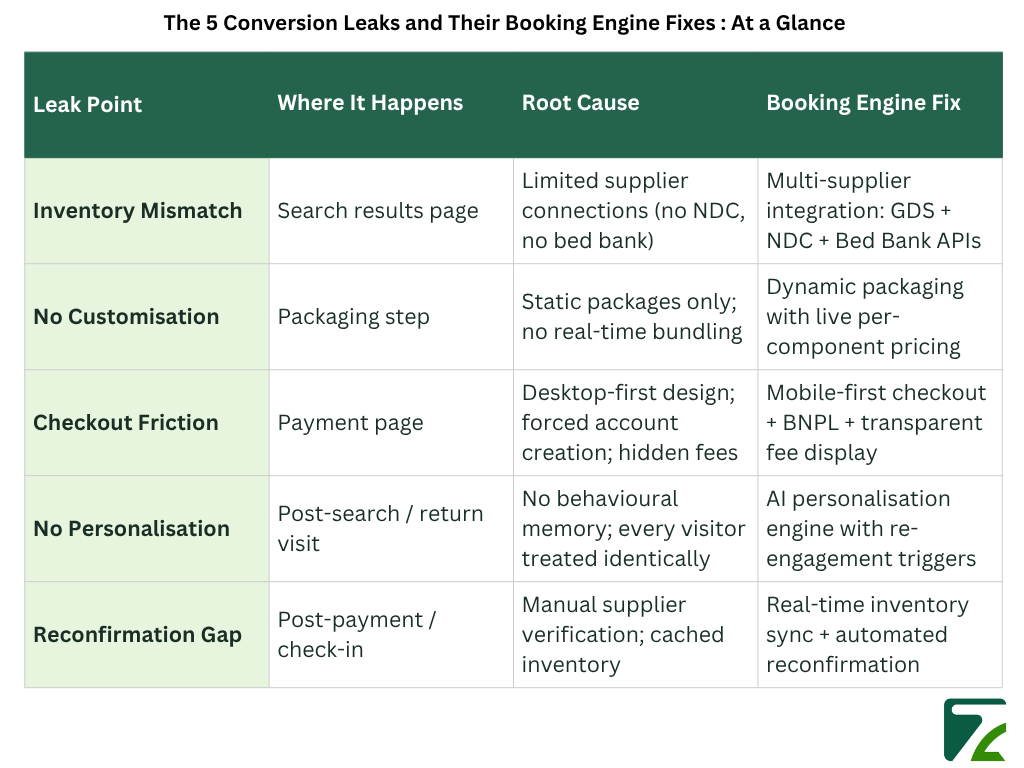
Travelers drop off at four predictable stages: the search results page, the packaging step, the checkout page, and the post-search stage. Each maps to a specific booking engine gap.
Key Terms Worth Knowing
Cart Abandonment Rate ): Cart abandonment rate in travel is the percentage of travelers who begin the booking process on a travel booking platform but leave before completing payment.
BNPL : Buy Now, Pay Later Buy now, pay later (BNPL) in travel is a payment option that allows travelers to confirm and receive a booking immediately while spreading the total cost across scheduled instalments.
Dynamic Packaging Dynamic packaging is a booking technology that allows travelers to combine multiple travel components : flights, hotels, transfers, activities into a single customised itinerary using live inventory and real-time pricing from multiple suppliers simultaneously.
Leak Point 1 — Search Results: Inventory Mismatch
The traveler searches. Results come back incomplete or missing the combination they want a specific airline paired with a boutique hotel, or a room category the booking engine cannot access because supplier connections are limited. They close the tab and open a platform that has it. There is no error message. The agency has no record of the loss.
Leak Point 2 — Packaging Step: No Customisation Means No Commitment
The traveler wants to add a hotel, airport transfer, and activity to the flight they have selected. The travel booking platform cannot do this in a single real-time transaction. As of 2024, 68% of travelers prefer customised travel packages (Market Growth Reports, 2024). A traveler who has actively built their own itinerary is far more invested in completing the purchase. Customisation builds commitment. Platforms that do not offer it lose travelers to ones that do.
Leak Point 3 — Checkout: Friction at the Final Step
The traveler has searched, selected, and arrived at payment. Baymard Institute’s 2024 research found that 22% of shoppers abandon checkout because the process is too long or complicated, and 24% leave because they are forced to create an account (Baymard Institute, 2024). Mobile compounds this further: mobile devices now account for 57% of all online travel reservations and are projected to reach 75% by 2030 (Mordor Intelligence, 2025). A checkout built for desktop performs poorly on the device most travelers are using.
Leak Point 4 — Post-Search: No Personalisation Means No Return
The traveler browses, does not book, and closes the browser. The platform has no memory of them. Skyscanner’s Traveler Insights Survey (February 2025) found that 66% of travelers expect tailored recommendations based on their habits and preferences (Skyscanner via TravelOperations, 2025). When every visitor is treated as an anonymous first-time user, travelers go to platforms that do understand them.
The 5 Booking Engine Features That Seal Each Conversion Leak
The five booking engine features that eliminate abandonment are: dynamic packaging, AI personalisation, mobile-first checkout, flexible payment options, and real-time inventory sync with automated reconfirmation.
1. Dynamic Packaging: Let Travelers Build Their Own Trip
Dynamic packaging lets travelers bundle flights, hotels, transfers, and activities in real time within a single transaction. It closes Leak Point 2 by turning customisation into commitment.
Dynamic packaging is the ability to combine multiple travel components using live inventory and real-time pricing across all suppliers simultaneously , within one transaction, on one checkout page. This is fundamentally different from pre-built static packages, which offer fixed combinations at fixed prices.
Vacation packages are the fastest-growing segment in online travel, projected to advance at 10.51% annually through 2030 (Mordor Intelligence, 2025). For travel agencies, dynamic packaging also increases average booking value: a traveler who builds a complete itinerary with hotel, transfer, and activity generates three to four times the transaction value of a flight-only booking, with no additional acquisition cost.
What to look for: Live inventory across multiple suppliers, real-time per-component pricing, single checkout for the complete bundled booking.
What to avoid: Static package templates, pre-fixed bundles, engines requiring separate transactions per travel component.
A traveler who has built their own itinerary is far less likely to abandon dynamic packaging turns browsers into committed buyers.
2 . AI Personalisation: Recover Hesitant Bookers
AI personalisation surfaces relevant options based on past behaviour and re-engages travelers who browsed without completing. It closes Leak Point 4 by making the platform feel like it understands the traveler.
For a repeat client, this means the engine remembers that they prefer business class on long-haul routes, consistently choose boutique hotels, and travel at the end of the month. The next visit surfaces those preferences automatically. For a new visitor who spent twelve minutes on Dubai packages and left, personalisation means a triggered re-engagement — a saved search notification or a relevant price alert when they return.
AI-powered booking systems can boost conversions by as much as 35% (AgentiveAIQ, 2025). AI-driven personalisation increases bookings by up to 25% (Mize, 2025). For travel agencies, where bookings involve multiple touchpoints and significant consideration time, reducing friction through relevance is among the highest-leverage improvements available on any travel booking platform.
What to look for: Behavioural recommendation engine, saved search preferences across sessions, automated re-engagement triggers for incomplete bookings.
Personalisation is not a luxury booking engine feature , it is the difference between a browser who leaves and a client who books.
3. Mobile-First Checkout: Not Just Mobile-Responsive Design
Mobile-first means the checkout was designed for touch and fast load times from the ground up. Mobile-responsive means a desktop design was adapted for smaller screens. The distinction directly determines how many mobile bookers convert versus abandon.
A mobile-responsive booking engine was originally designed for desktop and adapted to display on smaller screens. A mobile-first booking engine is designed from the ground up for touch navigation, minimal input, and fast load times. With 57% of reservations now made on mobile and 75% projected by 2030 (Mordor Intelligence, 2025), agencies operating desktop-first booking engines are building a widening structural disadvantage year on year. Multi-step forms requiring ten input fields, small tap targets, pages taking more than three seconds to load, and checkout flows without digital wallet support are direct exit triggers.
What to look for: Single or two-step checkout, auto-fill enabled, digital wallet support (Apple Pay, Google Pay), sub-three-second load time on mobile.
If your booking engine checkout was designed for a desktop, you are losing the majority of your potential bookers before they ever reach payment.
4 . Flexible Payment Options Including BNPL
Payment friction at checkout is a silent conversion killer. Flexible cancellation, multi-currency support, and BNPL options remove the final barriers that stop high-intent travelers from completing.
Amadeus’s Traveler Sentiment Survey (March 2025) found that 79% of travelers say flexible cancellation policies are very important when booking (Amadeus via TravelOperations, 2025). That flexibility must be visible throughout checkout ,not in the terms and conditions link at the page bottom. Buy now, pay later is the fastest-growing travel payment tool, expanding at an 18.25% compound annual growth rate (Mordor Intelligence, 2025). For high-value packages , honeymoon trips, group tours, long-haul itineraries spreading costs across instalments removes the single biggest hesitation at the payment stage.
What to look for: Multi-currency support, integrated BNPL, transparent fee display at every checkout step, instant booking confirmation on payment.
What to avoid: Single payment method, fees appearing only at the final step, cancellation policy hidden from the booking flow.
For high-value travel packages, payment flexibility is not a nice-to-have , it is what converts consideration into a confirmed booking.
5 . Real-Time Inventory Sync With Automated Reconfirmation
Real-time inventory sync ensures search results reflect actual availability. Automated reconfirmation verifies the booking with the supplier after payment, eliminating check-in failures that permanently destroy client relationships.
This feature addresses a conversion problem most travel agencies do not recognise as one , because the loss happens after the booking is confirmed and paid.
Here is how it unfolds. A traveler books a hotel through the travel booking platform. Payment processes. The confirmation email is sent. But the booking was never verified with the hotel’s reservation system , either because the engine uses cached inventory, or because post-booking supplier reconfirmation is a manual process. The guest arrives at check-in. The hotel has no record.
That guest does not return. They do not refer others. The marketing cost of acquiring them is permanently lost. This is the highest-cost conversion failure in travel agency operations and it happens after the booking engine has technically done its job.
What to look for: Live supplier inventory at search time (not cached), automated post-booking reconfirmation workflow, real-time booking status visible in one central dashboard.
Conversion does not end at payment a booking that is never reconfirmed with the supplier is a client relationship waiting to be permanently lost.
A 5-Question Self-Audit for Your Travel Booking Platform
Answer these five questions about your current booking engine. Every ‘no’ or ‘not sure’ is an active conversion leak with a known fix.
- Can a traveler build a custom flight, hotel, and transfer package on your platform without calling your agency?
- Does your mobile checkout complete in under three steps without requiring account creation?
- Does your booking engine surface different results for a returning visitor based on their previous searches?
- Can a traveler split or defer payment for a high-value booking?
- After a booking is confirmed and paid, does your system automatically verify it with the supplier or does someone on your team do that manually?
If the answer to any of these is no or “I am not sure” that is an active conversion leak. Each no corresponds directly to one of the five booking engine features above.
What Fixing These Booking Engine Gaps Looks Like in Numbers
The right travel booking platform integration can boost conversion rates by up to 40% and increase repeat bookings by approximately 25% from the same existing traffic.
Research compiled by AZDS Interactive Group found that booking engine integration can boost conversion rates by up to 40% (AZDS Interactive Group via Hotel Online, 2024). AI personalisation applied to returning visitor behaviour increases repeat bookings by approximately 25% (Gitnux via Mindful Ecotourism, 2025).
In agency terms: a platform processing 200 bookings per month gaining a 25% conversion improvement earns 50 additional confirmed bookings from existing traffic, with zero increase in marketing spend. The agencies growing fastest are not outspending competitors. They are converting the traffic they already have.
Conclusion:
Travel agencies rarely have a traffic problem. They have a conversion problem and most of it is embedded inside the booking engine itself.
The five features in this guide dynamic packaging, AI personalisation, mobile-first checkout, flexible payment, and real-time reconfirmation each address a specific, diagnosable point where travelers leave your travel booking platform without completing. None require a full rebuild. All are available in well-architected modern booking engines. The difference is knowing which gap is costing you the most, and fixing it first.
Frequently Asked Questions
UX friction, not price. SiteMinder’s Changing Traveler Report 2025, surveying 12,000 travelers across 14 countries, found that 52% abandon a booking due to a poor digital experience (SiteMinder, 2025). The primary causes on agency booking engines are checkout complexity, mobile performance gaps, and the absence of personalisation , none of which are visible in standard traffic analytics.
Yes. 68% of travelers prefer customised packages (Market Growth Reports, 2024). A travel booking platform that cannot bundle components in real time is directing those travelers to platforms that can. Vacation packages are the fastest-growing online travel segment at 10.51% annual growth (Mordor Intelligence, 2025). Dynamic packaging is no longer a premium addition, it is the baseline modern travelers expect.
Mobile-responsive means a desktop-designed engine scaled for smaller screens. Mobile-first means the checkout was architecturally built for touch and speed from the ground up. With 57% of reservations now on mobile and 75% projected by 2030 (Mordor Intelligence, 2025), this distinction directly determines how many travelers complete versus abandon at checkout.
For high-value packages, the total price at checkout is often the final conversion barrier. BNPL removes it by spreading cost across instalments. It is the fastest-growing travel payment tool at 18.25% CAGR (Mordor Intelligence, 2025). Agencies offering BNPL on packages above a threshold consistently report lower checkout abandonment on high-ticket bookings.
Run the five-question self-audit above. The questions you cannot answer yes to are your active leaks. Each maps directly to a specific booking engine feature in this guide: inventory depth, dynamic packaging, mobile checkout, payment flexibility, and reconfirmation automation.