
TL;DR
Payment gateway integration determines how many bookings complete, how much fraud exposure the business carries, and how quickly it recovers when payment failures occur. This guide covers what payment gateway integration means in a travel context, where the financial risks concentrate across the full booking lifecycle, how to implement correctly using the Travel Payment Readiness Framework, and how to measure whether it is working backed by verified 2025–2026 industry data.
Why Payment Gateway Integration Matters More Than Ever in 2026
Every year, travel agencies miss out on bookings not due to weak packages or lack of service but at the stage of checkout. A traveler discovers the perfect itinerary, clicks Book Now, and is met with a payment form that doesn’t support their methods of choice, rejects their card or appears too unfamiliar to trust. They leave. In many cases, they go book elsewhere and never come back.
This is not a solitary issue. According to ResearchAndMarkets, global payment gateway market size is estimated at $53 billion by 2026, and travel and hospitality have been identified as the fastest growing segment with a CAGR of 14.68% till 2031. In India, only the digital payment gateway market is expected to grow up to $30.45 billion by 2026. The opportunity is great and so is the revenue loss of public works that can’t handle it.
This guide covers the full picture: What payment gateway integration looks like in a travel setting, where any risk sits from across the booking lifecycle, how to go about correctly implementing it, and also tracking back whether or not it works.
"For travel agencies in 2026, payment infrastructure is not a backend decision it directly determines how many bookings complete, and how many walk out the door."
Key Terms Worth Knowing
Payment Gateway : The technology that encrypts and routes payment data between a customer’s browser, the booking engine, and the acquiring bank. The operational bridge between checkout and transaction authorization.
PCI DSS : Payment Card Industry Data Security Standard , the global compliance framework for any business handling card data. Agencies using hosted payment fields qualify for SAQ A, the lightest compliance tier, with no external audit required.
Tokenization : Replacing a card number with a unique, non-reversible token stored in the gateway’s vault. Enables secure repeat bookings, reduces fraud by 30%, and improves Visa approval rates by 4–4.6% (Checkout.com, 2026).
Chargeback : A forced transaction reversal initiated by a cardholder through their bank. Travel carries the highest average chargeback value across all sectors $120 per dispute with disputes rising 30% year-over-year (Mastercard, 2025).
3D Secure 2.0 (3DS2) : An authentication protocol that verifies high-risk card transactions while passing low-risk ones with minimal friction. Mandatory in the EU and UK under Strong Customer Authentication (SCA) rules.
The Hidden Payment Risks Across the Travel Booking Lifecycle
Travel payment processing also has a reality that does not apply to most e-commerce. A clothing retailer ships an item shortly after payment. A travel agency receives payment months before their client’s travel, handles multiple suppliers per itinerary and deals with cancellations based on individual airline and hotel policies. The structural gap between payment collection and service delivery is where the bulk of agency payment risk concentrates over three different problem areas.
The Chargeback Problem Hiding in Every Future-Dated Booking
A lot can change when a customer pays in February for a September departure. Airlines reschedule. Hotels overbook. When an agency’s refund process is out of sync with its gateway rules, customers are going around the agency and filing for disputes directly with their card issuer. Travel has the highest average chargeback value of all industries at $120 per dispute, and a 30% year-over-year increase in travel disputes, according to Mastercard’s 2025 chargeback analysis. The full transaction value, plus a dispute fee. A chargeback ratio above 1% risks merchant account review or termination.
Missing Payment Methods and Wrong Currency Are Silent Conversion Killers
The Payrails Hospitality Payment Report gets specific on how much that costs: If travelers can’t use their preferred payment method, they will abandon a booking 74% of the time. 91%-92% of international travelers expect to see prices charged in their home currency. Requiring a traveler to see some price in USD while paying in AED or INR creates friction that translates directly into conversion. Card declines compound this issue; 17% of travelers experience a decline at the time of booking, and nearly 20% of these customers will book again with a competitor and never come back.
Why Travel Agencies Are a High-Value Fraud Target
Travel agencies are a prime target for all kinds of fraud due to high transaction values, non-shippable products, and multiparty complexity. According to Mastercard’s 2025 fraud data, the average travel and ticketing company loses $11 million a year to fraud. The most prevalent patterns are card testing, small test charges before a high-value fraudulent booking and friendly fraud, in which a legitimate customer disputes an entirely valid charge, after completing travel.
"The gap between collecting payment and delivering the trip is precisely where most travel agency financial risk lives and where the right payment gateway integration strategy makes the clearest difference."
What to Look for When Choosing a Digital Payment Gateway
Digital payment gateway is the technology that encrypts and routes the payment data from a customer’s browser to the booking engine, then to the acquiring bank. Comparing transaction fees alone is not enough choosing the right one means evaluating security architecture, payment method coverage and booking engine compatibility.
Security Features That Every Travel Agency Needs in Place
At the very minimum, PCI DSS compliance is a given for any agency accepting card payments. For most small and mid-size agencies, the practical way forward is to minimize PCI scope as far as possible by using hosted payment fields from a certified gateway. If card data is captured within the four walls of the gateway PCI-certified environment and never touches the agency’s servers, this obligation reduces SAQ A, a simple self-assessment questionnaire with no external audit required.
There are three security features, beyond PCI scope management, that are non-negotiable:
- 3D Secure 2.0 (3DS2): Adds authentication for high-risk transactions and passes low-risk ones through without friction. Required as per Strong Customer Authentication regulations in EU and UK. Directly reduces fraud-related chargebacks.
- Network Tokenization: Increases booking approval rates by 4–4.6% for Visa and 2.1% for Mastercard, while tokenized payments experience 30% less fraud, according to Checkout. com’s 2026 analysis. Its card information is stored as secure tokens for repeat bookings making payments without having to re-input the card details.
- AVS and CVV Checks: Address Verification Service and card security code validation blocks fraud at the moment of authorization without layer of friction to checkout.
How Your Payment Gateway Should Connect to Your Booking Engine
For travel agencies, there are two integration models. Hosted integrations take the customer to the gateway payment page and bring them back when completed this is the quickest model to deploy, has a low PCI scope and is best for agencies that don’t have an in-house build resource but comes at the expense of limited checkout branding control.
With API-based integration, you will have the payment form right inside the agency’s own booking interface through the gateway’s JavaScript fields. PCI scope is minimal because card data never touches the agency’s servers, yet checkout is 100% branded. This one typically requires a developer’s involvement and can quickly be worth it as the bookings volume increases, as well as finding a consistent checkout UX becomes a measurable conversion factor.
Payment Methods and Currencies That Directly Affect Conversion
There is a noticeable difference in each market on the preferred payment method. As of late 2025, nearly 64% of the payment gateway market in India was handled via UPI, and it processes more than 14 billion transactions monthly, according to a Worldpay’s airline payments review. A UPI unsupported agency serving Indian travelers is making a structural conversion block between the customer and the payment page.
For 2026: agencies should test digital wallets for mobile checkout, BNPL for high-value packages as it’s proven to increase AOV by as much as 60% and local payment rails like Mada in Saudi Arabia, KNET in Kuwait and iDEAL in the Netherlands. These are the main payment methods in their marketplaces, not optional extras. Multi-currency presentation is distinct from multi-currency acceptance: With 91–92% of international travelers wanting to pay in their home currency, dynamic currency display is key for cross-border conversion.
"A gateway matched to your markets, booking engine, and fraud profile is a strategic infrastructure decision not a commodity purchase."
The Travel Payment Readiness Framework: A Three-Phase Integration Playbook
Most integration guides are specific to certain platforms a WordPress plugin, a proprietary travel CMS, or an individual booking system. The Travel Payment Readiness Framework below is agnostic to platform, agency technical setup, or size.
Phase 1 : Requirements and Gateway Shortlisting
Before you evaluate any gateway, write down four operating facts: The markets and currencies your customers book from and travel to; Your average transaction value. Bookings above $1K have a different fraud profile than low-value domestic transactions; your dispute, refund and cancellation patterns (partial refunds must support agency policy as well); and three to five payment methods that account for 80% or more of bookings by market.
Use these as a weighted scorecard for your shortlist. Weight fraud tooling, travel-vertical experience, uptime SLAs and support quality on top of headline transaction fees. A gateway charging a lower per-transaction fee but offering sub-optimal dispute tooling will end up costing more in chargebacks than it saves you on fees.
Phase 2 : Testing the Scenarios Most Agencies Miss
All of the gateways offer a sandbox environment. The success path is often the only one that most agencies test: card entered, payment succeeds, booking confirms. That’s not enough for travel operations. Test these five scenarios the most integration guides don’t cover before going live:
- Authorized payment, yet the supplier does not confirm: shall the system hold, void or capture the charge?
- Partial cancellation: can the gateway refund one component without voiding the full itinerary charge?
- Card decline after itinerary is held: what’s the retry logic and what occurs to supplier inventory?
- 3DS2 challenge mid-session: does the booking survive the authentication redirect without losing the itinerary?
- Currency mismatch: Is conversion clear and compliant if card currency and booking currency are different?
Phase 3 : Go-Live Hardening and Monitoring
Before activating live transactions: configure fraud rules calibrated to your average ticket value and customer geographies; set velocity limits to block card testing attacks; configure a fallback gateway for automatic rerouting during downtime; align your published refund policy with gateway processing timelines; and restrict admin access with role-based permissions and activity logging from day one. Post-launch, monitor authorization rates and decline reason codes weekly, a sudden drop is an early warning of misconfiguration, recoverable if caught quickly.
"Agencies that test travel-specific failure scenarios before go-live avoid the compounding cost of failed payments, supplier disputes, and customer escalations that follow a poorly configured launch."
Measuring Performance: The Five KPIs That Tell the Real Story
The right payment gateway creates measurable results. The five KPIs below from the measurement layer of the Travel Payment Readiness Framework. Review these monthly not quarterly , so that you can spot issues before they turn into revenue events.
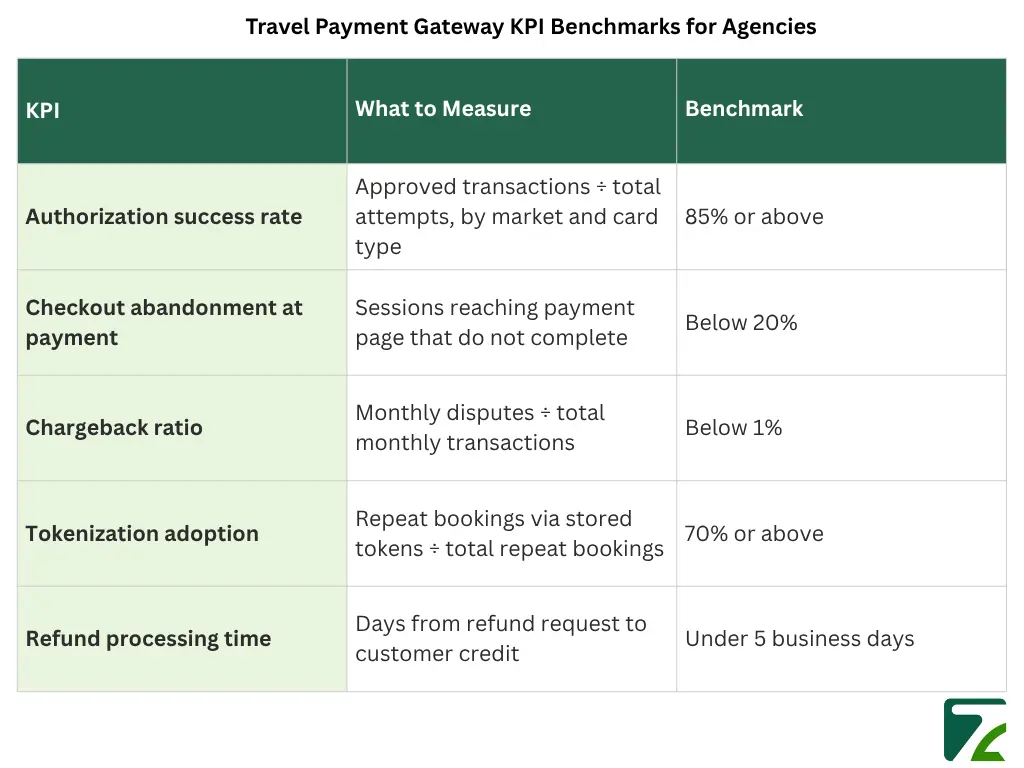
Read them together, not in isolation. High authorization rate coupled with an increasing chargeback ratio indicates overly liberal fraud rules. High drop-offs at the payment step indicate friction either missing payment methods, slow page load, or a checkout experience that fails to assure customers. Together, both signals provide a complete picture of integration that helps or hinders a business.
Secure Bookings Go-Live Checklist
- All booking pages and subdomains have active SSL
- Hosted payment fields in place, PCI scope reduced to SAQ A
- 3DS2 enabled and tested across primary card schemes
- Refund policy shown at checkout, aligned with gateway processing timelines
- Chargeback response documented, booking records, communication logs, and supplier confirmations ready
- Fallback gateway configured and sandbox-tested before go-live
- Admin access restricted with role-based permissions and activity logging
"Authorization rate and chargeback ratio together are the two most critical indicators of whether a travel agency's payment gateway integration is protecting or draining revenue."
Conclusion:
Integrating a payment gateway is not just a onetime technical job; it’s an ongoing operational job. Every week an agency operates with the wrong gateway setup, incorrect payment methods or poorly calibrated fraud rules; it’s losing bookings that it will never know were lost.
The agencies that nail this in 2026 share an identifiable trend. They choose gateways based on their real customer markets and booking engine architecture, not brand recognition. They run tests on the scenarios that truly break travel operations before they become productionized. And they monitor the five KPIs in the Travel Payment Readiness Framework frequently enough to flag issues early.
Payment infrastructure is the best place to begin if your agency now has high checkout abandonment, increase chargebacks, or legitimate card declines.
Frequently Asked Questions
A payment gateway captures, encrypts, and transmits card data at checkout for authorization. A payment processor handles the actual movement of funds between the customer's issuing bank and the agency's merchant account. In 2026, most providers bundle both under a single contract. For travel agencies, gateway performance uptime, fraud tools, and booking engine compatibility have a greater impact on conversion and chargebacks than processor selection alone.
PCI DSS applies to any business accepting card payments regardless of size. Using hosted payment fields from a certified gateway means the agency never stores raw card data, reducing compliance to SAQ A , a self-assessment questionnaire with no external audit required. The gateway assumes responsibility for securing card data within its certified environment.
Display cancellation policy explicitly at checkout before payment; send booking confirmation within minutes of payment; enable 3DS2 to filter fraud-related disputes at authorization; and maintain a documented dispute response process with booking records, communication logs, and supplier confirmations ready within the card network's 7–20 day representment window.
Yes, and for mid-size agencies, two gateways are advisable. A primary gateway handles the majority of transactions. A secondary acts as a fallback during downtime or elevated decline periods. Some agencies maintain separate gateways by market: one for domestic card processing and another for cross-border transactions and alternative methods such as UPI, wallets, or BNPL.