TLD;R
This guide is for travel agencies evaluating or upgrading their booking engine. It covers what a booking engine does, which capabilities separate competitive agencies from the rest in 2026 GDS connectivity, NDC support, B2B agent portals, real-time pricing, and API integrations and a practical checklist to use before signing with any vendor.
The Hidden Cost of the Wrong Booking Engine
Picture this: a travel agency starts every morning logging into six OTA extranets separately Booking.com, Expedia, their own website, their B2B agent portal, and two wholesale partner updating rates one by one. By the time they finish the last one, the first is already out of date. For agencies without automation, this is a daily reality.
This is not a staffing problem. It is a booking engine problem.
The booking engine is the central technology platform of any travel agency where inventory is sourced, priced, and sold. But what a booking engine needs to do in 2026 has expanded significantly. Travelers expect real-time pricing across every device. B2B agents expect their own portal with markups applied automatically. Airlines are moving their best fares to NDC, away from traditional GDS. And the global OTA market now valued at $612 billion is growing at 8.6% annually through 2030 (Grand View Research, 2025).
The agencies growing fastest are not the ones with the biggest marketing budgets. They are the ones whose booking engines can actually keep up.
What Is a Travel Booking Engine?
A travel booking engine is an online reservation system that connects a travel agency to its inventory suppliers and gives customers direct consumers or B2B agents the ability to search, compare, and book travel with real-time pricing and instant confirmation.
At the front end, it is the search-and-book interface your customers use. At the back end, it connects your platform to airlines via GDS or NDC, to hotels via bed bank APIs, and to tour operators, transfer providers, and activity suppliers through their own integrations. It handles the full transaction search, pricing, payment, and confirmation automatically, without manual intervention.
Every booking that bypasses this infrastructure and routes through a third-party OTA instead costs your agency 15–25% in commission per booking (Hotelogix, 2025). The booking engine is what allows you to sell directly and keep that margin.
Key Terms Worth Knowing
GDS (Global Distribution System): Amadeus, Sabre, Travelport the traditional infrastructure connecting agencies to airline and hotel inventory globally.
NDC (New Distribution Capability): IATA’s modern XML standard enabling airlines to distribute richer content and personalised pricing directly to agencies via API often unavailable through GDS.
API (Application Programming Interface): The live connection between your booking engine and a supplier’s system, enabling real-time pricing and booking without manual steps.
Bedbank: A wholesale accommodation supplier (e.g. Hotelbeds, WebBeds) that aggregates hotel inventory and distributes it to travel agencies at net rates.
The Six Capabilities That Define a Competitive Booking Engine in 2026
1. GDS Connectivity: The Foundation
GDS systems remain the backbone of global travel distribution, particularly for flights and corporate bookings. Amadeus, Sabre, and Travelport process hundreds of millions of transactions annually and provide standardised access to airline inventory, hotel rates, and car rental across most of the world. Any booking engine serving a full-service travel agency must have certified integrations with the GDS systems relevant to its markets.
AI integration among major GDS providers reached 65% in 2025 (Fingent, 2025), and the GDS market is growing at 11.7% annually through 2032. These platforms are not disappearing, but they have a hard ceiling on what content they can distribute, which is why NDC has become essential alongside them.
2. NDC Support: No Longer Optional
NDC is the IATA-backed standard that allows airlines to sell their full product catalogue seat selection, baggage options, meal preferences, branded fare bundles directly to travel agencies via modern API, bypassing the content limitations of traditional GDS channels.
American Airlines now routes 80% of bookings through NDC or direct channels (ASD Team, 2026). Lufthansa pioneered GDS surcharges specifically to shift agencies toward NDC. Seven major NDC versions are currently in active use across the industry. Agencies without NDC-capable booking engines are already missing fares and ancillary content that NDC-connected competitors can offer.
The cost of building NDC integration from scratch is real full GDS certification with NDC can exceed $15,000–$25,000 per integration (ASD Team, 2026). Agencies working with platforms that have pre-built NDC connectors avoid that cost entirely.
"GDS gets you access to global inventory. NDC gets you access to what the airline actually wants to sell."
3. B2C and B2B From One Platform
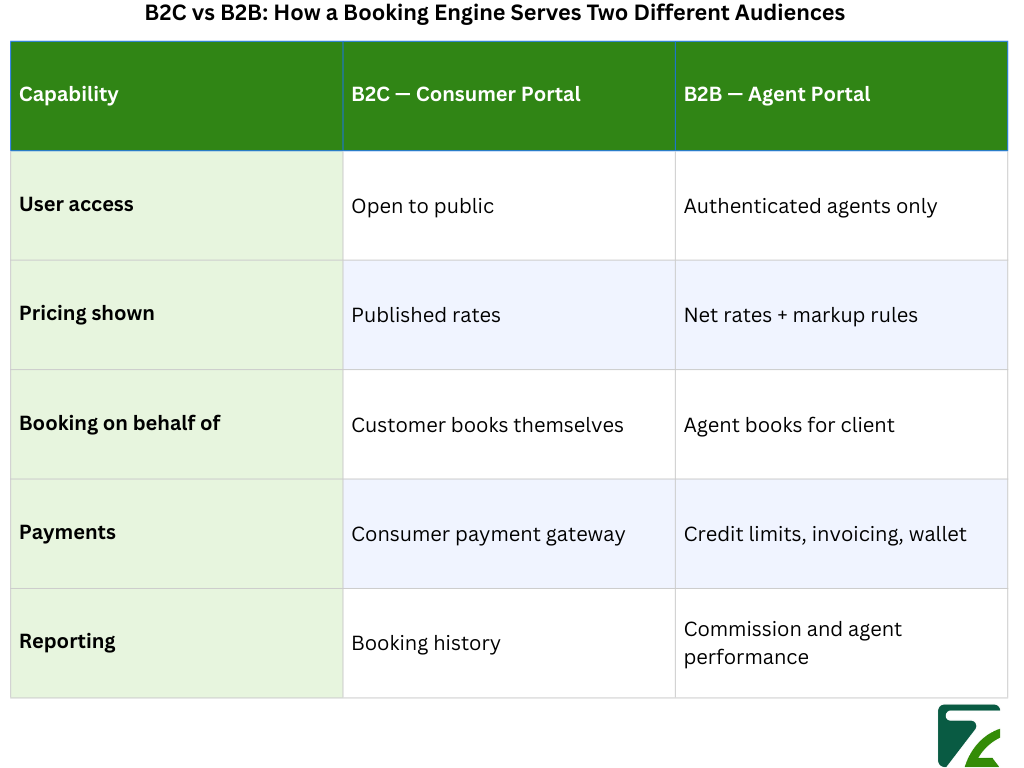
Most travel agencies serve two audiences: direct consumers through a public website (B2C), and sub-agents or corporate clients through a private portal (B2B). Running these on separate platforms doubles operational overhead and creates inventory sync errors. A capable booking engine handles both from a single back end with separate configuration layers.
B2B portals have distinct requirements that consumer sites do not: agent authentication and credit limits, configurable markup and commission rules per agent tier, group booking management, and detailed performance reporting by sub-agent. Without these capabilities built into the booking engine, agencies manage a patchwork of manual workarounds and that is where pricing errors and revenue leakage happen.
4. Real-Time Pricing Not Cached Snapshots
Some booking platforms display cached inventory rates pulled hours or days ago and stored locally. When a customer reaches a checkout and the price has changed, conversion drops. When an agent confirms a fare that is no longer available, the agency absorbs the cost difference.
A booking engine in 2026 must query supplier systems live at search, revalidate the fare at the moment of payment, and confirm availability before the booking is issued. Expedia’s Rapid API alone provides access to 700,000+ properties globally (ASD Team, 2026) with real-time rate queries as the standard. Your platform supplier connections need to operate at the same level.
5. Mobile-First Design
Mobile now accounts for over 52% of all OTA bookings (Grand View Research, 2025) and is projected to reach 75% of all travel bookings by 2030. A mobile-first booking engine is designed from the ground up for touch navigation, fast load times, and minimal-input checkout flows. This is different from a mobile-friendly engine built for desktop and adapted for smaller screens. For agencies whose customers book on the go, this distinction directly affects how many bookings complete versus how many are abandoned at checkout.
6. Broad Supplier Connectivity Via API
Beyond GDS and NDC, competitive agencies need accommodation inventory from bedbanks (Hotelbeds, WebBeds, GTA), activities from providers like Viator and GetYourGuide, transfers, cruise lines, and low-cost carriers. Each comes with its own API or XML feed.
A capable booking engine either has pre-built connectors to these suppliers making new inventory a configuration task rather than a development project or provides a clean API framework that agencies can extend without rebuilding the platform. Platforms with 100–300 pre-built supplier connections reduce the time and cost of expanding inventory from months to days.
How to Evaluate a Booking Engine: 7 Questions to Ask Any Vendor
- Which GDS systems do you connect to, and are those integrations certified? Certification affects ticketing, fare-filing, and PNR management an uncertified connection creates operational risk.
- Do you support NDC, and which airlines or NDC aggregators are connected? A platform with 10 NDC airline connections is meaningfully different from one with 40.
- Can you serve both B2C and B2B from one back end? Ask for a live demonstration of the agent markup controls and sub-agent management not a slide deck.
- Is pricing real-time or cached? Specifically ask: does fare revalidation happen at payment, or only at search?
- How many pre-built supplier connections do you have bedbanks, LCCs, and activity providers?
- How long does onboarding a new supplier take if they are not in your library? Days signals API maturity. Months signal a legacy integration model.
- What does the mobile booking experience look like? Test it on an actual phone before signing.
"A booking engine that looks impressive in a sales demo on a desktop can still fail your customers during mobile checkout."
What Does the Right Booking Engine Mean for Your Agency's Revenue?
Every booking your agency routes through a third-party OTA costs 15–25% in commission (Hotelogix, 2025). A booking engine that enables direct sales through your own website, and the B2B portal captures that margin instead of surrendering it. The booking value difference reinforces this: hotel websites averaged US$516 per booking in 2025 versus US$312 via OTA a 65% higher average transaction value on direct channels (SiteMinder, 2025).
For NDC specifically, the value is access to fare content and ancillaries that GDS-only agencies cannot offer branded fares, seat bundles, and ancillary upsells that increase average booking value and reduce the race to the bottom on base fare pricing.
For B2B, a well-configured agent portal replaces email chains and manual markup spreadsheets with automated systems that scale without adding headcount. Agencies typically report significant reductions in back-office processing time within the first quarter of deploying a proper B2B booking engine layer.
Conclusion: The Booking Engine Is the Foundation of Everything
Every customer-facing improvement a travel agency makes better pricing, faster confirmation; smoother checkout depends entirely on what the booking engine underneath can support. An agency with the right platform can offer real-time fares, serve agents and consumers from one system, access NDC content competitors cannot reach, and accept bookings from a phone as cleanly as a desktop.
An agency running on an outdated booking engine spends that same energy on manual workarounds instead.
For travel agencies at any stage of this journey, the priority is the same: audit what your current booking engine can and cannot do, identify the gaps against the capability checklist above, and evaluate new platforms on real-time pricing, NDC readiness, and B2B portal depth not just the feature list on a sales deck.
Frequently Asked Questions
A booking engine powers your own sales channels your website, B2B agent portal, and app. It is the platform your agency uses to search inventory, price it, and sell it directly. A channel manager distributes a hotel or property's rates to external OTAs like Booking.com and Expedia, and syncs reservations back. If you are a travel agency selling travel, you need a booking engine. If you are a hotel managing listings across multiple OTAs, you need a channel manager. They solve different problems, though modern booking engines often integrate with channel manager platforms.
If you sell travel under your own brand and want control over pricing, customer data, and checkout experience, yes. Directing all customers to third-party OTAs means paying commission on every booking, losing customer data to the OTA platform, and having no ability to optimise your own conversion rate. White-label booking engine solutions can be deployed in weeks, making them accessible to agencies of any size not just large OTAs.
It means access to fares and content from NDC-enabled airlines that are not available through traditional GDS including ancillary services, branded fare bundles, and in some cases more competitive pricing than GDS-mediated rates. The practical requirement: your booking engine must support NDC via a certified aggregator or direct airline connection. Without it, you are selling an incomplete version of what those airlines offer.
White-label platforms with pre-built GDS and supplier connections can go live in weeks for standard configurations. Full implementations with custom B2B portals, NDC connections, and multiple bespoke supplier integrations typically take 3–6 months. Building a major GDS or NDC integration from scratch takes 2–6 months of development time alone (ASD Team, 2026) which is why pre-built connector libraries matter when comparing platforms.
NDC connectivity, if you are selling flights and your platform does not currently support it. Airlines are actively moving their best content away from legacy GDS channels, and the gap between what NDC-connected agencies can offer versus GDS-only agencies is growing every quarter. After NDC, the next priority is real-time fare revalidation at checkout it is the single most common source of booking errors and lost customer trust.