There is no travel agency in the world that does not cringe at losing a hot lead. You get all excited when someone ask for an itinerary, you create this beautiful itinerary for them, send the quote, and… silence. Days pass. You reach out once, maybe twice, and then boom; that train has left the station. In the meantime, the competitor who replied quicker or followed up more consistently just got the booking.
This happens thousands of times every day inside travel agencies around the globe, and not because of lack of specialties or offering poor products. It’s about navigating a complex landscape of interactions that create modern travel customer journeys. That initial “I want to know more about Bali” message through to the follow up letter once they are home. Every touchpoint between you either reinforces your relationship or gives your competitors an opportunity.
Travel CRMs that are built for the travel industry change the way agencies process these important milestones. Where generic business software might address day-to-day operations, a Travel CRM gets the unique cadence of how travel sells: long consideration periods, the emotional burden of vacation planning, and the potential to turn one-off customers into repeat clients for life.
The expectations for modern travelers have completely changed. Google’s Travel Trends report shows that 57% of travelers want brands to offer them personalized recommendations based on their past interactions with the brand. Before they reach out to any agency, they will do research on Instagram, TripAdvisor and Google reviews. When they do reach out, they want to be treated in a way that matches how they say they want to be treated instantly, direct answers.
The challenge is scattered communication. At 9 AM, someone submits an inquiry through your website form. Then during lunch, the same customer sends additional questions via Instagram DMs. They’ll have emailed me by the evening asking about payment methods. But with no central hub, your team is trying to put context together from 3 different systems, and the important pieces of information are falling through.
According to research from Skift, travel agencies lose an estimated 35-40% of potential bookings due to slow response times or not following up. Out of every ten opportunities that die due to price or product issues, four die due to communication breakdowns.
Platforms like Salesforce or HubSpot are built for straightforward B2B sales cycles, but they don’t understand travel’s unique workflow. A Travel CRM knows that your “deal” isn’t closed when the booking is confirmed. The journey continues through ticketing, documentation, pre-trip preparation, on-trip support, and post-trip relationship building.
Salesforce or HubSpot are platforms created for simple B2B sales cycles, not travel workflow. A Travel CRM understands that your “deal” is not sealed when the booking is done. The journey flows through ticketing, documentation, pre-trip preparation, on-trip support, and post-trip relationship establishment.
Essentially, your Travel CRM is your agency’s single source of truth: the centralized home base for all customer information, tracking of individual interactions, management of a booking process, and the intelligent automation of your communications throughout your traveler’s journey.
Here is the practical part of it: A couple asks about a Mediterranean cruise for their 25th anniversary. Instantly, Your Travel CRM records their purchases, logs that they wrote “luxury” and “anniversary celebration,” and send the lead directly to your cruise specialist. An acknowledgment email is immediately dispatched within minutes of the actual submission, and a follow up reminder is triggered 24 hours later by the automated system.
Every quote that your agent makes gets stored in the Travel CRM with a timestamp. Their bookings are responded to with a series of pre-programmed touchpoints set off by the booking itself: reminders to pay, requests for documents, preparation emails for their trip sent on specific dates before departure and a series of touchpoints scheduled for their return home.
As reported by Zendesk’s Customer Experience Trends Report, 42% of customers expect a business to respond within one hour of contacting them. A travel agency managing multiple channels with dozens of active inquiries will find it near-impossible to meet this expectation without systematic support.
The travel customer journey flows through six distinct phases: initial inquiry, quote creation, booking confirmation, pre-trip communication, on-trip support, and post-trip follow-up. Let’s explore how Travel CRM transforms each phase.
A query is a very high-intent moment, and then the next 24 hours are crucial. This is the timeframe during which how you handle this lead creates a difference between getting a booking or losing them to a competitor.
People face issues such as queries coming from different platforms (website, WhatsApp, Instagram, email), and getting lost, no clear ownership where multiple agents can handle the request, delayed responses where messages go unnoticed in personal accounts, etc.
Inquiries from all channels are routed to one platform, which a travel CRM solves. With website forms, email parsing, and channel integrations, all contact points are recorded. The system automatically distributes inbound inquiries according to the rules you define round-robin distribution, geographic specialization, or product expertise, etc.
Response tracking becomes built-in accountability. The CRM indicates the wait times for each inquiry and flags those which are about to breach your service level. But most importantly, it tracks source attribution and allows you to finally answer: which channels get you bookings and not just questions?
Quoting is your most value-added stage with customer touchpoint. The traveler has interacted sufficiently to ask for specific details, but your proposal immediately impacts their decision making.
The reasons quotes don’t convert: 3-5 days to reply while 24-hour responses from competitors, long email threads with multiple versions sent leading to confusion, one size fits all proposals with no mention of customer context, no systematic follow-up after sending quote
According to research carried out by Phocuswright, agencies that convert over 25% of quotes into bookings always respond within 24 hours and tailor proposals to the customer preferences stated.
Follow-up sequences are automated (no more guesswork): 48 after sending is “Any questions on the Italy itinerary?”. 5 days no reply: “I thought would send you the article about favorite hidden gems in Tuscany” 10 days no reply “I have your choice dates on hold, but I will need to release them soon” Within 30-40% of quotes booked, we see agencies with structured follow-up sequences.
Booking confirmation marks a very complex operational phase extending weeks or months until departure when its customer already says yes. There are a number of stages in the booking lifecycle such as pending (awaiting deposit), confirmed (payment received), ticketed (major components locked), documents pending (waiting for passports/visas), payment pending (less than 7 days to final balance) and completed (fully paid and in the bag).
Each stage triggers specific actions. This is when a booking is confirmed, and operations get notified so that they can start coordinating with suppliers. Finance updates payment tracking when it is ticketed.
With Travel CRM, booking records are centralized, and all components (Flights, Hotels, Transfers, Activities) can be monitored and viewed at one place. With visual pipeline views, you can see where every booking is in the process. Automated payment reminders: “Only 60 days until your adventure in Italy! Final payment of $4,200 is due by March 15th.”
Travel Market Report says agencies that follow systematic booking lifecycle management see a 67% reduction in post-booking errors, while on-time payment collection improvement is at 43%.
The period between booking confirmation and actual departure is the most crucial yet widely overlooked. There is great customer excitement, but also anxiety with questions about passports, packing, vaccines, and weather.
Agencies that go radio silent after getting paid their final check are missing out on confidence-building opportunities. Travel CRM is the one with time-bound automation in the form of scheduled touchpoints.
T-15 days before you go: Passport and visa novelties, travel insurance document; packing lists based on season and plans; vaccination recommendations.
T-7 days before: finalize itinerary with all confirmation numbers, emergency contacts, hotel addresses (in both English and local languages), and recommendations for local SIM cards.
T-1 day: flight check-in steps, weather forecast, airport shuttle info with phone number for the driver, first hotel check-in info
Day of departure: best wishes for the travel, emergency support number reminder, first day meeting point details.
These automated sequences are how you always stay in touch without your staff feeling bombarded. A consistent pre-trip experience for every customer, regardless of the agent through which a booking was made.
Even well-organized holidays come across some issues of flight delays, hotels overbooking, weather events, and medical issues. It is how agencies react in these stressful times that determine whether travelers will become die-hard advocates or write scathing reviews.
Take when a traveler calls from Barcelona at 2 AM because the hotel reservation they made several hours ago cannot be found; that travel agent requires immediate access to the full reservation history, contacts for their best suppliers, special requests, customer preferences, travel insurance coverage and any pre-authorized spending limits.
That agent has to spend precious moments asking stressed travelers to repeat information and scouring emails without Travel CRM. Travel CRM gives them a complete picture instantly, and all the actions are done in seconds. Every interaction during the trip is logged on the platform, allowing for seamless handoffs if multiple team members are working on the same traveler.
Unless agencies choose to turn travel bookings into recurring relationships, most charge one-off transactions. According to Travel Weekly, it costs 5-7 times more to acquire a new customer than to retain an existing one; repeat customers spend 67% more, and referred customers have 16% higher lifetime value.
Still less than one out of three travel agencies have post-trip follow-up processes in place.
Travel CRM changes this overnight from an occasional process to an automatic one. Travelers receive an automated survey asking for feedback two to three days after they return: Was the trip satisfying, what exceeded expectations, what disappointed and how we can improve.
Implicit review requests with direct links to Google, TripAdvisor, and Facebook create a frictionless process around the reviews for satisfied customers and high ratings. Immediate alerts to management for personal follow up on low ratings by a dissatisfied customer to prevent them from becoming a public complaint.
Strategically timed reactivation campaigns based on trip type ensure that relationships stay warm: beach planned travelers are reactivated 10 months out of their trip with summer planning for the following year, adventure travelers hear from you 6 months later for their next adventure, and anniversary travelers are contacted 11 months later.
Referral requests to excited customers turn happy clients into actively selling customers “Do you know someone with an Italian excursion in the works? We would love to give them the same experience.
For measuring the performance, you will need the right KPI on board to implement Travel CRM. At the inquiry level, track average inquiry response time (goal should be <1 hour), lead source conversion rates, and inquiry-to-quote conversion. While going through quoting, you can measure quote-to-booking conversion rate (average in industry is 15-25%) & proposal turnaround time. Keep an eye on the payment collection turnaround time and the documentation completion ratio for booking management. Focus on NPS, review generation rates, and repeat booking rates after the trip is completed.
McKinsey research on customer analytics has shown that travel companies that track these metrics on a regular basis see conversion rates improve 20-30% within a year.
We cannot understand how it is possible that even today, there are companies that use CRM as a mere contact book, rendering a value to CRM that extends slightly beyond that of a freaking spreadsheet. Having no follow-up automation kind of defeats the whole point of the system. Undefined pipeline stages give teams no visibility. Without an assignment of ownership, no one is responsible. Not addressing post-trip workflows is the highest-return opportunity that is ignored. Standardize, and then enforce. Inconsistent data entry creates ineffectiveness, and with that, all the other problems.
Audit the current customer touch points across the travel customer journey: At Inquiry ensure all channels feed into CRM with under 1 hour response time, auto acknowledgment and clear ownership. Automated Reminder for 48-Hours to Track Quote Versions. Establish clear pipeline stages with payment milestone tracking, line of demarcation, and documented handoffs at the time of booking. T-15, T-7 and T-1-day communications prior to a trip.
On trip demands complete booking context accessibility and logged interactions. Post-trip needs automated feedback surveys, review requests for satisfied customers, and scheduled reactivation campaigns.
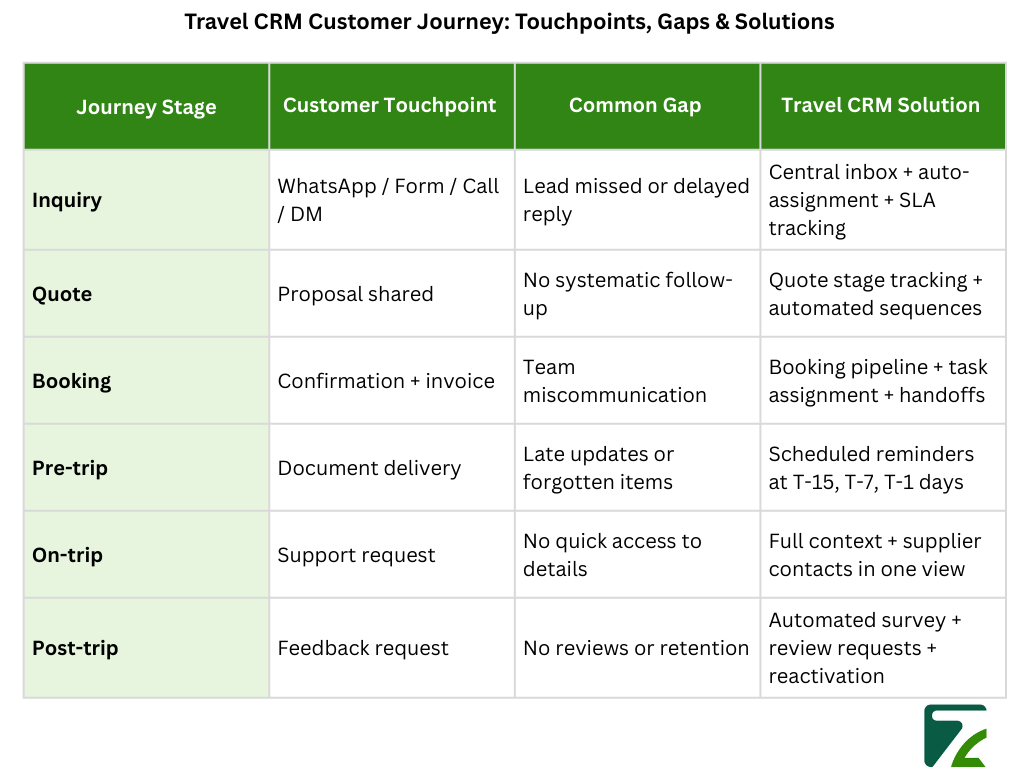
From the first inquiry all the way through post-trip follow-up, the travel customer journey is filled with dozens of customer touchpoints where agencies will either build loyalty or lose the momentum. Every touchpoint a potential customer receives whether it be a quote followup, a pre-trip reminder or a post-trip survey is a chance to show professionalism and stand apart from the competition.
A good Travel CRM, automated and repeatable, ensures that those touchpoints are not manual; they are following a process. It guarantees that no question goes unanswered, no quotation goes unpursued, there is a documented reservation on every reservation, and each traveler comes home with not less than an engagement.
In 2026 it might not be the cheapest price that wins market share for the agencies, but the most seamless and personalized experience at every single touchpoint from inquiry to engagement post-trip. Travel CRM is the infrastructure enabling that consistency, transforming disjointed processes into seamless excellence and a well-oiled machine for repeat bookings, referrals, and sustainable growth.
A Travel CRM is built for travel agencies to manage leads, itineraries, quotes, bookings, payments, and follow-ups all in one system.
It ensures faster replies, structured follow-ups, and personalized communication so leads don’t go cold or switch to competitors.
Look for multi-channel lead capture, quote tracking, booking pipeline stages, automated reminders, and customer history tracking.
Yes, it can send auto follow-ups, payment reminders, document requests, and pre-trip updates at the right time.
Higher CSAT boosts repeat bookings and client retention, leading to stronger long-term profitability.

Travel Automation Expert