Travel agents rely on the degree to which they safeguard high-revenue hotel reservations.
It’s not just the lost reconfirmation of a corporate account, or the last-minute inventory issue for a strategic partner or premium leisure client it’s also revenue, relationship with customers and renewal contracts down the road. This article describes how to enable VIP priority in your reconfirmation portal so that your bookings are managed with less manual effort and more operational control.
Hotel distribution is complicated with many suppliers, types of rates, and channels. The market size of online travel agency (OTA) is forecasted to increase to more than double between the year 2025 and the year 2034. The global travel agency services market is worth hundreds of billions of dollars and has kept expanding.
With growth comes operational pressure. Research has demonstrated that cancellation and change rates exceed 30 percent in most markets, not to mention indirect channels experience far higher rates than direct bookings. Most agencies are still using email, phone calls across time zones, and spreadsheets for confirmation management, adding 30-60 minutes of manual work to each complex trip. One failure with a key account or high-value traveler can ruin your reputation and revenue for years.
Studies on travel technologies show that efficient work processes and automation save money, limit mistakes, and deliver obvious ROI. If you build VIP priority into your reconfirmation portal, it applies to those benefits to bookings where failure is the most expensive.
The idea of VIP priority is not just a label. It is a set of rules which inform your portal which bookings are meant to be handled urgently, and how they should be treated differently.
In a reconfirmation portal, VIP priority consists of three components:
This is not the same as flagging a customer as “important” in your CRM. VIP priority is operational. It dictates which bookings are prioritized for reconfirmation first, the tighter time windows and repeat follow-ups that a booking receives. When escalations triggers or alerts are generated, how exceptions are managed once the booking is created.
The idea for travel agencies is to create a controlled fast lane on top of their standard reconfirmation logic, rather than having it run as a separate manual process independently.
Travel agencies face some operational challenges that VIP priority resolves are:
Heavy manual workload
Operations teams waste a significant portion of their days chasing confirmations and updating spreadsheets when they could be working with relationships or sales.
Booking mismatches
Research reveals significant proportions of reservations that have dates and room types wrong as well as status discrepancies between systems if they’re not checked on a routine basis. They usually occur near arrival, when there is limited time to react.
High cancellation exposure
Studies suggest cancellation rates can range around or above one-third of bookings, but that OTA channels may have higher rates than direct. VIP reservations are similarly at risk without additional focus.
Reputation damage
Research suggests that the rare bad experience can hurt many future bookings. Failure of a high-value account can undo years of relationship-building for agencies.
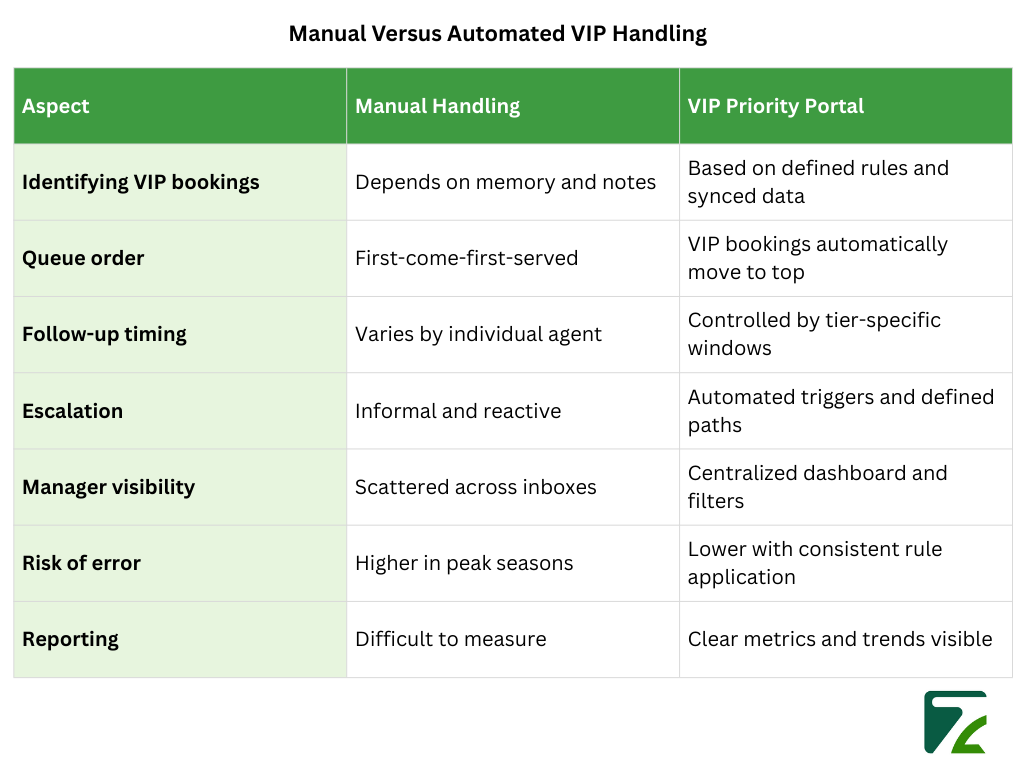
A Structured VIP priority configuration will help avoid crucial reservations are left to be managed on an ad-hoc basis. Those who do employ rule-based workflows and a central portals report experience less administrative burden, fewer errors and increased manager supervision.
Begin with a policy level discussion between sales, operations, and account management. Define who should be VIP:
Consider which booking attributes elevate a reservation:
Have two to four VIP categories. Your team slow down with too many tiers. For example:
Decide where VIP information lives and how your portal consumes it. Common approaches include:
Check in with your technology team regarding how data moves from upstream systems into your portal, as well as the frequency of updates.
Your staff is to be able to identify which ones are VIP reservations at a glance. Configure:
During busy times, an agent that logs in should be able to tell straight away which bookings are crucial without having to navigate inside each record.
Figure out where VIP data can be transformed into operational rules:
Queue ordering: VIP roles are pushed to the top of reconfirmation queues
Time Frames: VIP reservations trigger reconfirmations requests before standard bookings
Follow-up frequency: VIP bookings see more closer follow ups and alternate contact routes
Escalations: No confirmation or detected mismatch generates notifications to the senior staff members.
Additional checks: Verify room type, bedding, special requirements and package inclusions
Make a rule set for each tier. Keep it simple and scale up once your team has demonstrated consistent usage.
Set up your portal to notify when:
Send in-the-moment alerts to the agent responsible or team lead on bookings as well as daily summaries of VIP bookings both pending, having issues and those that have cleared thus far.
Choose one strong VIP group, ie one strategic corporate account and one high volume wholesale partner. Send their upcoming bookings through new VIP rules but leave your current process as a safety net. Track how many days before arrival reconfirmation triggers, how long does it take for mismatches to be revealed, and which reservations lost out on VIP flagging.
Use past instances that became sources of internal stress as test cases, like a corporate group booking with multiple conflicting dates or a wholesale partner booking where the hotel turned out overbooked at check-in.
Share with staff:
Encourage agent feedback. They will tell you which rules work, and which causes friction.
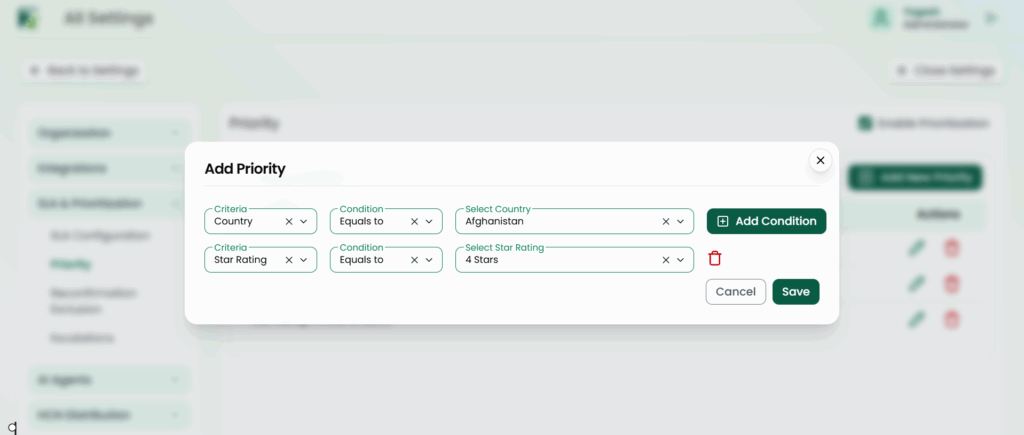
Zeal Connect’s reconfirmation platform has a VIP priority setting in their specific section. In platform settings, the SLA and prioritization section allows you to select which bookings are considered as VIP, and how they should be treated differently.
In particular, the priority setting enables rules to be specified which prioritize bookings from certain suppliers,ratings,countries or client types as VIP. The system highlights these bookings, so your staff can get to focus on them for quicker approval. Additionally, you can set up auto-escalation rule around VIP status to make certain that key reservations trigger alerts long before the check-in process if reconfirmation is not established.
Additionally, Zeal Connect’s role-based user management operators, admin, and agents are clearly able to see VIP bookings that have been assigned to them. The platform separates the duties apart, so administrators are in charge of setting up, and operations managers process the high queues
According to industry data, the indirect channels, in particular cancellation and change rates are still high so if you do not have control over key bookings, there is real financial exposure. Manual handling of booking data can take up a lot of staff time when you do tens or hundreds of thousands of bookings in a year.
Travel technology projects involving standardized workflow have a payback in months with lower labor costs and less impact on the bottom line from errors. For VIP bookings, it is often more clear. A single failed high-value trip costs more than annual savings from refining reconfirmation rules for dozens of standard bookings.
Strong VIP priority helps you:
Do not make VIP models excessively complex. If you could define too many tiers and exceptions from the day one, your team has to work hard to follow rules consistently and configuration becomes difficult to maintain. Begin on a small scale; extend as the usage proves consistent.
Ignore data quality at your peril. If client data and account types are incorrect at the upstream systems, VIP bookings will not be recognized by the portal. And it is essential that there be regular audits and clear responsibilities for ensuring classifications are up to date.
Training is easy to overlook. Fresh hires or employees switching teams may not grasp why some bookings are favored. Folding VIP handling into onboarding prevents inconsistent behavior.
Treat VIP priority as something to set once if you want limited results. Schedule periodic reviews in which you scrutinize incident data, solicit feedback from agents, and refine rules according to real-world results. The best long-term results will be produced by incremental adjustments.
Setting VIP priority in your reconfirmation portal brings operations into line with commercial reality. Not all bookings are equally risky, and systems should take note of that distinction.
By establishing clear VIP criteria, consistently mapping in data to your portal, creating visible flags, applying straightforward but effective rules, configuring alerts, testing with real-case examples and training about the feature for your team now you’re turning the informal promise of VIP handling into a dependable and measurable process.
Industry research consistently demonstrates that structured processes and automations lead to higher levels of accuracy, lower costs, and better client outcomes. Implementing those same principles on your most important bookings preserves key relationships, reduces crises, and enables future growth.
If your current VIP strategy relies largely on memory and random emails, there’s no time like the present to begin. Just by setting up a focused VIP priority inside your reconfirmation portal you’ll be arming your team with confidence, providing managers a more consistent view of what’s happening and giving the people that matter most to your business another frictionless reason to trust in using your agency.
VIP priority is a rule-based workflow that ensures high-value or high-risk bookings are handled first with tighter timelines, faster follow-ups, and additional checks to prevent last-minute issues.
Agencies use predefined criteria such as account type (corporate/TMC), booking value, group size, annual volume, itinerary complexity, and service-level agreements to determine VIP eligibility.
VIP flags are configured by mapping account data into the system, tagging important clients, and creating rules that push VIP bookings to the top of queues, trigger early reconfirmations, and escalate delays.
It reduces operational risk, detects issues earlier, protects key accounts, cuts compensation costs, and ensures smoother handling of reservations that have the highest business impact.
Automation removes manual guesswork by enforcing consistent rules, scheduling follow-ups, flagging mismatches instantly, and giving managers clear visibility into all VIP bookings.

Travel Automation Expert