Details are everything for travel agencies.
A guest can enjoy a perfectly good room, in a great hotel, for a fair price. But if they ordered a king-size bed with an ocean view, early check-in and a crib for the baby and you arrive only to find one of those things is lacking, the whole experience feels broken.
Here are where special requests in the hotel booking confirmation determine your agency’s reputation you may not even know it.
For big OTAs with hundreds of thousands of bookings across different channels, this problem is definitely a scaling one. When booking. com partner properties manage channels from Expedia, Agoda and direct bookings at the same time,” special requests become a co-ordinational nightmare. They are still resolvable by the correct process for small travel agencies.
This guide explains what special requests are, why travel agencies care so much about them and how to build a dependable, scalable process for managing them whether you’re working 50 bookings or 50,000 per week.
Special requests are individual guest’s specific preferences and needs that exceed the standard room reservation.
They’re ranging from bed type (king vs twin), floor preference (high floor, far from elevator), view preference (sea, garden, pool, city), early check-in or late checkout availability, accessibility requirements, dietary requests for meals and drinks’ preferences concerning celebrations as birthday , honeymoon …whether there are things you’d wish to add in your room like parking’s needs or transfer needs.
They are not always promised, but as soon as a guest enters a request in a form or tells it to a travel agent, the expectation is that someone will own the responsibility. For travel agencies, that someone is you.
Special requesting is itself a demonstration of commitment. Travelers who personalize their stay are more committed to the trip. Industry figures also back this up: customers who make personal requests upon arrival or during their stay accomplish a 53% lower cancellation rate than standard bookings without personalization request.
In other words: special requests are not nice to have. They are previews of booking and loyalty potential.
Imagine that: Your guest books with one king bed, high floor, early check-in at 1 PM, and a baby crib. They show up after flying for hours to find twin beds only, next to elevator rooms, 3 pm check-in at normal times, and no cribs.
The guest does not hold the hotel systems responsible for this. They blame your agency.
Studies show that about 25% of Booking. com style properties see overbooking in their 1st year due to miscommunication b/w travel agencies/OTAs & properties.
The problem is broken confirmation workflows and unchecked special requests.
Hotel reservation cancellation rates average 20% across the industry according to SiteMinder’s 2024 data (although some OTA channels have cancellation levels as high as 40%). Special requests that fail cause cessation to increase dramatically.
A guest who anticipates early check-in and then encounters a standard 3 PM check-in is less likely to cancel.
Guests who have a problem at check-in are 15.2% less likely to return, according to a hospitality study in 2010. The price per guest who endures a service failure: $51.21 in other lost lifetime value.
Early check-in creates $35 per guest in ancillary revenue. Late checkout brings in about $37 per guest. If presented and confirmed properly, these time-flexibility options will be purchased by many guests.
According to research by Salesforce, 75% of customers demand faster service and personalization upon sharing preference data. Today’s guests expect special requests to carry across mobile bookings, through confirmation emails and into hotel systems.
Requests for room preference are common: bed type (king vs queen vs twin), floor preference, view preference (ocean, pool or garden), smoking and non-smoking accommodations, quiet room location desires and adjoining rooms.
Mismatch of room types is the biggest single complaint at check in. Hotel systems might read “King Room Available,” but the guest asked for “firm mattress, king bed, high floor.” Technically the guest gets a king bed, but they feel shortchanged.
Time Based Requests are Checking-in early, late check-out and non-business-hour check-in. Statistics indicate that 68 per cent of guests ask for early arrival/late departure times. For travel agents, the danger is in guaranteeing these without checking.
Special Requests like honeymoons, birthdays or anniversary trips are high emotion, high impact. If they’re managed well, these instances become stories that guests share online. When they are badly managed, they can turn into very public failures.
Accessibility and medical needs (wheelchair-accessible rooms, ground-floor rooms, visual alarms, allergy-friendly rooms, refrigerators for medication) also come with legal considerations. Not managing these properly creates safety and legal problems for all parties.
The path from guest to hotel looks like: Guest → OTA Booking Engine → Travel Agency CRM → Email → Hotel PMS → Individual Staff Member.
Each hop would be an opportunity for loss of information. For OTAs, this problem multiplies. When Expedia sends a reservation through the Booking Notification API (blocking message, synchronous XML format using OTA 2003B schema) special requests may be present or not based on the way properties have configured their PMS fields. Not all of the PMSs have special request fields that are standardized. Opera PMS, Mews and Cloudbeds treat the special request fields differently.
Most agencies currently issue bookings by emailing hotels one at a time, manually copying details between systems, keeping spreadsheets and making the phone to confirm somebody’s seen that email. This breaks at a scale. Emails are missed; people don’t get round to replying, staff changes happen, and audit trails disappear.
A medium-sized travel agency may have up to a hundred or two bookings per day during high season. Each booking comes attached with 3-5 special requests on average. What scales at 20 bookings limits on return at 200.
For OTAs handling millions of bookings from many different channels concurrently, scale creates a compounding complexity. Booking. com being integrated with Expedia channel managers, a property would be able to get that same booking from several different channels. The structure of request fields in each channel varies. Due to the sheer existence of such a large presence, manual inspection at scale is not possible.
The agencies that consistently get this right follow a clear process structured around CHECK-IN DATE, not booking date.
Use structured fields and check boxes for standard information requests. Enqueue critical request (Accessibility, Medical) separate from optional (view preference). Demand specificity: Do not request a “nice room,” ask for one on the high floor, far from the elevator, with firm mattress. Generate unique reference numbers for tracking.
Note: You do NOT contact the hotel directly. This is captured and queued.
Be certain booking is still enabled in your CRM. Keep track of any changes or guest updates. Flag cancellations or date changes immediately. For VIP, group or corporate bookings tag for early reconfirmation.
If booking is six weeks out, nothing more happens until the 72-hour window. If a booking is made within 48 hours of check-in, reconfirmation will be upon booking.
This is the CRITICAL WINDOW. Do not call sooner.
Find all bookings checking in 48-72 hours from today. Contact or use API to confirm all special requests with a hotel staff member. Ask questions specifically: “You can confirm early check in request at 1 PM and put remarks in the reservation?” Verify that room type, number of beds, and floor preference in the hotel’s system. Record hotel confirmation with time, date and staff member.
Why 48-72 hours: Hotels update data refreshing daily; 48+ hours ensure full mapping. If there are issues, hotel has time to address them.” Travel agencies still has time to rebook or escalate for the guest. Guests have time to modify plans prior to arrival.
Send an updated confirmation email with a reconfirmation summary applied for the guest. Explicitly specify which requests are confirmed vs tried vs not available. Include the hotel’s direct phone number.
Example email:
Subject: Your Room Is Booked (Check in March 15)
Dear John,
You’re officially set for your Marriott Downtown stay:
CHECK-IN: March 15, 2025 (early check-in is confirmed)
CHECKOUT: March 17, 2025 (Late checkout Is confirmed
ROOM DETAILS: ✓ King bed confirmed ✓ 8th floor, away from elevator (confirmed) ✓ Baby crib will be in room (confirmed)
Your room is reserved and ready.
For high-priority or group bookings, or complex special requests, make one final concise call 24 hours before check-in. Check that room has been assigned. Check if the front desk team is aware of special requests.
This does NOT happen on every booking only group (10+ rooms), VIP/corporate travelers, accessibility/medical needs, high-ticket ($500+/night) bookings.
If a guest calls with a problem at check in, log immediately. Contact hotel to escalate. Arrange solutions. Follow up with guests.
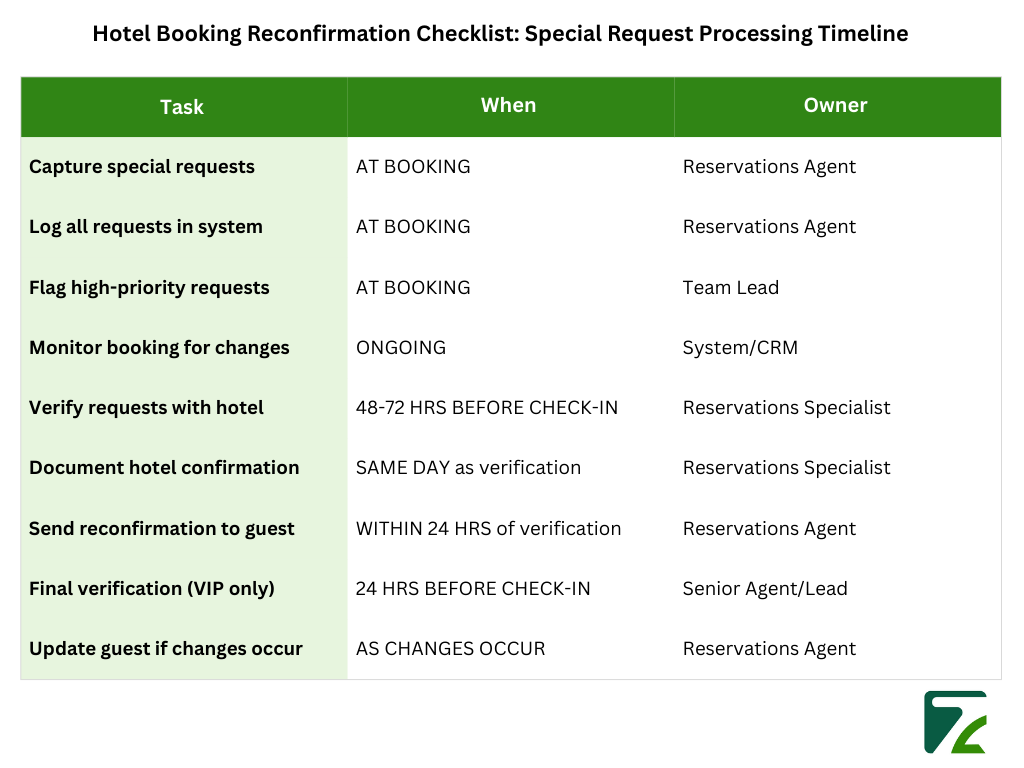
Processing time: 5-10 minutes at booking (capture only), 3-5 minutes at 48–72-hour window (verification call). Total investment per booking: 8-15 minutes.
Manual email system: 65-75% success rate, 10-15 minutes per booking. Does not scale. No audit trail.
PMS with Channel management (Opera, Mews, Cloudbeds with Booking. com or Expedia APIs): 80-85% success rate, 5-8 minutes per booking. Real-time sync, audit trails, and less manual emails.
Reconfirmation platforms (dedicated, AI powered): Success rate 95%+, time per booking 2-3 minutes (set up only). Call hotels on autopilot, with API, chat or voice. Log confirmations centrally. Notify agents when hotels cannot accommodate requests.
Travel agencies with automation: 30% lower rebooking costs, 40% lower guest complaints, 50% more revenue from special request upsells, and 60% less fannies in seats time on follow-ups.
Special requests are not minor operational details. They are commitment signals (53% lower cancellation rates), moments of truth at check-in, loyalty & referral multipliers & revenue generators ($35-$37 per guest to have time flexibility).
Agencies who perfect the practice of special request workflows will experience fewer escalations and complaint calls, lower last minute rebooking costs; get more repeat clients and referrals (due to the great service!); create room to upsell time flexibility and celebration add-ons.
If your process right now consists of some phone calls, random emails or worse, staff memory and a hope that it all comes together for arrival day…audit how you are working today: Map out current flow from booking to arrival. Introduce a clear checklist with ownership. Identify bottleneck steps. Decide which parts to automate. Include confirmation practices along with a 48–72-hour allowance.
Special requests are no longer extra for travel agencies. They are baked into the centerpiece promise. Agencies that come to the realization now will quietly shine in an environment where most travelers feel like little more than a booking ID number.
The companies that succeed at this don’t merely meet guest expectations , they surpass them. And guests notice.
Special requests is not just about additional details in hotel booking confirmations anymore, it’s a fundamental aspect of your promise to service guests. The data is clear: Special requests guests cancel 53% less, make $35-$37 more per booking on site and show a 50% higher loyalty intention.
But the majority of travel agents don’t have a successful model for managing special requests because the process is broken. Communication lags between OTAs, agents and properties result in 25% overbookings and disappointed guests at check-in. The answer is a disciplined 6-step system: Capture requests when booking, track the booking until 48-72 hours before arrival, check with the hotel for last minute reconfirmation of request, confirm back to guest clients details, make final checks on high priority bookings and address any post check in issues.
The 48–72-hour reconfirmation is important. That gives hotels time to accept changes, travel agents time to escalate if necessary and guests time to adjust plans. Manual email-based approaches can reach only 65-75% precision. Current channel merging confirming systems achieve 80-85% confidence. Specialist reconfirmation services already have greater than 95% success as well as staff time down by over >60%.
Those travel agencies that become good at this process will experience less complaints, reduced rebooking costs, an increase of repeat customers and more upsell options. Those who continue to rely on ad hoc email threads and staff recollection will see increased grumblings and lose clients to competitors. The difference between success and failure is based on one thing: Whether you check for special requests 48-72 hours before check-in or at arrival.
Hotel booking reconfirmation verifies reservation details and special requests with the property 48-72 hours before guest arrival. It prevents 80% of check-in failures by catching issues early when they can still be fixed, not at arrival when it's too late.
Reconfirm 48-72 hours before check-in, not at booking. This gives hotels time to fix problems and your agency time to rebook if needed.
Bed type (king vs twin), floor/location preferences, early check-in/late checkout, accessibility needs, and celebration occasions. Room type mismatches cause most check-in complaints.
Yes. Automated reconfirmation platforms use APIs to verify bookings, achieving 95%+ success rates vs 65-75% manual. Essential for OTAs managing 10,000+ weekly bookings.
During the 48–72-hour window: contact hotel for alternatives, notify guests with options (alternative/rebook/switch property), and document everything. Never wait until check-in.

Travel Automation Expert