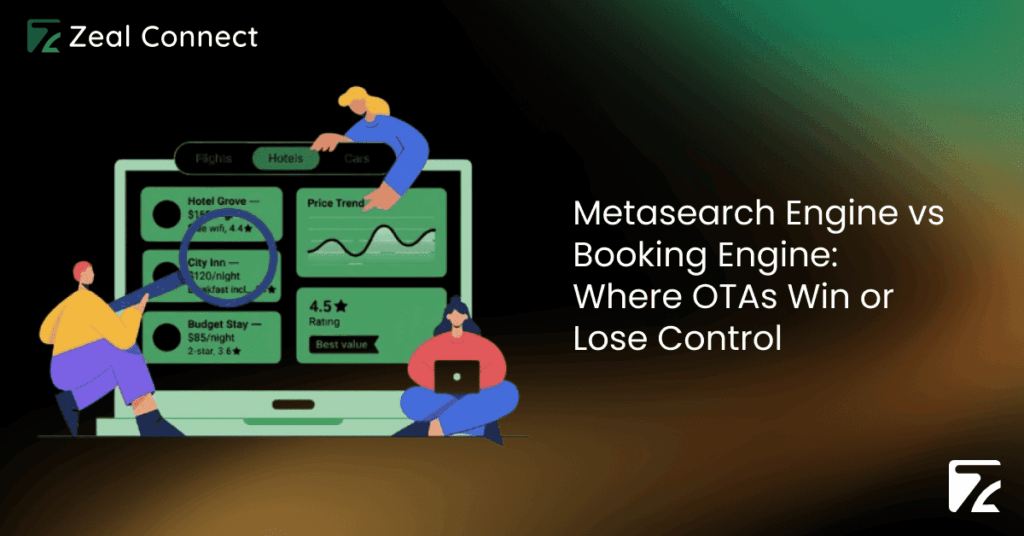
Metasearch Engine vs Booking Engine: Where OTAs Win or Lose Control
Quick Summary A metasearch engine (Google Hotels, Kayak, Trivago) is a price comparison tool it does not take the booking. A booking engine is the system that actually confirms and processes the reservation. OTAs dominate both, and travel agencies lose margin and guest data every time a booking goes through an OTA. This guide explains both tools simply, shows where OTAs win and lose, and tells you what to do about it. Why Every Travel Agency Needs to Understand Metasearch Engine and Booking Engine Right Now Travel agencies that do not appear on metasearch engines lose bookings before the traveler ever reaches a booking engine. Understanding both systems is the first step to recovering that revenue. A traveler searches for a hotel in Dubai. In under three seconds, Google shows prices from Booking.com, Expedia, and Agoda all side by side. They click the best rate and book. Your travel agency never appeared. This happens millions of times every day. Two systems are working together, and most agencies do not fully understand either of them. The first is the metasearch engine. The second is the booking engine. They are not the same thing. They do completely different jobs. And OTAs have mastered both. In 2025, the four largest OTAs: Booking Holdings, Expedia, Airbnb, and Trip.com, spent a combined $20 billion on marketing. Booking Holdings alone spent $8.2 billion up from $7.3 billion in 2024. A large portion of that spend flows directly into metasearch platforms like Google Hotel Ads, locking your agency out of the traveler’s decision moment. By 2026, 65% of all travel bookings will happen online, up from 61% in 2023. Agencies that are not present on both metasearch and direct booking channels are competing with one hand tied behind their back. The agencies that grow in 2026 are not the ones with the biggest budgets. They are the ones that understand the system well enough to compete inside it. What Is a Metasearch Engine? How This Search Aggregator Controls the First Click A metasearch engine is a search aggregator that pulls prices and availability from multiple travel websites and shows them together on one page, allowing travelers to compare options without visiting each site individually. The critical point: a metasearch engine does not complete the booking. It is purely the comparison layer. When a traveler clicks a rate, they are taken to the site that offered it. That could be an OTA, a hotel website, or your agency page. The metasearch platform then earns revenue on a cost-per-click (CPC) or cost-per-acquisition (CPA) model. Which Metasearch Engine Platforms Matter Most for Travel Agencies? Google Hotel Ads and Google Flights the dominant metasearch engine globally, driving 65–85% of all hotel metasearch traffic Kayak owned by Booking Holdings, strong in North America; also functions as a search aggregator for flights and hotels Trivago majority-owned by Expedia, hotel-focused price comparison Skyscanner strong in Europe and Asia-Pacific, especially as a flight search aggregator TripAdvisor combines reviews with metasearch, high trust factor among leisure travelers Wego leading metasearch engine across South Asia, Southeast Asia, and the Middle East The global metasearch engine market was valued at $8.33 billion in 2024 and is projected to grow at a CAGR of 30.2% through 2033. Why Is the Metasearch Engine the Most Important Battleground for Travel Agencies Today? Because it is where the traveler’s booking decision is made. A traveler who never sees your rates here will never visit your booking page. In other words, the metasearch engine is the gatekeeper to all downstream revenue. OTAs understand this, which is why they invest billions to dominate it. If your agency’s rates are not on Google Hotel Ads, Trivago, or Skyscanner, you are invisible at the exact moment a traveler decides where to book. What Is a Booking Engine? The Transaction System That Decides Who Gets Paid A booking engine is the software system that processes, confirms, and records a travel reservation including checking availability, applying pricing, and handling payment. It is the system where money actually changes hands. If the metasearch engine brings a traveler to a door, the booking engine is the door itself. For your agency, this might be an in-house reservation system, a white-label platform, or a GDS-connected interface. For Booking.com or Expedia, however, the booking engine is their core product. It is the transaction layer that processes millions of reservations daily. The reason this distinction matters: whoever operates the booking engine controls the guest data and the relationship. As a result, when a traveler books through an OTA’s booking engine instead of yours, the OTA gains all of that not your agency. Metasearch Engine vs Booking Engine: What Is the Real Difference? One system gets you found. The other gets you paid. OTAs have invested $20 billion per year to dominate both. Your agency can compete but only once you understand the difference. OTAs and the Booking Engine: Win, Lose, and What It Means for Travel Agencies The booking engine is where money changes hands. OTAs have built powerful, trusted booking engines, but that same system creates measurable weaknesses that cost travel agencies revenue, data, and long-term customer relationships. Where OTAs Win on the Booking Engine The OTA booking engine wins on traveler trust at the moment of payment. A traveler who has used Booking.com before knows the checkout process, trusts the payment of security, and knows how cancellations work. When they reach the payment page, there is no hesitation and no reason to look elsewhere. This is a process familiarity advantage, not a price advantage. OTAs have spent two decades making their booking engines feel safe and predictable. As a result, their booking engine converts at a higher rate than most alternatives even when a competing price is lower. For travel agencies appearing on a metasearch engine alongside an OTA, this is often where the booking is lost. Not on price, but on the traveler’s comfort with the transaction platform. The second win is commission lock-in. Because the OTA booking engine is where travelers prefer to transact, agencies must operate inside it to reach them paying 15–30% commission per booking to do so. Therefore, the booking engine is not just a checkout tool. It is the mechanism through which OTAs extract commercial value from every booking in their system.